
Assessment and measurement
Computerised balance and posture analysis
A force platform that quantifies sway and weight distribution, used to document fall risk at admission and again at discharge. Sway that worsens sharply with the eyes closed points to a sensory or vestibular problem rather than weakness, and that changes the programme.
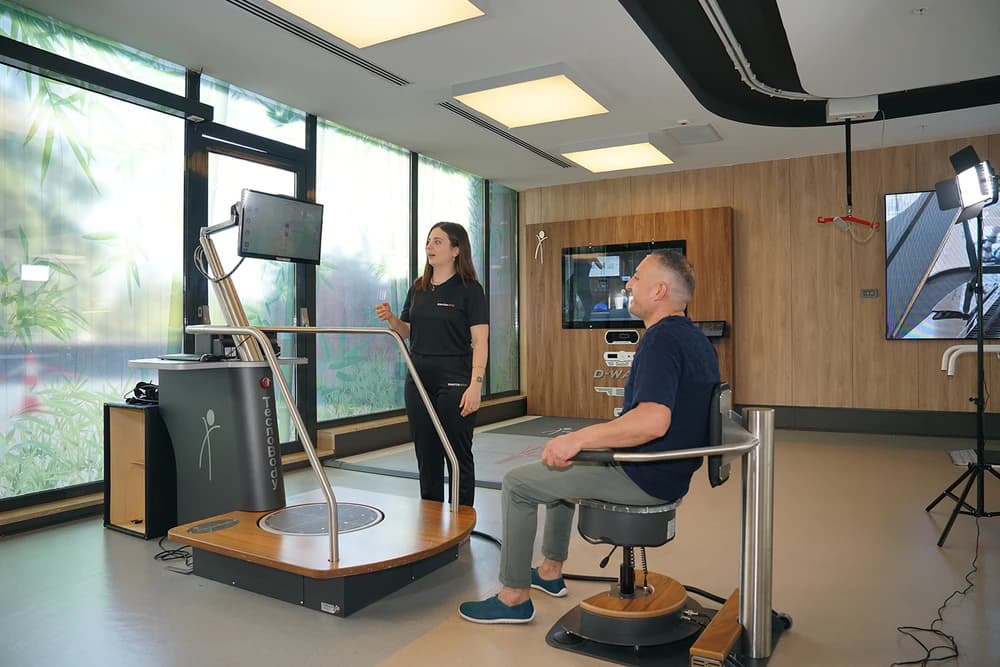
Standing measured objectively
A force platform records the centre of pressure while standing, quantifying sway area, sway velocity and weight distribution between the legs, under systematically varied conditions — eyes open and closed, firm and compliant surfaces.
Varying the conditions is what makes it diagnostic. Sway that worsens sharply with eyes closed points to a sensory or vestibular problem rather than a strength one, and that finding changes the programme.
Who it is used for
Falls assessment in older adults, balance disorder after stroke and brain injury, Parkinson's disease, multiple sclerosis, peripheral neuropathy, vestibular disorders, and postural assessment in scoliosis and chronic back pain.
It is also used as the outcome measure for balance programmes, since it repeats identically and is not subject to observer optimism.
A measurement, not a treatment
This system tells you what is wrong and how much. It does not fix anything, and a balance assessment that is not followed by a properly dosed balance programme has helped no one.
We report the numbers before and after. If they did not move, that is what we report.
Measuring what a balance test estimates
Force plate measurement quantifies sway, weight distribution and the limits of stability — the things a clinical balance score approximates. It shows whether a person relies on vision, on the inner ear or on position sense.
That distinction changes the treatment: someone dependent on vision needs different training from someone with a vestibular deficit, and clinical tests alone often cannot separate them.
Reading the strategy behind the score
People can achieve the same balance score by entirely different means: one using ankle movement, another using hip movement, a third relying almost wholly on vision. The platform shows which.
That distinction is what makes the training specific. Someone compensating with vision needs eyes-closed and unstable-surface work; someone with an ankle strategy deficit needs something else entirely.
How reliable are the measurements, and what do they say about falls?
Sway measurements repeat well only when the test is done carefully. A systematic review of repeat-testing studies found acceptable reliability in most of them, but concluded that most sway measures need recordings of at least 90 seconds, averaged over three to five repetitions 1. A single short trial varies too much from one attempt to the next to compare admission with discharge 1.
On falls, a meta-analysis of 44 studies involving 7,176 older adults found that several sway measures, including sway area per unit of time and the speed of sway, distinguish people who fall from those who do not 2. That helps to identify who is at higher risk; it cannot say whether or when a particular person will fall, because falls also depend on medicines, vision, strength and the home.
Sources
- Ruhe A, Fejer R, Walker B. The test-retest reliability of centre of pressure measures in bipedal static task conditions: a systematic review of the literature — Gait and Posture (2010)
- Quijoux F, Vienne-Jumeau A, Bertin-Hugault F, Zawieja P, et al. Center of pressure displacement characteristics differentiate fall risk in older people: a systematic review with meta-analysis — Ageing Research Reviews (2020)
- Barclay-Goddard R, Stevenson T, Poluha W, Moffatt MEK, et al. Force platform feedback for standing balance training after stroke — Cochrane Database of Systematic Reviews (2004)
Conditions this device is used for
The 18 conditions where this device is part of a routine programme, grouped by area. It is one tool inside the plan, never the plan itself.
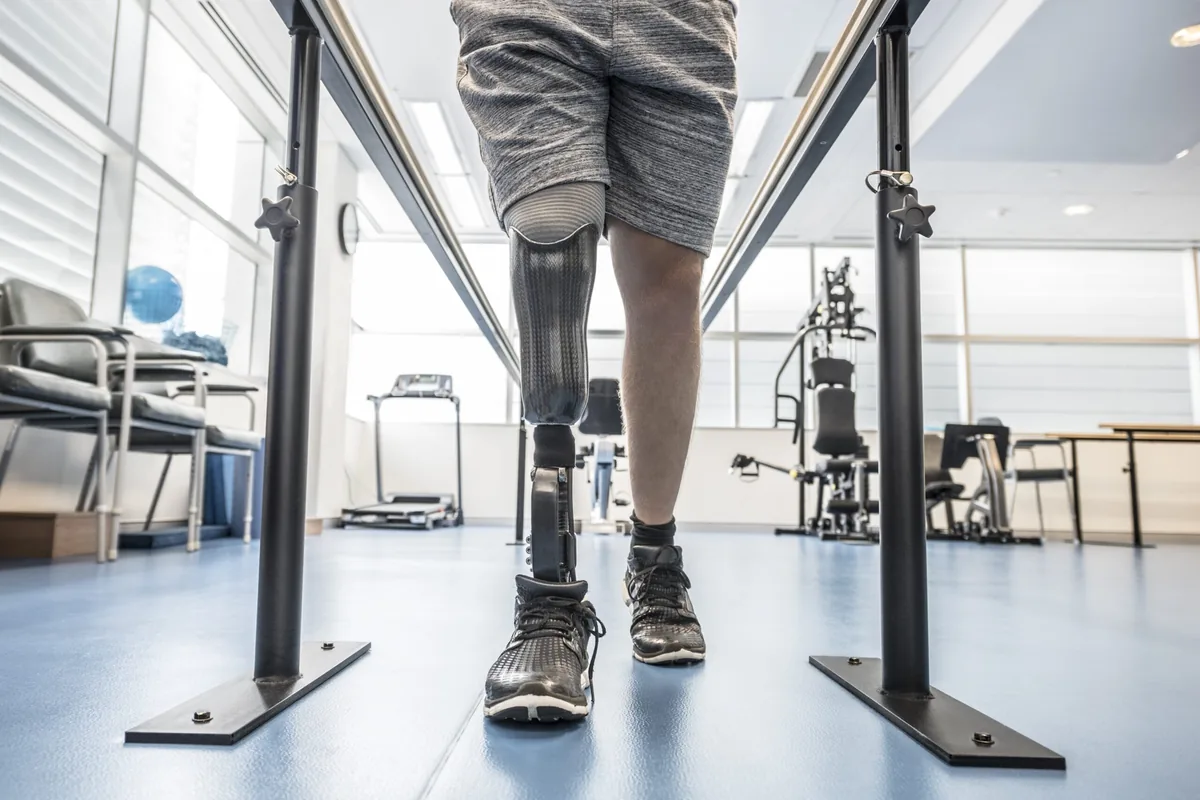 Amputation
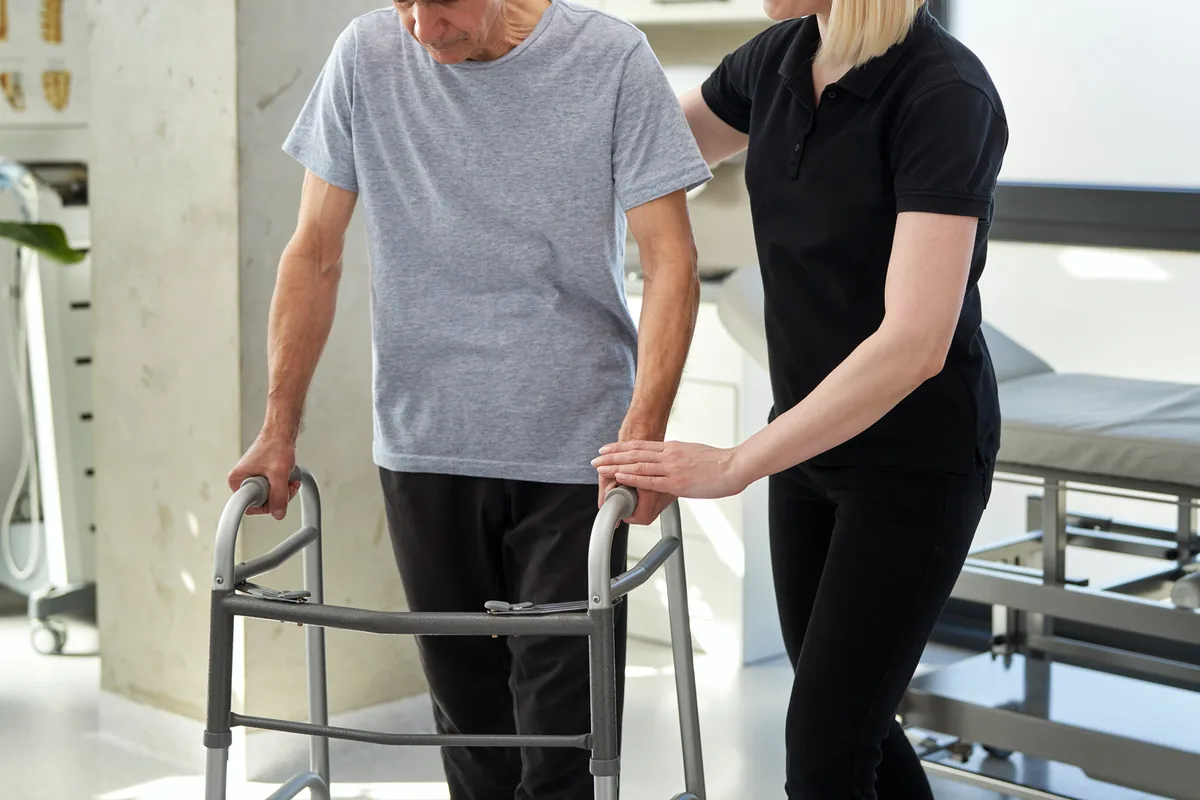 Parkinson's Disease
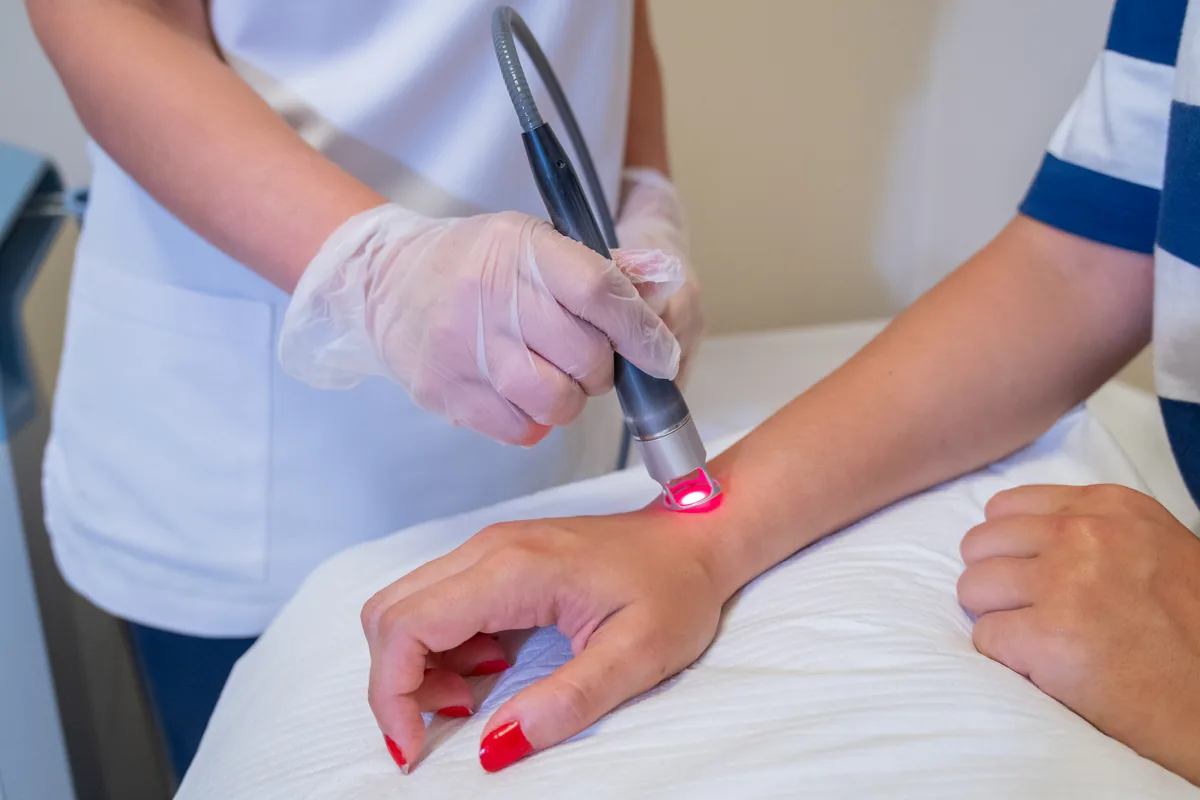 Peripheral Neuropathy
 Ankylosing Spondylitis
 Osteoporosis
 Falls and Frailty
 Balance and Vestibular Disorders
 Dementia
 Sarcopenia and Muscle Loss
 Familial Mediterranean Fever (FMF)
 Ankle Sprain and Chronic Ankle Instability
 Flat Foot (Pes Planus)
 Hallux Valgus (Bunion)
 Kyphosis and Flat Back
 Bow Legs and Knock Knees
 Intoeing (In-Toed Walking)
 Toe Walking in Children
 Clubfoot (Talipes Equinovarus)
Devices are used inside a programme and chosen after examination — they are not booked separately.
Your path to this treatment
Nothing here is booked from a page. You send the records you have, a rehabilitation physician reads them, and you get a written answer — including when the answer is that an intensive programme will not help.
4 steps, start to finish
1.Send your records
A discharge summary from the hospital that treated the original event, and any imaging of the affected area — CT, MRI or X-ray.2.A written plan in 48 hours
A rehabilitation physician reviews the case and returns the expected duration, the recommended programme and the centre. Free, no obligation.3.Travel and admission
Where a visa is needed we issue an invitation letter and treatment confirmation naming the dates and the facility. You are met at the airport and driven to the centre by private vehicle or ambulance; a bed for one companion and interpreting during therapy are arranged.4.Treatment, then home
The programme runs, then you leave with a discharge report and a written home exercise plan. Your return journey is organised before you go, with scheduled video reviews so progress does not stop.
In their words
What patients say after a programme
Short videos filmed during therapy: a child’s rehabilitation after a brain tumour, suspended gait training after spinal cord injury, and learning to walk again after a fall. Individual results vary.
Dave Evans on his physical therapy here
Musculoskeletal physiotherapy
Paediatric rehabilitation after a brain tumour
Inside a physiotherapy session
Spinal cord injury — the rehabilitation process
Suspension-assisted gait training
Walking difficulty and restricted movement after a fall
Regaining gait and range of motion
Locations
Centres that have this device — pick one.




Questions people actually ask
About this device
Is this the same as a balance test?
It is more precise. Clinical scales rate performance; this measures the strategy being used to achieve it.
Does it show why I fall?
It contributes. Falls have multiple causes, and this addresses the balance component alongside medication review, vision and strength.
Is it used for training too?
Yes — the same platform provides visual feedback for balance training. After stroke, a Cochrane review found that such feedback made standing weight more even between the legs but did not improve clinical balance scores or independence, so it is combined with balance exercise rather than used on its own 3.
How often is it repeated?
At the start and end of a programme, and at intervals where balance is the primary goal.
Why is part of the test done with my eyes closed?
Because comparing eyes open with eyes closed shows how much your balance depends on vision. Sway that increases sharply without vision points towards a problem with sensation from the feet or with the inner ear rather than with strength. Both conditions give acceptable, repeatable readings when the recording is long enough 1.



