
Gait and lower limb
Paediatric robotic gait training
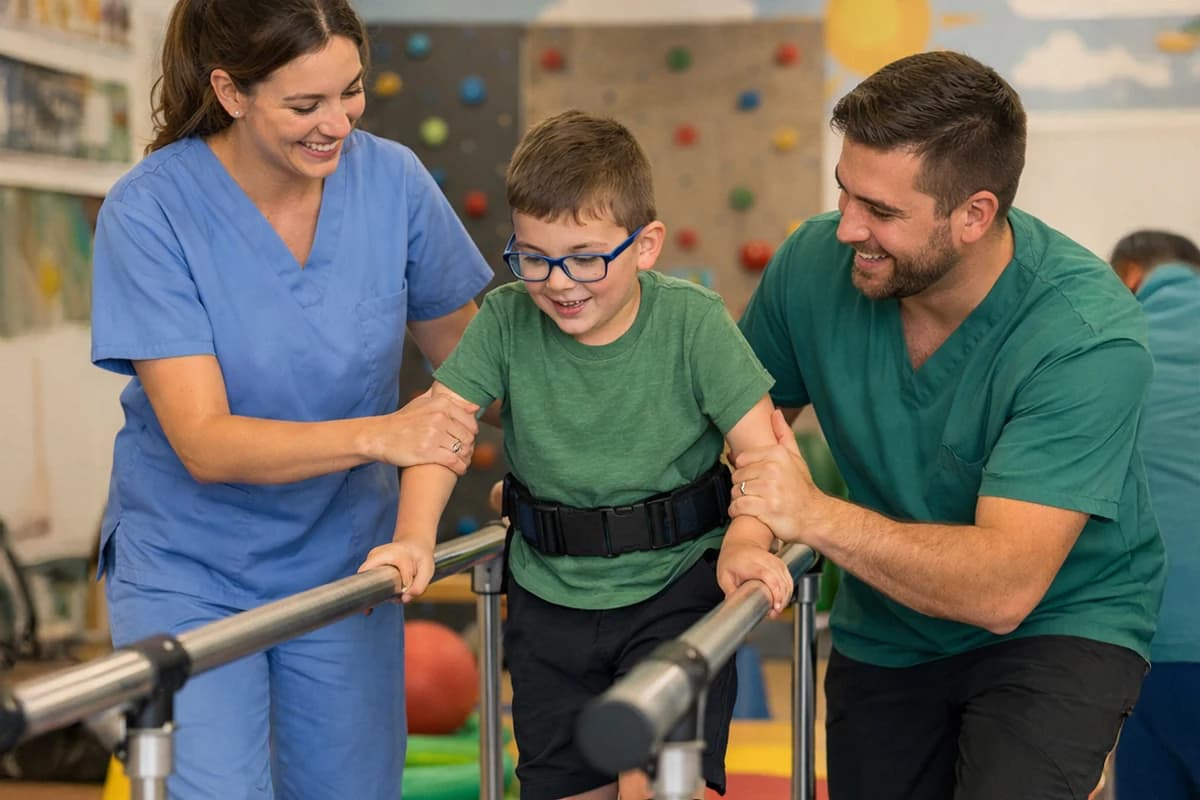
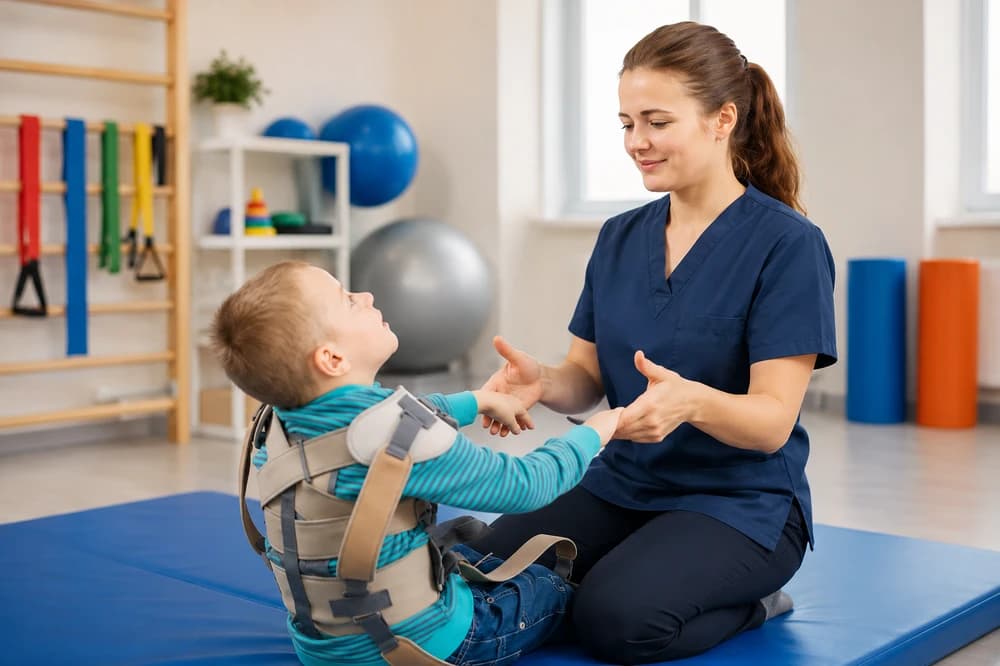
The same guided gait training scaled to a child's body, with game-based screens that keep a child engaged through the long repetition that motor learning needs. Shorter leg segments and a child-sized harness allow training from around four years old, depending on leg length rather than age.
Built for a child's body, not scaled down from an adult's
The paediatric configuration uses shorter leg segments, lighter forces and a harness sized for a child, so that gait training can start from around four years old depending on leg length rather than age alone. Body-weight support, speed and robot assistance are set the same way as in adults but within ranges appropriate to a growing skeleton.
Screen-based games are driven by the child's own stepping, which is what makes the repetition possible. A child will not keep practising walking simply because they were asked to; they will complete the practice while playing a game that happens to require correct steps.
Who it is used for
Most often cerebral palsy, where the goal is improving gait quality and endurance rather than producing walking that was never going to develop. Also spinal cord injury, acquired brain injury, spina bifida, and neuromuscular conditions where walking is deteriorating.
Suitability depends on leg length, joint range, cooperation and the absence of severe contracture or hip instability. Children with significant hip subluxation are assessed by an orthopaedic surgeon first, because loading an unstable hip is not neutral.
Honest expectations for parents
Robotic gait training in cerebral palsy can improve walking speed and endurance, but in trials the extra gain over conventional physiotherapy has been modest or absent 12. It does not change the underlying condition and it will not make a child who is at GMFCS level IV walk independently.
We will tell you what we think is achievable before you travel, based on the assessment, and we will say when we think a block will not add enough to justify it.
Working with a child rather than on one
Sessions are shorter, the harness and leg cuffs are sized for the child, and the screen games are what hold attention long enough for the repetitions to accumulate. A bored child produces poor-quality steps.
A parent is present and is shown what is being trained, because the walking practice that continues at home between blocks is what carries the gain forward.
What does the research show in cerebral palsy?
The main evidence comes from trials comparing robotic gait training with conventional physiotherapy in children with cerebral palsy. A 2026 systematic review of 15 randomised trials with 542 children found that the two produced similar improvements in most movement, walking and balance measures, with a modest extra gain for the robot in walking endurance and speed 1. An earlier meta-analysis of 8 trials with 188 participants found no greater benefit than standard care for walking distance, walking speed, or standing and walking skills 2.
The trials are small and use very different schedules, and reviewers describe the evidence as weak and inconsistent 3. In practice, the robot is one way of delivering a large amount of walking practice rather than a better kind of practice.
Sources
- Al Matairi A, Abuhashem O, Hammadeh BM, Al Najjar B, et al. Robot-assisted gait training in cerebral palsy: a GRADE-assessed systematic review and meta-analysis with trial sequential analysis — Neurological Research (2026)
- Conner BC, Remec NM, Lerner ZF. Is robotic gait training effective for individuals with cerebral palsy? A systematic review and meta-analysis of randomized controlled trials — Clinical Rehabilitation (2022)
- Lefmann S, Russo R, Hillier S. The effectiveness of robotic-assisted gait training for paediatric gait disorders: systematic review — Journal of NeuroEngineering and Rehabilitation (2017)
Conditions this device is used for
The 6 conditions where this device is part of a routine programme, grouped by area. It is one tool inside the plan, never the plan itself.
Devices are used inside a programme and chosen after examination — they are not booked separately.
Your path to this treatment
Nothing here is booked from a page. You send the records you have, a rehabilitation physician reads them, and you get a written answer — including when the answer is that an intensive programme will not help.
4 steps, start to finish
1.Send your records
A discharge summary from the hospital that treated the original event, and any imaging of the affected area — CT, MRI or X-ray.2.A written plan in 48 hours
A rehabilitation physician reviews the case and returns the expected duration, the recommended programme and the centre. Free, no obligation.3.Travel and admission
Where a visa is needed we issue an invitation letter and treatment confirmation naming the dates and the facility. You are met at the airport and driven to the centre by private vehicle or ambulance; a bed for one companion and interpreting during therapy are arranged.4.Treatment, then home
The programme runs, then you leave with a discharge report and a written home exercise plan. Your return journey is organised before you go, with scheduled video reviews so progress does not stop.
In their words
What patients say after a programme
Short videos filmed during therapy: a child’s rehabilitation after a brain tumour, suspended gait training after spinal cord injury, and learning to walk again after a fall. Individual results vary.
Dave Evans on his physical therapy here
Musculoskeletal physiotherapy
Paediatric rehabilitation after a brain tumour
Inside a physiotherapy session
Spinal cord injury — the rehabilitation process
Suspension-assisted gait training
Walking difficulty and restricted movement after a fall
Regaining gait and range of motion
Locations
Centres that have this device — pick one.






Questions people actually ask
About this device
What age can a child start?
From around four years in most systems, depending on leg length and the ability to follow simple instruction. Size rather than age is usually the limiting factor.
Is it safe for a child with cerebral palsy?
Yes, with screening for hip status, bone density and contracture. Hip displacement in particular is checked before starting.
How long does a block last?
Two to four weeks of daily sessions, repeated two or three times a year in most treatment plans.
Will my child walk independently afterwards?
That depends on the underlying condition and the level of motor function, not on the device. We give a realistic answer after assessment rather than an encouraging one before it.
Does it help children with conditions other than cerebral palsy?
There is little research to go on. A systematic review of robotic gait training in children found a lack of evidence for any diagnosis other than cerebral palsy 3. For a child with spinal cord injury, acquired brain injury or spina bifida, the decision rests on the assessment, and the reviewers advise close monitoring of each child's progress with suitable measures 3.



