
Physical agents
Electrotherapy
Electrical stimulation used either to reduce pain or to activate a muscle that cannot yet be contracted voluntarily. The two uses require different settings and different goals. Muscle stimulation has the clearest role, re-establishing activation after surgery or neurological injury, and each type is judged on its own evidence.
Several different treatments under one word
Electrotherapy covers distinct modalities with distinct purposes and very different evidence. TENS delivers current through the skin to reduce pain. Neuromuscular electrical stimulation contracts a muscle directly, which is used where voluntary contraction is absent or very weak. Functional electrical stimulation times that contraction to a task, most commonly to lift the foot during walking.
Treating them as one thing is how the field acquired its mixed reputation. They should be judged separately.
Where each one is worth using
Neuromuscular stimulation has the clearest role: maintaining muscle and re-establishing activation after surgery or neurological injury, particularly quadriceps activation after knee surgery, where voluntary contraction is inhibited and does not simply return with use.
Functional electrical stimulation for foot drop after stroke has good support and produces an immediate, visible improvement in walking. TENS provides short-term pain relief for some people: a review of 381 randomised trials found moderate-certainty evidence that pain is lower during or immediately after TENS than with placebo, without serious adverse events 1. It is cheap and self-administered, which makes it a reasonable thing to try.
What it does not do
Passive electrical treatment does not build strength the way exercise does, does not restore function on its own, and does not justify a long course of clinic appointments.
Where a patient can contract a muscle voluntarily, exercise beats stimulation. Stimulation is for where they cannot, or not yet.
Safety
Not used over the heart or over an implanted pacemaker or defibrillator, over the pregnant abdomen, over the carotid sinus, over active malignancy, over broken skin, or where sensation is impaired and the patient cannot report discomfort.
Skin irritation under electrodes is the common minor problem and is usually a placement or hygiene issue.
Functional stimulation is the part with the strongest case
Electrical stimulation used to produce a functional movement — lifting a dropped foot during walking, activating a muscle that cannot yet contract voluntarily — is different from stimulation used passively for pain.
In neurological rehabilitation this is where the technique earns its place, and it is delivered as part of movement training rather than as a standalone modality.
Why we do not build programmes around it
Passive modalities are easy to deliver, easy to bill and produce short-term comfort. None of them build capacity, and a plan filled with them displaces the exercise that does.
We use them where they make the active work possible and we state that role rather than presenting them as treatment.
Is a foot-drop stimulator better than an ankle brace?
Not on current evidence. A review of 11 randomised trials with 1,135 participants after stroke found moderate-quality evidence that both an ankle-foot orthosis and functional electrical stimulation increase walking speed, with neither better than the other 2. A Cochrane review of peroneal nerve stimulators reached a similar conclusion and found low-certainty evidence that people using stimulation may be more likely to drop out during treatment 3.
So the choice is practical: whether the skin tolerates electrodes, whether the person can put the device on without help, and which of the two they are willing to wear every day. Walking training continues with whichever device is chosen, because neither replaces it.
Sources
- Johnson MI, Paley CA, Jones G, Mulvey MR, et al. Efficacy and safety of transcutaneous electrical nerve stimulation (TENS) for acute and chronic pain in adults: a systematic review and meta-analysis of 381 studies (the meta-TENS study) — BMJ Open (2022)
- Nascimento LR, da Silva LA, Araújo Barcellos JVM, Teixeira-Salmela LF. Ankle-foot orthoses and continuous functional electrical stimulation improve walking speed after stroke: a systematic review and meta-analyses of randomized controlled trials — Physiotherapy (2020)
- Mendes LA, Lima IN, Souza T, do Nascimento GC, et al. Motor neuroprosthesis for promoting recovery of function after stroke — Cochrane Database of Systematic Reviews (2020)
Conditions this is used for
The 12 conditions where this method is part of a routine programme, grouped by area. It is never the whole plan on its own.
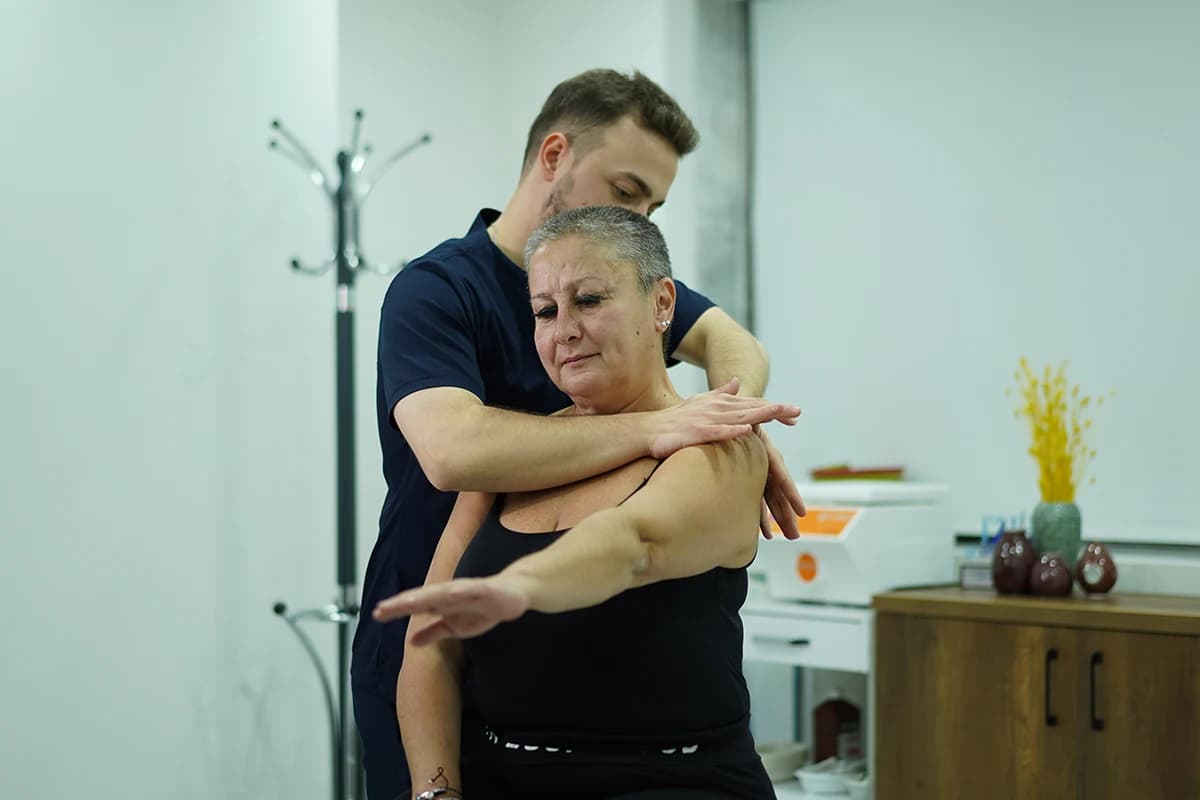


Methods are combined inside a programme and chosen after examination — they are not booked separately.
Your path to this treatment
Nothing here is booked from a page. You send the records you have, a rehabilitation physician reads them, and you get a written answer — including when the answer is that an intensive programme will not help.
4 steps, start to finish
1.Send your records
A discharge summary from the hospital that treated the original event, and any imaging of the affected area — CT, MRI or X-ray.2.A written plan in 48 hours
A rehabilitation physician reviews the case and returns the expected duration, the recommended programme and the centre. Free, no obligation.3.Travel and admission
Where a visa is needed we issue an invitation letter and treatment confirmation naming the dates and the facility. You are met at the airport and driven to the centre by private vehicle or ambulance; a bed for one companion and interpreting during therapy are arranged.4.Treatment, then home
The programme runs, then you leave with a discharge report and a written home exercise plan. Your return journey is organised before you go, with scheduled video reviews so progress does not stop.
In their words
What patients say after a programme
Short videos filmed during therapy: a child’s rehabilitation after a brain tumour, suspended gait training after spinal cord injury, and learning to walk again after a fall. Individual results vary.
Dave Evans on his physical therapy here
Musculoskeletal physiotherapy
Paediatric rehabilitation after a brain tumour
Inside a physiotherapy session
Spinal cord injury — the rehabilitation process
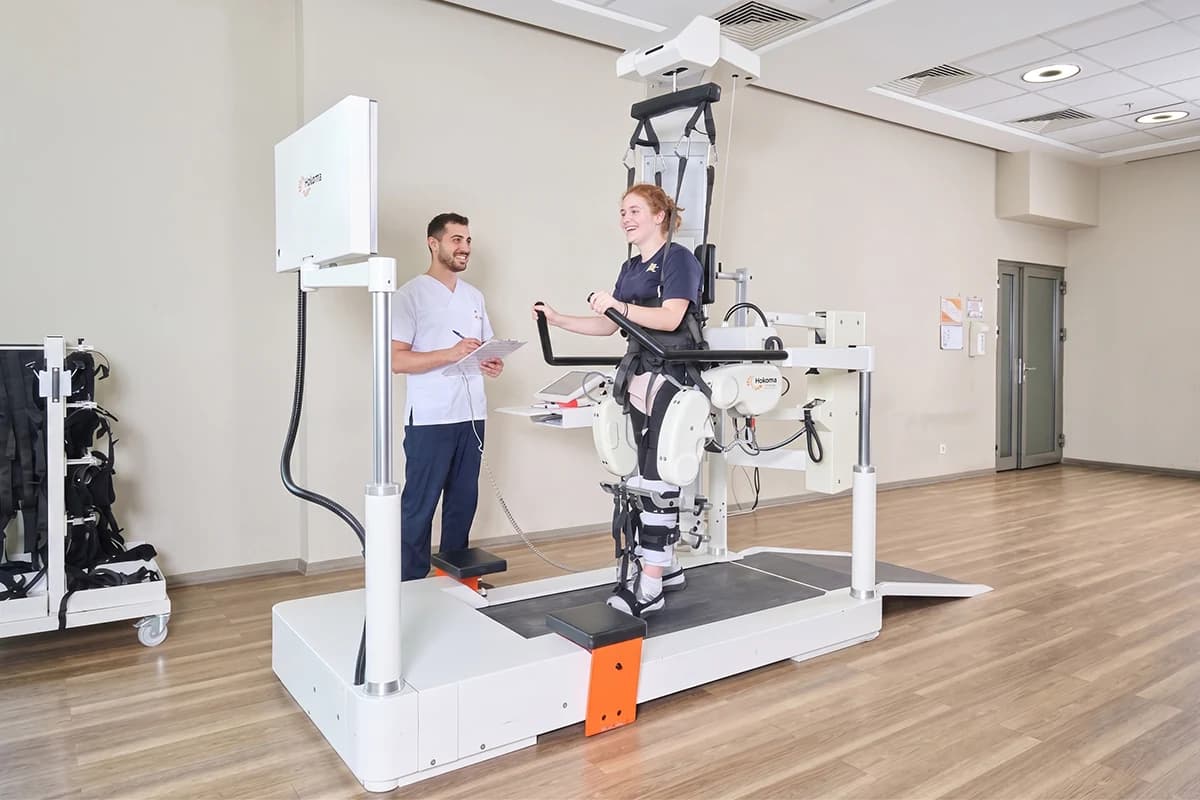
Suspension-assisted gait training
Walking difficulty and restricted movement after a fall
Regaining gait and range of motion
Locations
Our centres











Questions people actually ask
About this treatment
Does TENS work for pain?
It provides short-term relief for some people and does not change the underlying problem. As a tool to make exercise tolerable it is reasonable; as a treatment course it is not.
What is functional electrical stimulation?
Stimulation timed to produce a useful movement during activity — most commonly lifting the foot during the swing phase of walking after stroke or in multiple sclerosis.
Can it rebuild muscle after nerve injury?
It can maintain muscle bulk while a nerve recovers, which matters because a muscle that has wasted completely responds poorly when reinnervation arrives. It does not speed the nerve itself.
Is it safe with a pacemaker?
Not without cardiology clearance, and certain applications are contraindicated. Pacemakers, implanted pumps, pregnancy, active malignancy in the area and impaired sensation all change what is appropriate.
Does it hurt?
It should feel like a strong tingle or a controlled muscle contraction, not pain. Intensity is set by the patient and adjusted throughout.



