
Gait and lower limb
Assisted walking system
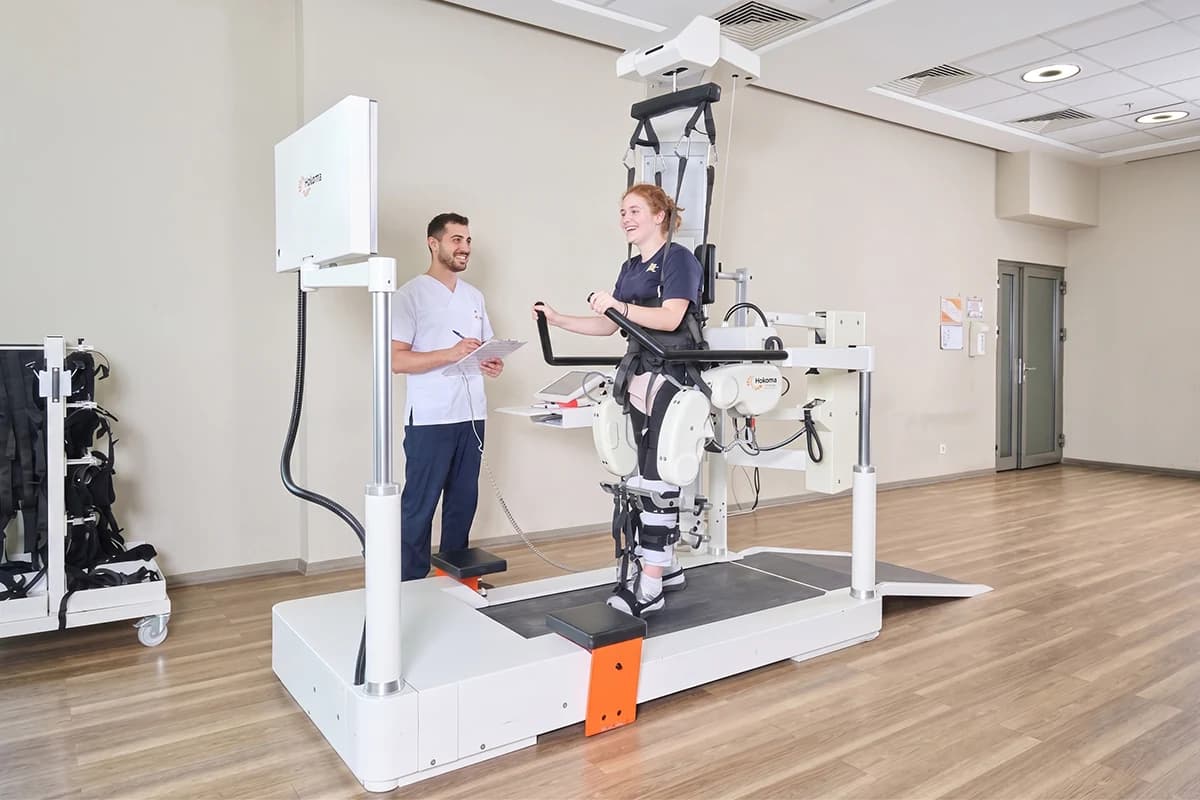
A mobile frame and harness that follow the patient as they walk over real ground, carrying part of their body weight and catching any fall, so walking practice can begin early and continue without a therapist holding them up. The walking is real walking — turning, stopping and stepping around a chair on the corridor floor.
A harness on wheels rather than a treadmill
The patient is fixed into a belt and support harness attached to a motorised frame that moves with them. The frame takes a set share of body weight — as much as needed at first, less as strength returns — keeps the trunk upright and stops a fall before it happens. Walking itself is done by the patient, on the corridor floor, at their own pace.
Because nothing is fixed in place, the walking is real walking: turning, stopping, starting again, stepping around a chair, crossing a threshold. Those are the parts of walking a treadmill cannot train and the parts that decide whether someone walks at home.
Who it is used for
Walking difficulty and balance problems after stroke, in incomplete spinal cord injury, in multiple sclerosis and Parkinson's disease, after brain injury, and after orthopaedic surgery where weight bearing is allowed but not yet trusted. It is also how many patients take their first steps after weeks in bed.
It requires enough trunk control to tolerate standing in the harness and some ability to move the legs. Where the legs cannot yet step at all, the treadmill-based robot comes first.
What it adds to therapy
Early, safe mobilisation with the fall risk removed, which means more steps per session and steps taken with confidence rather than fear. The therapist's hands are free to correct the pattern instead of holding the patient up.
Body-weight support is reduced session by session, and the setting is recorded, so progress is a number — how much of your own weight you carried, how far you walked — rather than an impression.
What it is not
It is not a powered exoskeleton and it does not move the legs for the patient. It supports and protects; the walking is the patient's own, which is exactly why what is learned here transfers to walking without it.
It is a centre-based system used within a programme. It is not a device to take home.
What does the research show?
Research on mobile overground support systems is still small-scale. In a single-session study of 27 mostly older rehabilitation patients, walking in such a system produced about the same number of steps and walking distance as ordinary walking, with fewer rest breaks and less fear of falling, although walking was slower 1. In a pilot randomised trial of 37 people in the first weeks after stroke, adding four weeks of body-weight-supported overground walking to conventional physiotherapy improved walking independence, but not the other measures 2.
Across gait technologies more broadly, a meta-analysis of 23 trials with 1,452 people found that gait training with body-weight support devices was not superior to conventional overground training in the first six months after stroke 3.
Sources
- Fay A, Synott E, McDaid E, Barrett E. A comparison of the immediate effects of the Andago over ground body weight support trainer versus over ground walking on selected gait parameters in a post-acute rehabilitation population — Physiotherapy Theory and Practice (2024)
- Brunelli S, Iosa M, Fusco FR, Pirri C, et al. Early body weight-supported overground walking training in patients with stroke in subacute phase compared to conventional physiotherapy: a randomized controlled pilot study — International Journal of Rehabilitation Research (2019)
- Hsu CY, Cheng YH, Lai CH, Lin YN. Clinical non-superiority of technology-assisted gait training with body weight support in patients with subacute stroke: a meta-analysis — Annals of Physical and Rehabilitation Medicine (2020)
- van Hedel HJA, Rosselli I, Baumgartner-Ricklin S. Clinical utility of the over-ground bodyweight-supporting walking system Andago in children and youths with gait impairments — Journal of NeuroEngineering and Rehabilitation (2021)
Conditions this device is used for
The 3 conditions where this device is part of a routine programme, grouped by area. It is one tool inside the plan, never the plan itself.

Devices are used inside a programme and chosen after examination — they are not booked separately.
Your path to this treatment
Nothing here is booked from a page. You send the records you have, a rehabilitation physician reads them, and you get a written answer — including when the answer is that an intensive programme will not help.
4 steps, start to finish
1.Send your records
A discharge summary from the hospital that treated the original event, and any imaging of the affected area — CT, MRI or X-ray.2.A written plan in 48 hours
A rehabilitation physician reviews the case and returns the expected duration, the recommended programme and the centre. Free, no obligation.3.Travel and admission
Where a visa is needed we issue an invitation letter and treatment confirmation naming the dates and the facility. You are met at the airport and driven to the centre by private vehicle or ambulance; a bed for one companion and interpreting during therapy are arranged.4.Treatment, then home
The programme runs, then you leave with a discharge report and a written home exercise plan. Your return journey is organised before you go, with scheduled video reviews so progress does not stop.
In their words
What patients say after a programme
Short videos filmed during therapy: a child’s rehabilitation after a brain tumour, suspended gait training after spinal cord injury, and learning to walk again after a fall. Individual results vary.
Dave Evans on his physical therapy here
Musculoskeletal physiotherapy
Paediatric rehabilitation after a brain tumour
Inside a physiotherapy session
Spinal cord injury — the rehabilitation process
Suspension-assisted gait training
Walking difficulty and restricted movement after a fall
Regaining gait and range of motion
Locations
Centres that have this device — pick one.






Questions people actually ask
About this device
Does the machine walk for me?
No. It carries part of your weight and prevents falls. Your legs do the walking, with the therapist correcting the pattern.
How early can it be used?
As soon as standing in a harness is tolerated and the legs can move at all — often in the first days of a programme, which is the point of it.
Is it the same as the robotic gait trainer?
No. The robotic trainer guides the legs on a treadmill; this system follows you over real ground and lets you walk yourself with support.
Is it safe if I have fallen before?
It is designed for exactly that situation. The harness takes the body weight if balance is lost, so practice can continue safely.
Will I walk the same way in it as without it?
Not quite. In a study of mostly older rehabilitation patients, people walked more slowly in such a system than on their own, although they covered a similar distance 1. In children and teenagers, the highest level of weight support tested reduced the activity of a key hip muscle, the gluteus medius 4. Support is therefore lowered as soon as it is safe.



