
Inpatient
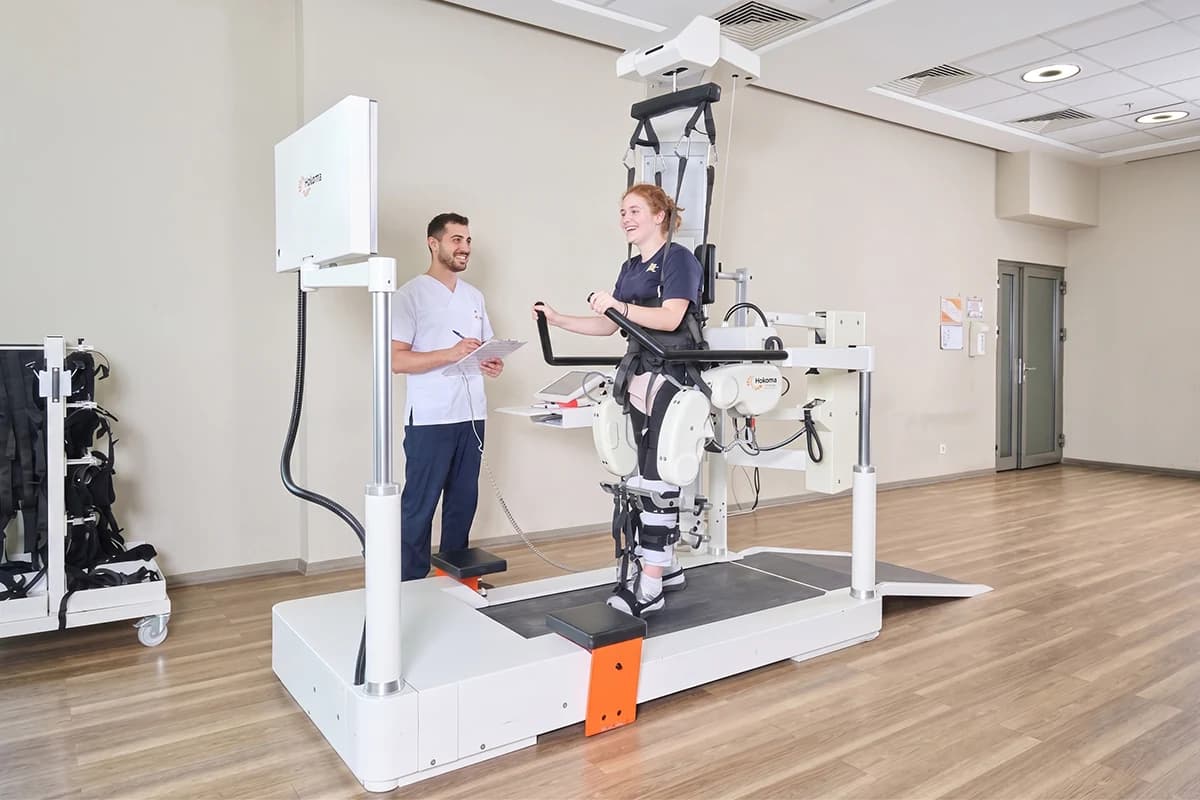
Robotic gait rehabilitation
Intensive walking retraining with body-weight-supported robotic systems, for people who cannot yet walk safely without help. Delivered five days a week alongside conventional therapy. The robot adds volume — more correct steps than a therapist can assist by hand — and the rest of the programme turns that volume into walking on real ground.
What the programme actually consists of
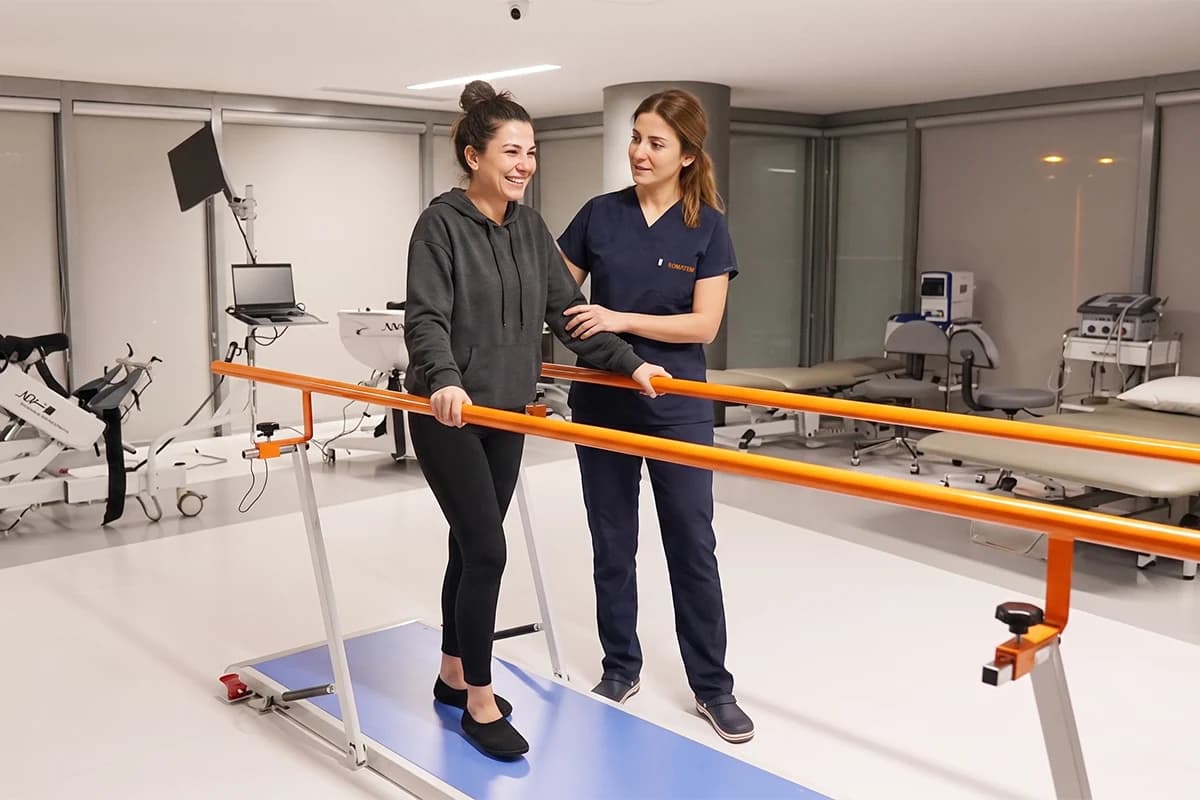
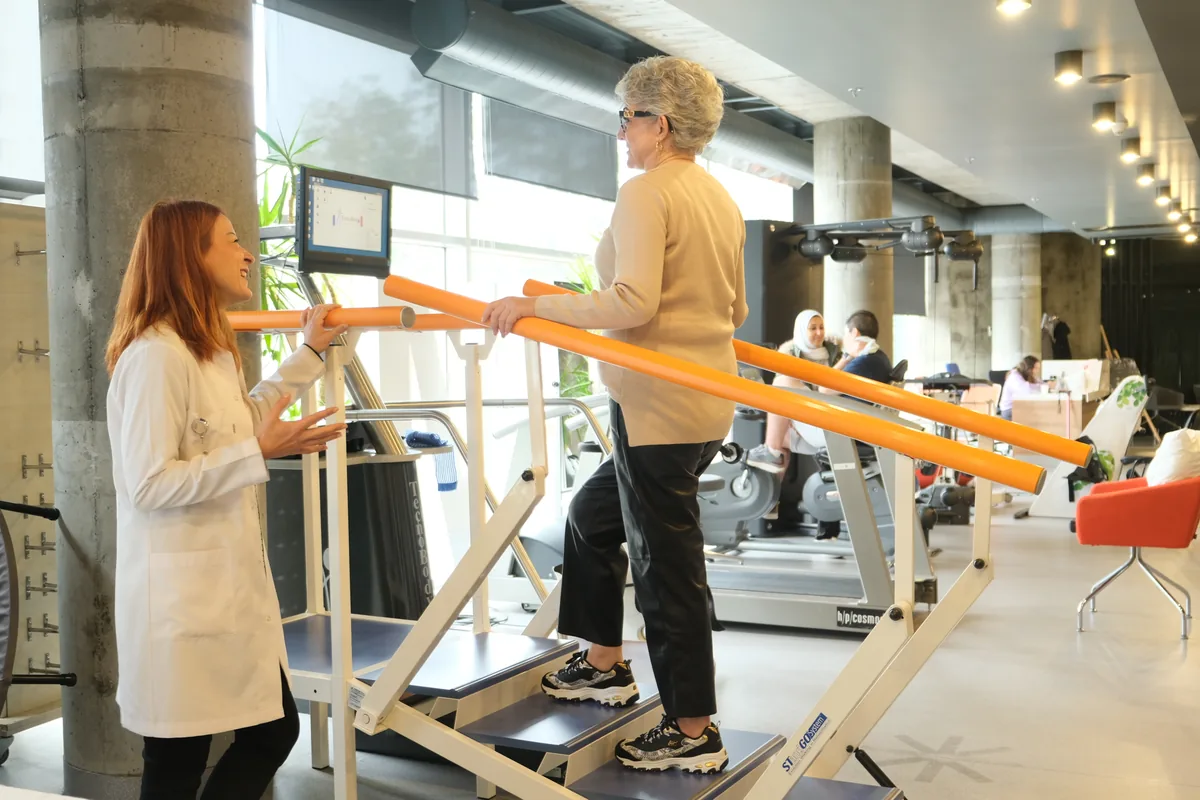
Robotic gait sessions form part of a full programme, not the whole of it. A typical day combines robot-assisted walking with conventional gait training on the ground, strengthening, balance work and functional training.
The robot's contribution is volume: it delivers more correct steps in a session than a therapist can produce by manually assisting a patient who cannot bear their own weight. That volume is the mechanism, and it only helps if the rest of the programme converts it into walking on real ground.
Who it suits
Patients who cannot yet walk safely or far enough to practise conventionally — after stroke, spinal cord injury, brain injury, in multiple sclerosis and in Parkinson's disease with significant gait deterioration.
Requirements: adequate hip and knee range, no unhealed lower limb fracture, intact skin where cuffs sit, sufficient bone density for loading, and cardiovascular stability for upright exercise. These are assessed before you travel and we will tell you if you do not meet them.
What the evidence supports
Robotic gait training added to conventional therapy improves the chance of independent walking after stroke, and the effect is clearest in patients who are not walking at the outset.
It has not been shown to beat an equal amount of skilled conventional gait training in patients who already walk. We will tell you which group we think you are in, and we will not recommend a robotic programme to someone who would do just as well without one.
Duration and what to expect
Programmes typically run three to six weeks. Improvement in walking distance and speed is usually measurable early in the programme; if it is not, we reassess the plan rather than continue on schedule.
You receive walking speed and distance measurements at start and finish. If they did not change, the report says so.
What the robot does and does not do
It supports body weight and guides the legs through a walking pattern, allowing many more repetitions at a consistent quality than a therapist can deliver by hand. That is its entire contribution: volume and consistency.
It does not make decisions, judge effort or replace the therapist, who sets the parameters and progressively reduces the assistance. A session in which the machine does the work while the patient is passive achieves very little.
Combined with conventional therapy, not instead of it
The evidence supports electromechanical-assisted gait training as an addition to conventional therapy rather than a replacement for it, and the people most likely to benefit are those who cannot yet walk independently.
So it is scheduled alongside floor-based work, strengthening and task practice. A programme sold as robotic training alone is selling equipment rather than rehabilitation.
Sources
- Mehrholz J, et al. Electromechanical-assisted training for walking after stroke — Cochrane Database of Systematic Reviews (2025)
Conditions this programme treats
The 4 conditions this programme is built for, grouped by area.

The programme is chosen after a rehabilitation physician has read your records — not from this page.
Your path to this treatment
Nothing here is booked from a page. You send the records you have, a rehabilitation physician reads them, and you get a written answer — including when the answer is that an intensive programme will not help.
4 steps, start to finish
1.Send your records
A discharge summary from the hospital that treated the original event, and any imaging of the affected area — CT, MRI or X-ray.2.A written plan in 48 hours
A rehabilitation physician reviews the case and returns the expected duration, the recommended programme and the centre. Free, no obligation.3.Travel and admission
Where a visa is needed we issue an invitation letter and treatment confirmation naming the dates and the facility. You are met at the airport and driven to the centre by private vehicle or ambulance; a bed for one companion and interpreting during therapy are arranged.4.Treatment, then home
The programme runs, then you leave with a discharge report and a written home exercise plan. Your return journey is organised before you go, with scheduled video reviews so progress does not stop.
In their words
What patients say after a programme
Short videos filmed during therapy: a child’s rehabilitation after a brain tumour, suspended gait training after spinal cord injury, and learning to walk again after a fall. Individual results vary.
Dave Evans on his physical therapy here
Musculoskeletal physiotherapy
Paediatric rehabilitation after a brain tumour
Inside a physiotherapy session
Spinal cord injury — the rehabilitation process
Suspension-assisted gait training
Walking difficulty and restricted movement after a fall
Regaining gait and range of motion
Locations
Where this programme runs — pick a centre.




Questions people actually ask
About this programme
Who benefits most from robotic gait training?
People who are not yet walking independently, particularly in the earlier phase after stroke or spinal cord injury. Those already walking reasonably well generally gain more from task-specific floor training.
How many sessions are needed?
It is delivered five days a week within a programme of three to six weeks. The number matters less than the total repetitions and whether assistance is being reduced as capacity improves.
Is it safe with a spinal cord injury?
Yes, with screening. Bone density, skin condition, blood pressure regulation and joint range are checked first, and autonomic responses are monitored during sessions.
Will I walk again if I use this?
The device does not determine that; the injury and the recovery do. It improves the chances of independent walking for some groups and cannot create recovery that the nervous system is not capable of. We say which situation applies after assessment.
Can I continue this at home?
No — this is centre-based equipment. What continues at home is the walking and strength programme built alongside it, which is why the two are always delivered together.



