

Medical condition
Spinal Cord Injury
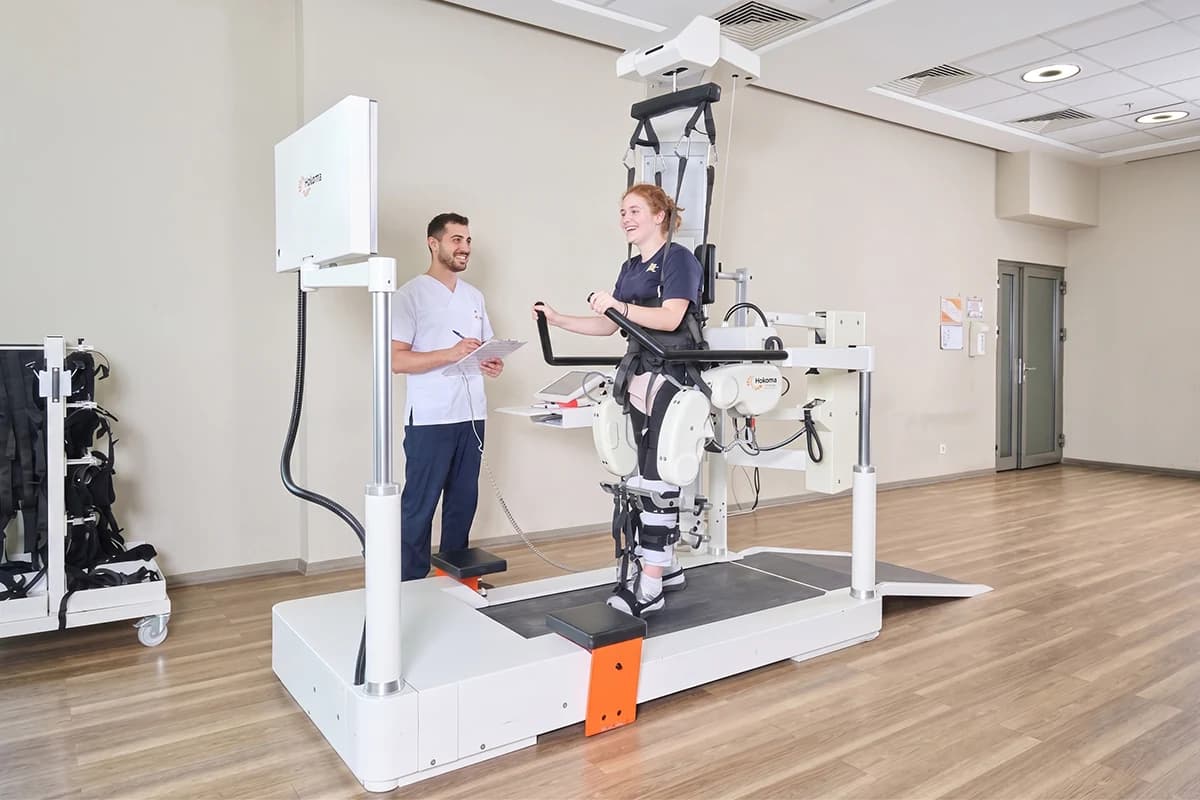
Spinal cord injury rehabilitation at Romatem is an inpatient programme of four to eight weeks covering mobility, transfers, bladder and bowel management, skin protection and wheelchair skills. Robotic gait training is used where the injury is incomplete. A companion is trained alongside the patient before discharge.
What the spinal cord does, and what is lost when it is damaged
The spinal cord carries every signal between the brain and the body below the neck: the instruction to move a leg, the sensation of a hand touching something hot, and the automatic controls for bladder, bowel, blood pressure and temperature. When the cord is damaged, the signals below the damaged point are reduced or lost.
This is why spinal cord injury is not only a walking problem. The functions people rarely think about — emptying the bladder, feeling that you have been sitting too long, sweating to cool down — are carried by the same cord. A rehabilitation programme that only trains legs has addressed the visible part of the injury and left the part that decides daily independence.
Level and completeness: the two words that determine the plan
Two facts shape everything that follows. The level is the lowest segment of the cord still working normally — cervical injuries affect the arms as well as the legs, thoracic and lumbar injuries usually do not. Completeness is whether any signal is still crossing the damaged point.
These are recorded with the international ASIA classification, from A (no motor or sensory function below the injury) to E (normal). The grade is not fixed at the moment of injury: it can improve over the first weeks and months, which is one reason the first assessment is repeated rather than trusted once.
When you contact us, the single most useful document is the ASIA classification and the imaging. With those, a rehabilitation physician can say something specific. Without them, any answer would be a guess dressed as a plan.
What natural recovery does, and where rehabilitation adds to it
Some neurological recovery happens on its own — most of it in the first three months, with smaller gains continuing for up to eighteen months — and it is greater in incomplete injuries 5. Rehabilitation does not replace that process. What it does is make sure the body is able to use whatever return arrives, and build function that does not depend on neurological recovery at all.
That second part is the one families underestimate. A person who transfers independently from bed to wheelchair has gained a great deal of freedom without a single nerve recovering. Much of the programme is built on that logic.
Bladder and bowel: the part that decides whether you go home
After spinal cord injury the bladder no longer empties on command. Left unmanaged this causes infections and, over years, kidney damage — which is why bladder management is not a comfort issue but a survival one. Most people are taught intermittent catheterisation on a fixed schedule, and the training continues until it can be done independently or by the companion reliably.
Bowel management works on the same principle: a routine performed at the same time of day, rather than waiting for a signal that no longer arrives. It is unglamorous and it is one of the strongest predictors of whether someone can live outside an institution.
We teach this during the stay rather than describing it at discharge. A family that has done it for three weeks under supervision goes home differently from one that has been handed a leaflet.
Skin: why one pressure injury can cost more than the programme
Where sensation is lost, the warning that normally makes a person shift position is gone. Sitting in one posture long enough damages the skin over the bone beneath it, and once that damage opens, it can take months to close — months spent lying down, which undoes the mobility the programme has just built.
Prevention is a schedule: pressure relief at set intervals, a cushion matched to the person rather than to the chair, and a daily skin check with a mirror for the areas that cannot be seen. The companion learns the check as well, because the patient cannot see everything.
Autonomic dysreflexia: the emergency that travels home with you
If the injury is at or above the sixth thoracic vertebra (T6), the body can respond to a problem below the injury — most often a full bladder, sometimes a blocked catheter, constipation or a skin injury — with a sudden and dangerous rise in blood pressure 2. The person feels a pounding headache, sweats above the injury level, and may have a flushed face and blurred vision.
A systolic rise of 20 mmHg or more above the person's own baseline is the threshold 2. Untreated it can lead to seizures, retinal haemorrhage and cerebral haemorrhage. It is a medical emergency and it is treated by sitting the person upright, loosening anything tight, and finding and removing the cause — usually draining the bladder.
Every patient with an injury at or above T6, and every companion, leaves our programme able to recognise this and act on it. It is the single most important thing we teach, because it happens at home, months after discharge, with no clinician in the room.
Walking: who robotic gait training is for, and who it is not for
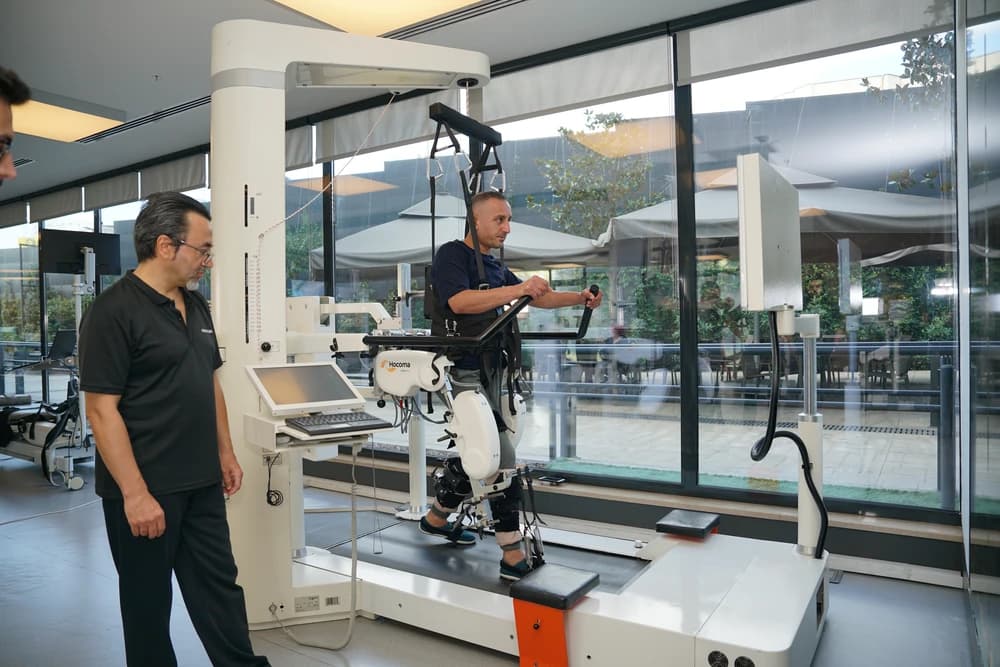
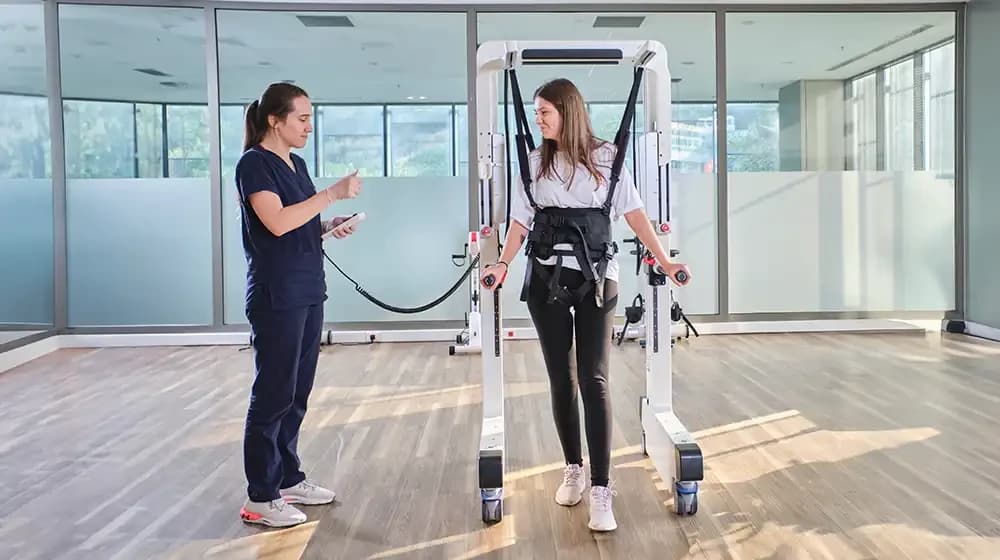
We use robotic gait training and body-weight-supported walking where the injury is motor-incomplete — ASIA C and D. In that group the evidence supports improvement in walking distance and speed, measured with the six-minute walk test, the ten-metre walk test and the Walking Index for Spinal Cord Injury.
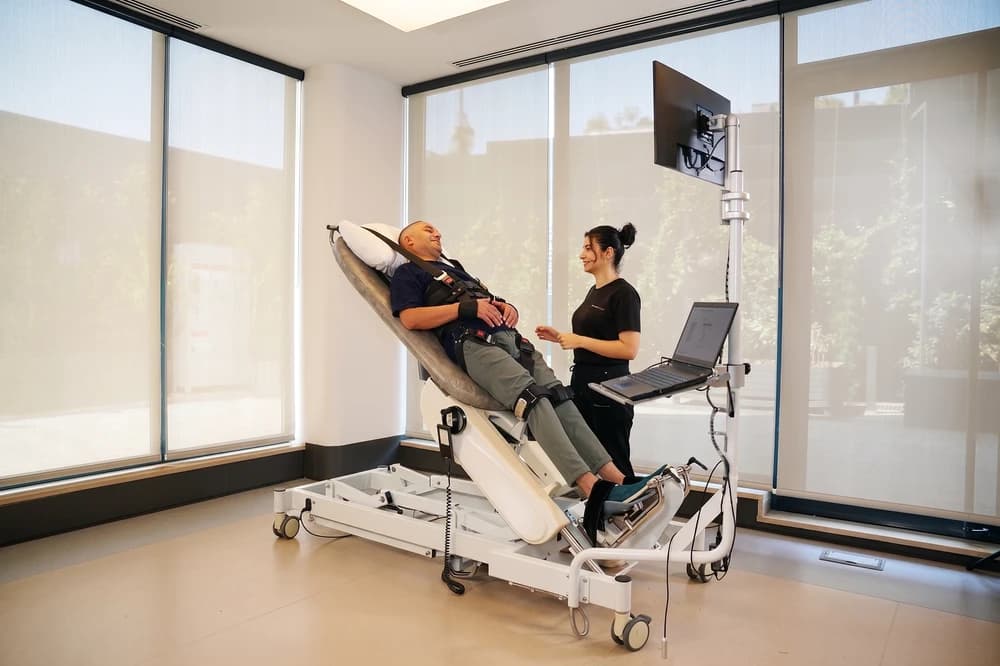
In complete injuries the same equipment is used for a different purpose: upright loading for bone density, circulation, bowel function and spasticity. That is a real benefit and we offer it. It is not a walking programme, and we will not describe it as one.
If a centre offers you walking after a complete injury without qualifying it, ask which classification they are working from. The difference is not marketing language; it is the difference between a goal and a false hope.
The companion is trained, not just informed
Almost every patient who travels for spinal cord rehabilitation travels with someone. That person will be doing transfers, skin checks, catheterisation support and the bowel routine within days of getting home, usually without a nurse nearby.
So the companion is scheduled into the programme rather than allowed to watch it. A bed for one companion is provided in the patient's room, and the discharge criteria include what the companion can do, not only what the patient can do.
What the programme covers
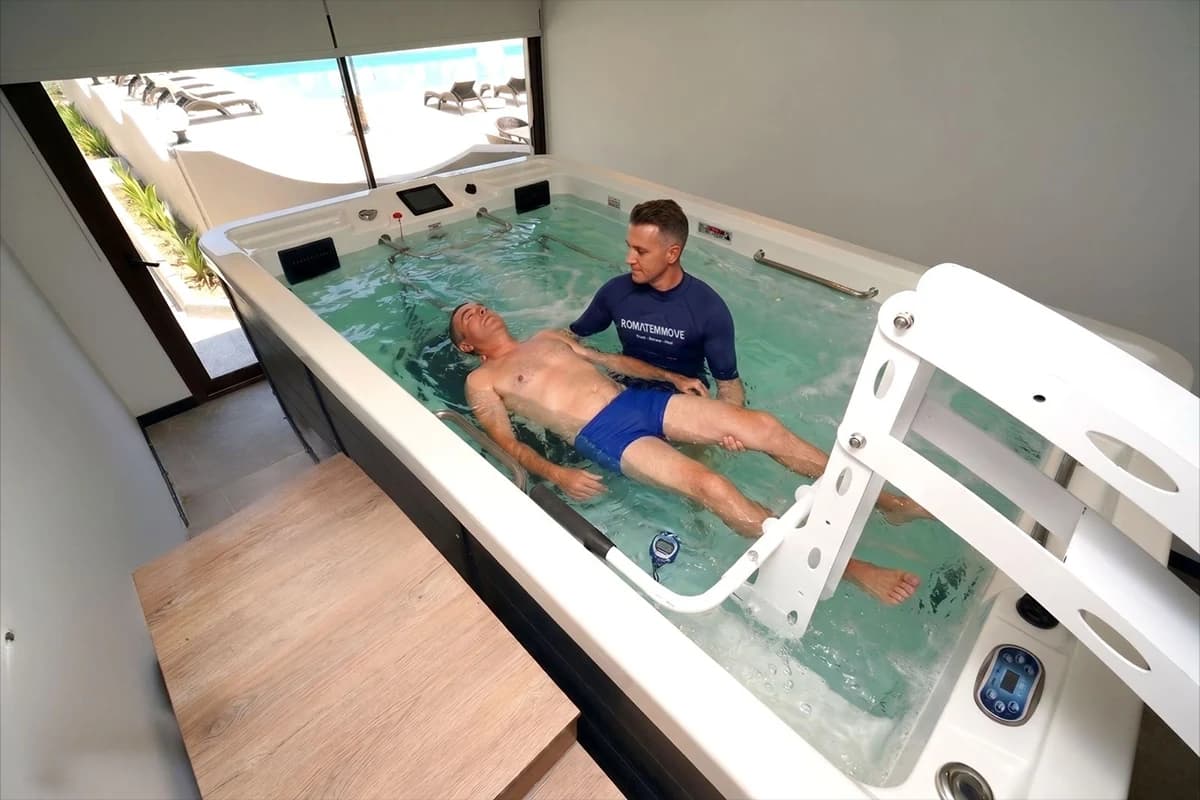
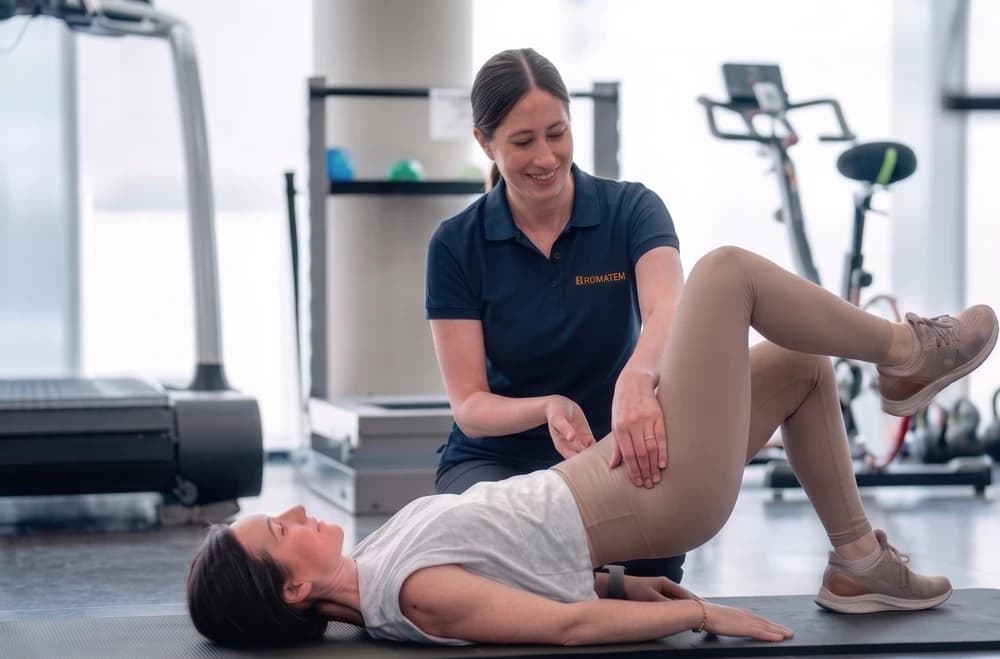
Four to eight weeks as an inpatient, four to six hours of active therapy a day, five to six days a week. Physiotherapy for strength, balance and transfers; occupational therapy for dressing, washing and the equipment that makes them possible; wheelchair skills including kerbs and slopes; bladder, bowel and skin training; and robotic or hydrotherapy sessions where they fit the plan.
A rehabilitation physician reviews the plan through the stay, and the discharge document is written to be usable by clinicians in your own country — because the programme continues there.
Understanding Spinal Cord Injury
Before treatment, the questions people actually ask first — what happens, how recovery behaves over time, and whether it is ever too late. Each opens the full article.
- Understanding spinal cord injuryWhat the injury level means, and why complete and incomplete describe different futures.
- How we treat spinal cord injuryWhat the programme contains, how the day is built, and why the parts nobody photographs matter most.
- What to expectWeek by week, from the day the records arrive to the day the home programme starts.
- Questions families askThe questions that come up in the first conversation, answered plainly.
Frequently asked questions
How much recovery is possible?
The ASIA grade and the level of injury are the strongest predictors, and the grade can change over the first weeks. A rehabilitation physician can give a realistic assessment once the classification and imaging are available. We would rather set an achievable goal than an impressive one.
Will I walk again?
It depends on completeness. In motor-incomplete injuries (ASIA C and D) walking is a legitimate goal and robotic gait training supports it. In complete injuries it is not, and we say so before you travel rather than after you arrive. Upright robotic work is still offered in complete injuries, for bone, circulation, bowel function and spasticity — but as those things, not as walking.
How soon after the injury should rehabilitation start?
As soon as the acute treatment is finished and the spine is stable enough for the medical team that operated or treated you to release you. Earlier is generally better, but a programme that starts before the spine is stable is not a programme, it is a risk.
What do you need from me before you can answer?
The ASIA classification, the imaging, the operation note if there was surgery, and a short description of what the person can do now — sitting balance, transfers, hand function if the injury is cervical. With those, a physician can be specific. Without them, we can only describe the programme in general.
Is four to eight weeks enough?
It is enough to change function and to train a routine that continues at home. It is not enough to complete recovery, and anyone who tells you a fixed number of weeks completes a spinal cord injury is selling something. The stay is designed to be repeatable — many people return for a second block after several months.
Can my companion stay with me?
Yes, and it is expected rather than tolerated. A bed for one companion is provided in the patient's room and the companion is scheduled into training sessions, because they will be doing much of this at home.
What is autonomic dysreflexia and do I need to worry about it?
It affects people with injuries at or above T6 2. Something the body cannot feel below the injury — usually a full bladder — triggers a sudden, dangerous rise in blood pressure, felt as a pounding headache with sweating above the injury level. It is an emergency. If your injury is at or above T6, you and your companion will leave able to recognise and treat it.
Do you treat pressure injuries that are already present?
A small, closed area can be managed alongside the programme. An open pressure injury usually needs to be treated first, because the treatment is offloading — which means lying down, which is the opposite of what a rehabilitation programme does. We will tell you which of the two applies when we see the records.
What happens after I go home?
You leave with a written home programme and a discharge document intended for clinicians in your own country. Remote follow-up is available. The programme is built to be handed over, not to keep you dependent on the centre that delivered it.
Sources
- International Standards for Neurological Classification of Spinal Cord Injury: Revised 2019 — American Spinal Injury Association (2021)
- Autonomic Dysreflexia — StatPearls, National Library of Medicine (2023)
- Autonomic Dysreflexia in Spinal Cord Injury — American Academy of Physical Medicine and Rehabilitation — PM&R KnowledgeNow (2023)
- Effectiveness of Body Weight-Supported Gait Training on Gait and Balance for Motor-Incomplete Spinal Cord Injuries: A Systematic Review with Meta-Analysis — Journal of Clinical Medicine (2024)
- Guidelines for the conduct of clinical trials for spinal cord injury as developed by the ICCP panel: spontaneous recovery after spinal cord injury and statistical power needed for therapeutic clinical trials — Spinal Cord (2007)
Which therapies would I actually receive?
A therapy is a single method used inside a programme. It is measured in sessions and is not sold separately.



Technologies we use

Locations
Where you can receive this treatment



Related articles
Neurological What can be recovered in the first year after a spinal cord injury?
Most neurological recovery after a spinal cord injury happens within the first year, and it is usually greater when the injury is incomplete. The level and completeness of injury, measured with the ASIA scale, guide expectations. Rehabilitation aims to use every recovered function and to build independence even where movement does not return.Read moreTreatments and technology Does robotic walking training work?
After stroke, robot-assisted walking training combined with physiotherapy increases the chance of walking independently, especially for people who cannot walk soon after their stroke. It gives a small gain in walking speed but not walking distance. After spinal cord injury, evidence is inconclusive. Robots add to, rather than replace, conventional therapy.Read moreNeurological How long does it take to recover from a stroke?
Most recovery after a stroke happens in the early months, when the brain is most able to reorganise, and it continues more slowly for a longer period after that. How far someone gets depends mainly on how severe the stroke was, where it happened and how much active therapy follows.Read more



