
Day programme
Upper limb robotic rehabilitation
Arm and hand retraining with sensor-based robots that take the weight of the limb, allowing many more guided repetitions per session than manual therapy alone can deliver. Practice with real objects is built in, because improvement inside a device does not automatically become the ability to pick up a cup.
Why arm recovery needs a different approach
Upper limb recovery after neurological injury is slower and less complete than lower limb recovery. The arm requires far more precise control, and the hand most of all, which is why intensity and repetition matter even more here than in gait work.
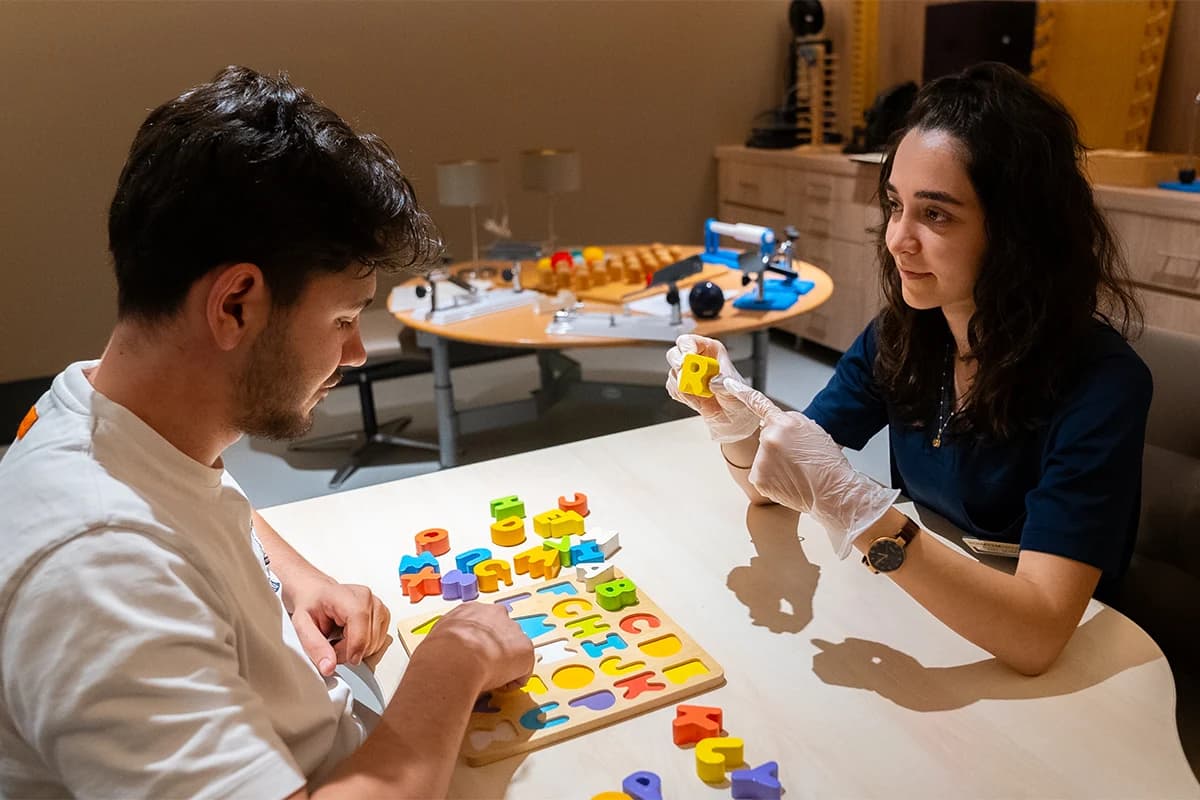
The programme combines arm robotics, hand robotics, virtual reality tasks and — critically — practice with real objects. Improvement inside a device does not automatically become the ability to pick up a cup.
Who it is for
Arm and hand impairment after stroke, brain injury, cervical spinal cord injury, in multiple sclerosis and in children with cerebral palsy. It works across a wide range of severity, because weight support and assistance levels can be set very high initially.
Patients with no active movement at all can still work in passive and force-feedback modes, and this is often the stage at which people are wrongly told there is nothing to be done.
Honest expectations
Where there is some active movement at the wrist and fingers, functional improvement is a realistic goal. Where the arm has no movement months after a stroke, the achievable goals are usually maintaining range, preventing pain and contracture, and improving the arm's role as a stabiliser.
We assess and state which of those we are working towards before the programme starts, rather than allowing an expectation to persist that we do not think is achievable.
How progress is measured
Standardised upper limb measures at start and finish, plus the device's own recorded data on range, speed and smoothness, plus performance on real daily tasks.
The real-task measure is the one that counts. A patient who improves on every device score and still cannot use the arm at home has not gained what they came for.
Why repetitions matter more than the device
Arm recovery responds to the number of meaningful, guided movements performed. A robot delivers many more of them per session than manual therapy alone can, and this volume is the mechanism.
The evidence indicates improvement in arm function and activities of daily living when robot-assisted training is added to usual care. The size of that benefit varies and is honest to describe as moderate rather than transformative.
What happens away from the machine
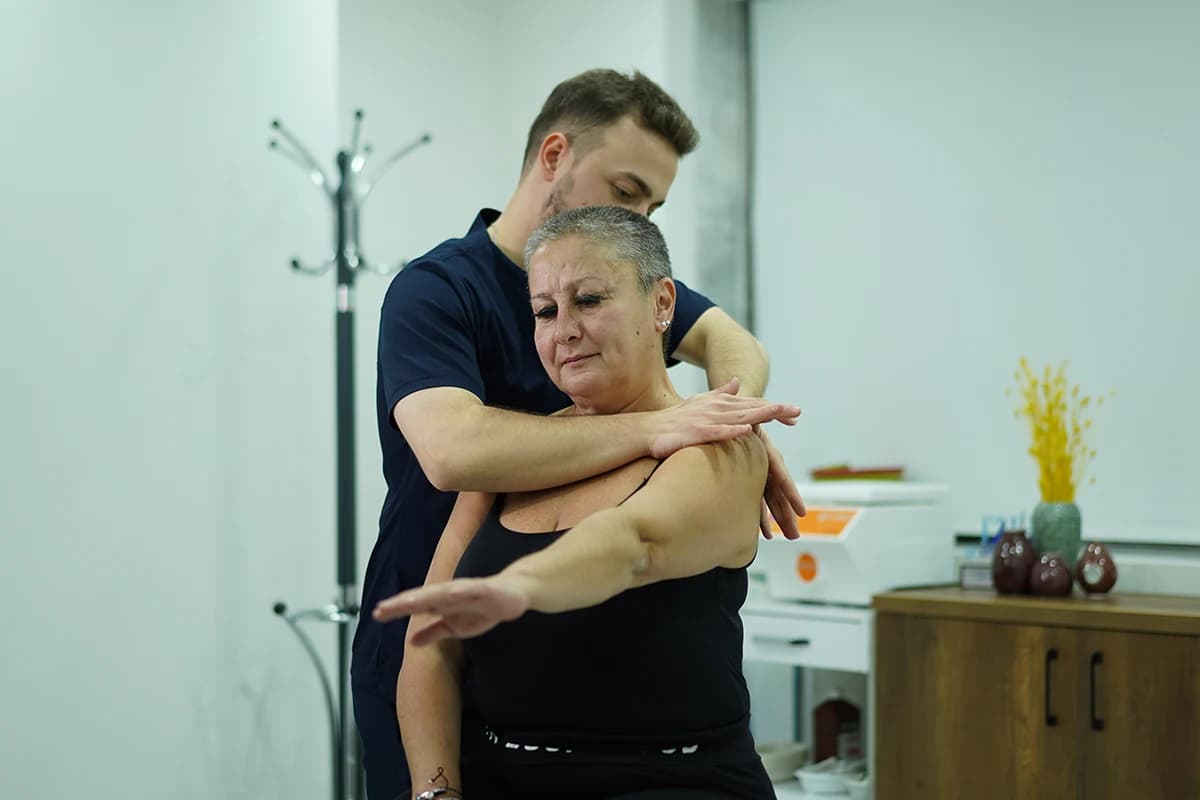
Constraint of the unaffected arm during specific tasks, task-specific practice with real objects, and work on the shoulder and trunk that the arm depends on. Function returns through use, and use happens outside the device.
Spasticity is managed alongside where it limits movement, because a limb that cannot be positioned cannot be trained.
Sources
- Mehrholz J, et al. Electromechanical and robot-assisted arm training for improving activities of daily living, arm function, and arm muscle strength after stroke — Cochrane Database of Systematic Reviews (2018)
Conditions this programme treats
The 3 conditions this programme is built for, grouped by area.

The programme is chosen after a rehabilitation physician has read your records — not from this page.
Your path to this treatment
Nothing here is booked from a page. You send the records you have, a rehabilitation physician reads them, and you get a written answer — including when the answer is that an intensive programme will not help.
4 steps, start to finish
1.Send your records
A discharge summary from the hospital that treated the original event, and any imaging of the affected area — CT, MRI or X-ray.2.A written plan in 48 hours
A rehabilitation physician reviews the case and returns the expected duration, the recommended programme and the centre. Free, no obligation.3.Travel and admission
Where a visa is needed we issue an invitation letter and treatment confirmation naming the dates and the facility. You are met at the airport and driven to the centre by private vehicle or ambulance; a bed for one companion and interpreting during therapy are arranged.4.Treatment, then home
The programme runs, then you leave with a discharge report and a written home exercise plan. Your return journey is organised before you go, with scheduled video reviews so progress does not stop.
In their words
What patients say after a programme
Short videos filmed during therapy: a child’s rehabilitation after a brain tumour, suspended gait training after spinal cord injury, and learning to walk again after a fall. Individual results vary.
Dave Evans on his physical therapy here
Musculoskeletal physiotherapy
Paediatric rehabilitation after a brain tumour
Inside a physiotherapy session
Spinal cord injury — the rehabilitation process
Suspension-assisted gait training
Walking difficulty and restricted movement after a fall
Regaining gait and range of motion
Locations
Where this programme runs — pick a centre.





Questions people actually ask
About this programme
Can this restore hand function after a stroke?
It improves arm and hand function for many people; how much depends on how much voluntary movement is present to build on. Where there is no active movement at all, expectations must be set differently and we say so.
Is it better than conventional therapy?
It is better as an addition than either alone in most studies. Framed as a replacement it is oversold, which is a claim worth checking anywhere it is offered.
How long before I see change?
Most people see measurable change after a period of intensive daily work. Progress is tracked with the Fugl-Meyer assessment rather than by impression.
Does it hurt?
It should not. The device supports the weight of the limb, which usually reduces shoulder pain rather than provoking it. Pain during sessions means the setup needs changing.
What if my arm is very stiff?
Spasticity is addressed first or alongside — stretching, splinting, and botulinum toxin where the tightness is focal and limiting. Training a limb that cannot be positioned wastes the sessions.



