
Gait and lower limb
Robotic gait training
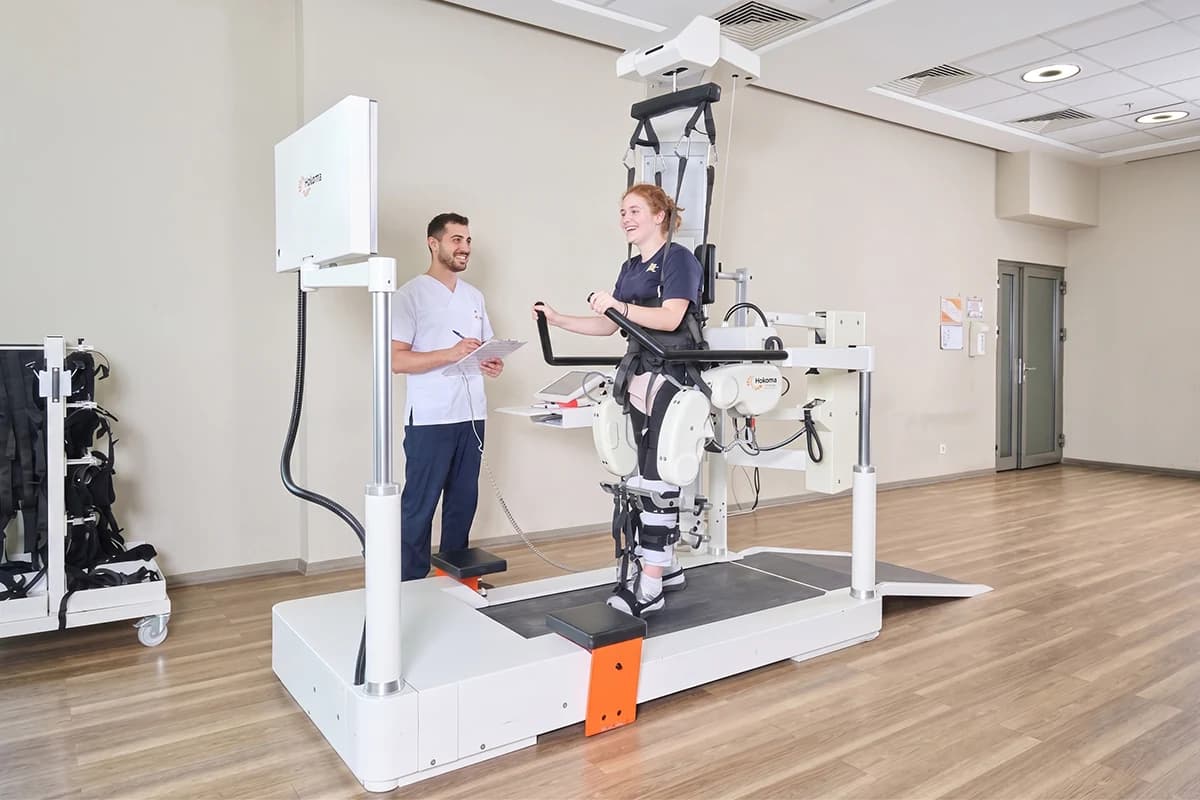
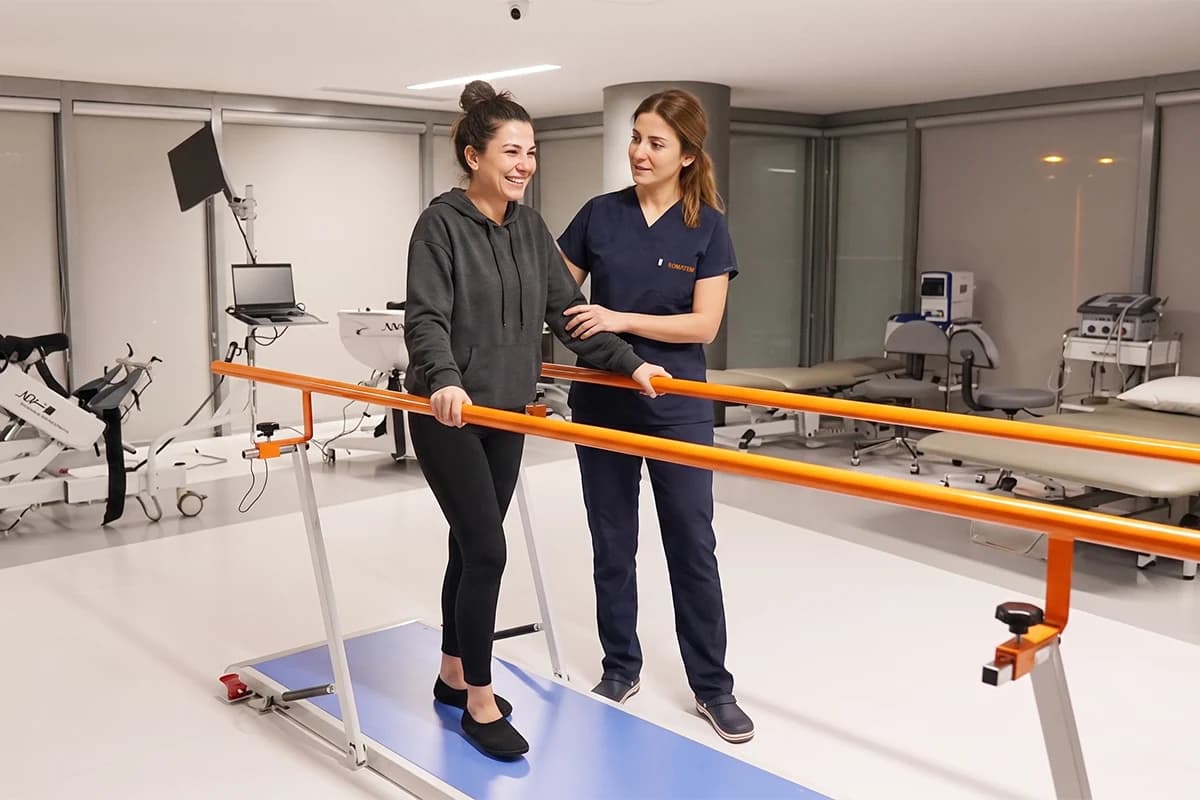
A powered exoskeleton over a treadmill that carries part of your body weight and guides your legs through a natural walking pattern, so walking can be practised long before it is possible unaided. It is most useful for people who cannot yet walk independently, and is combined with walking practice on the floor.
How robotic gait training works
A motorised exoskeleton is fitted to the legs above a treadmill, and a harness carries a set proportion of body weight. The robot then drives the hips and knees through a walking pattern while the treadmill moves underneath. Body-weight support, walking speed and how much the robot assists are each set separately; as the patient improves, support and assistance are reduced and speed is increased.
The point is repetition. Walking is relearned through many correct steps, and a therapist manually assisting a patient who cannot bear weight becomes physically exhausted well before enough repetitions are done in a session. The robot keeps delivering steps without the pattern degrading as the session goes on.
Who it is used for
Patients who cannot yet walk safely or at a useful volume unaided: after stroke, spinal cord injury, traumatic brain injury, in multiple sclerosis, and in Parkinson's disease where gait has deteriorated. It is most valuable in the window where a patient has some potential to walk but not enough strength or control to practise conventionally. It does not suit someone already walking reasonably well — for them, floor-based task practice transfers better.
It requires sufficient joint range at hip and knee, no unhealed fracture in the legs, skin intact where the cuffs sit, and cardiovascular stability for upright exercise. Bone density matters in long-standing spinal cord injury, where fracture risk during loading is real. These are checked at assessment, and a patient who does not meet them is told so rather than fitted anyway.
What the evidence supports, and what it does not
Robotic gait training combined with conventional physiotherapy improves the odds of independent walking after stroke. In the 2025 Cochrane review of 101 randomised trials with 4,224 participants, adding it to physiotherapy raised the odds of walking independently (odds ratio 1.65, 95% confidence interval 1.21 to 2.25; 51 trials, 2,148 participants; moderate-certainty evidence) — about one more person walking independently for every nine treated 1. People who were not yet walking, and those in the first three months after the stroke, appeared to benefit most 2.
The same review found no meaningful gain in walking speed or walking distance, and whether the benefit lasts after the programme ends is uncertain 1. It is not clear that it beats an equivalent amount of skilled conventional gait training in patients who can already walk 2. We do not present the robot as superior to a physiotherapist, and we do not build a programme around device time alone. It is a tool that lets us give more of the right practice, not a replacement for the practice.
What is Lokomat therapy?
The Lokomat is a treadmill-based robotic exoskeleton that supports body weight and guides the legs through a walking pattern. It allows gait training to begin before independent standing is possible, and it records every session so progression can be measured.
How a session works
The patient is supported in a harness over a treadmill with the legs attached to powered orthoses. Body weight support and guidance force are set by the therapist and reduced as ability improves. A session typically runs 30 to 45 minutes.
Body weight support commonly starts high and is reduced as tolerance improves, as is the robot's guidance force. Those two numbers, recorded each session, are a more honest record of progress than the number of sessions completed.
What it cannot do
It produces a symmetrical, guided pattern, which is useful early and limiting later. Real walking involves variability, obstacles and reacting to being off balance, so over-ground and outdoor practice has to follow.
There is also a risk of the patient becoming passive inside the device, letting the robot do the work. Modern systems vary the assistance to counter this, and a supervising therapist watching for it matters more than the setting.
Sources
- Mehrholz J, Kugler J, Pohl M, Elsner B. Electromechanical-assisted training for walking after stroke — Cochrane Database of Systematic Reviews (2025)
- Mehrholz J, Thomas S, Kugler J, Pohl M, Elsner B. Electromechanical-assisted training for walking after stroke — Cochrane Database of Systematic Reviews (2020)
- Hornby TG, Reisman DS, Ward IG, Scheets PL, et al. Clinical Practice Guideline to Improve Locomotor Function Following Chronic Stroke, Incomplete Spinal Cord Injury, and Brain Injury — Journal of Neurologic Physical Therapy (2020)
Conditions this device is used for
The 7 conditions where this device is part of a routine programme, grouped by area. It is one tool inside the plan, never the plan itself.

Devices are used inside a programme and chosen after examination — they are not booked separately.
Your path to this treatment
Nothing here is booked from a page. You send the records you have, a rehabilitation physician reads them, and you get a written answer — including when the answer is that an intensive programme will not help.
4 steps, start to finish
1.Send your records
A discharge summary from the hospital that treated the original event, and any imaging of the affected area — CT, MRI or X-ray.2.A written plan in 48 hours
A rehabilitation physician reviews the case and returns the expected duration, the recommended programme and the centre. Free, no obligation.3.Travel and admission
Where a visa is needed we issue an invitation letter and treatment confirmation naming the dates and the facility. You are met at the airport and driven to the centre by private vehicle or ambulance; a bed for one companion and interpreting during therapy are arranged.4.Treatment, then home
The programme runs, then you leave with a discharge report and a written home exercise plan. Your return journey is organised before you go, with scheduled video reviews so progress does not stop.
In their words
What patients say after a programme
Short videos filmed during therapy: a child’s rehabilitation after a brain tumour, suspended gait training after spinal cord injury, and learning to walk again after a fall. Individual results vary.
Dave Evans on his physical therapy here
Musculoskeletal physiotherapy
Paediatric rehabilitation after a brain tumour
Inside a physiotherapy session
Spinal cord injury — the rehabilitation process
Suspension-assisted gait training
Walking difficulty and restricted movement after a fall
Regaining gait and range of motion
Locations
Centres that have this device — pick one.






Questions people actually ask
About this device
Does the machine do the walking for me?
Only at the start. Assistance is reduced deliberately as capacity improves, and a session where the device does all the work achieves very little.
How many sessions are needed?
It runs five days a week within a three to six week programme, alongside conventional therapy rather than instead of it.
Is it painful?
It should not be. Harness discomfort is the usual complaint and is solved by adjustment; pain during a session means the setup needs changing.
Will it make me walk again?
The device does not determine that — the injury and the recovery do. It improves the chances of independent walking for some groups and cannot create recovery the nervous system is not capable of.
Is it worth it years after a stroke, if I can already walk?
Usually not, if the goal is faster or longer walking. A 2020 clinical practice guideline advises against robotic-assisted training for that purpose in people who walk and are more than 6 months past a stroke, incomplete spinal cord injury or brain injury, and recommends walking practice at moderate to high intensity instead 3. The guideline may not apply to people who still need substantial physical help to walk 3.



