
Upper limb and hand
Shoulder and arm robot
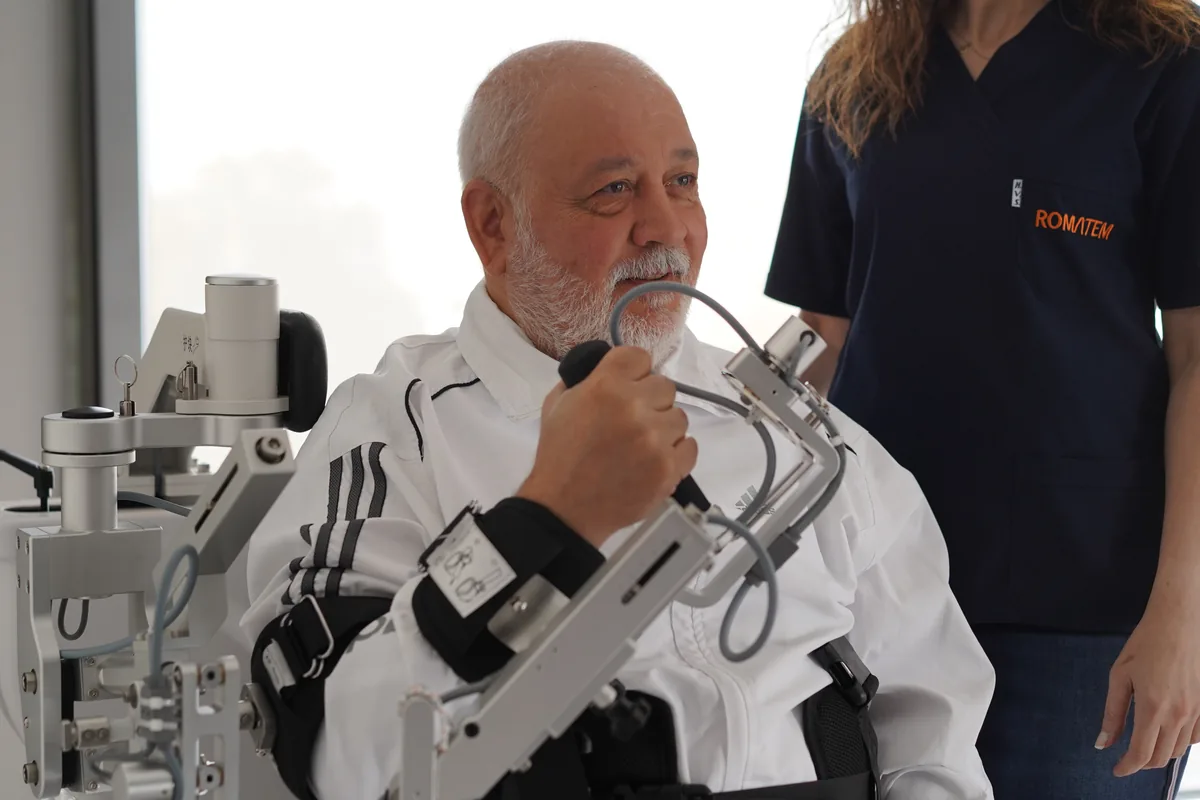
An arm support with sensors that takes the weight of the arm and turns therapy into on-screen tasks, so reaching, grasping and everyday hand movements can be trained with hundreds of repetitions per session. Support is reduced step by step as strength returns.
Weight support for the arm, so movement becomes possible
The arm rests in a spring-loaded support that offsets its own weight. A weak arm that cannot lift against gravity can often move well once gravity is removed, and this is what makes practice possible from an early stage. The amount of support is reduced step by step as strength returns.
Movements drive tasks on a screen — reaching, grasping, sorting — so the patient is doing an activity rather than performing an exercise, and the repetition count climbs accordingly. The system records range, speed and smoothness for every repetition, so change is measured rather than estimated.
Who it is used for
Arm and hand weakness after stroke, traumatic brain injury, spinal cord injury at cervical level, in multiple sclerosis, and in children with cerebral palsy affecting the upper limb. It suits patients across a wide range of severity, because the level of support can be set very high at the start.
The arm needs enough passive range at the shoulder to be positioned safely, and a painful subluxed shoulder is treated before loading it into the device.
What it changes and what it does not
Upper limb recovery after stroke is slower and less complete than lower limb recovery, and no device changes that. What arm robotics does reliably is increase the number of quality repetitions per session, and repetition volume is one of the few things consistently associated with better outcomes.
Gains in the device transfer to real tasks only if real tasks are trained too. We pair robot time with task practice using actual objects, because a patient who improves on screen and cannot pick up a cup has not improved.
Repetitions the arm could not otherwise perform
The device supports the weight of the arm, so movement becomes possible for someone who cannot lift against gravity. Hundreds of guided repetitions per session become achievable where manual therapy manages a fraction.
Evidence supports robot-assisted arm training as an addition to conventional therapy rather than a replacement, and that is how it is scheduled here.
How much difference does an arm robot make?
A modest one, on average. A Cochrane review of 45 trials with 1,619 people after stroke found small improvements in arm function, arm strength and daily activities with robot-assisted arm training, and adverse events were rare 2. The evidence was rated high quality, but the trials differed widely in training dose, device and patients 2. A later meta-analysis of 46 trials found that the gains were present at the end of treatment but not at follow-up, and appeared only when training added up to more than 15 hours and the patient took an active part 3.
The largest single trial, with 770 people with moderate or severe arm limitation, found that training with a different arm robot did not improve arm function compared with usual care 4.
Sources
- Efficacy of Robot-Assisted Training on Rehabilitation of Upper Limb Function in Patients With Stroke: A Systematic Review and Meta-analysis — Archives of Physical Medicine and Rehabilitation (2023)
- Mehrholz J, Pohl M, Platz T, Kugler J, et al. Electromechanical and robot-assisted arm training for improving activities of daily living, arm function, and arm muscle strength after stroke — Cochrane Database of Systematic Reviews (2018)
- Zhang L, Jia G, Ma J, Wang S, et al. Short and long-term effects of robot-assisted therapy on upper limb motor function and activity of daily living in patients post-stroke: a meta-analysis of randomized controlled trials — Journal of NeuroEngineering and Rehabilitation (2022)
- Rodgers H, Bosomworth H, Krebs HI, van Wijck F, et al. Robot assisted training for the upper limb after stroke (RATULS): a multicentre randomised controlled trial — The Lancet (2019)
- Rémy-Néris O, Le Jeannic A, Dion A, Médée B, et al. Additional, mechanized upper limb self-rehabilitation in patients with subacute stroke: the REM-AVC randomized trial — Stroke (2021)
Conditions this device is used for
The 9 conditions where this device is part of a routine programme, grouped by area. It is one tool inside the plan, never the plan itself.

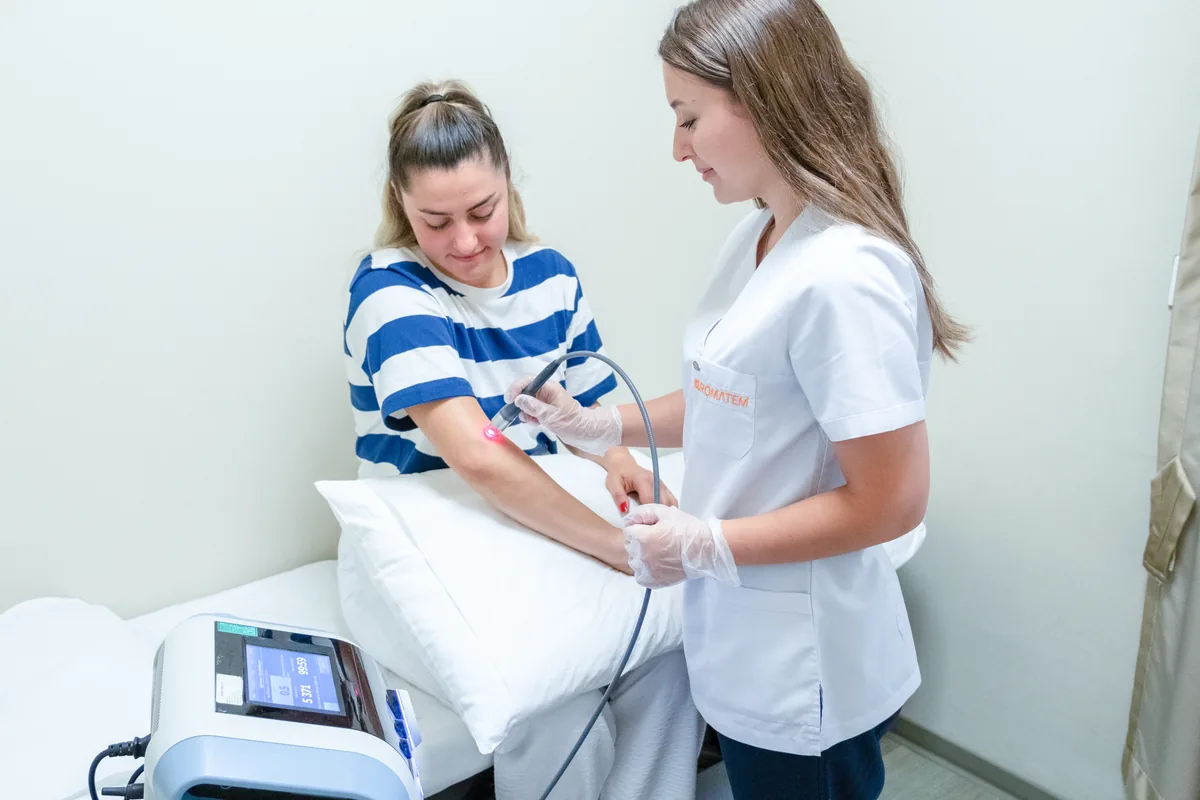

Devices are used inside a programme and chosen after examination — they are not booked separately.
Your path to this treatment
Nothing here is booked from a page. You send the records you have, a rehabilitation physician reads them, and you get a written answer — including when the answer is that an intensive programme will not help.
4 steps, start to finish
1.Send your records
A discharge summary from the hospital that treated the original event, and any imaging of the affected area — CT, MRI or X-ray.2.A written plan in 48 hours
A rehabilitation physician reviews the case and returns the expected duration, the recommended programme and the centre. Free, no obligation.3.Travel and admission
Where a visa is needed we issue an invitation letter and treatment confirmation naming the dates and the facility. You are met at the airport and driven to the centre by private vehicle or ambulance; a bed for one companion and interpreting during therapy are arranged.4.Treatment, then home
The programme runs, then you leave with a discharge report and a written home exercise plan. Your return journey is organised before you go, with scheduled video reviews so progress does not stop.
In their words
What patients say after a programme
Short videos filmed during therapy: a child’s rehabilitation after a brain tumour, suspended gait training after spinal cord injury, and learning to walk again after a fall. Individual results vary.
Dave Evans on his physical therapy here
Musculoskeletal physiotherapy
Paediatric rehabilitation after a brain tumour
Inside a physiotherapy session
Spinal cord injury — the rehabilitation process
Suspension-assisted gait training
Walking difficulty and restricted movement after a fall
Regaining gait and range of motion
Locations
Centres that have this device — pick one.










Questions people actually ask
About this device
Will it restore hand function?
It improves arm and hand function for many people, and how much depends on how much voluntary movement there is to build on. Where there is none, expectations are set differently and we say so.
Does it hurt?
It should reduce shoulder pain rather than cause it, because the weight of the arm is supported. Pain means the setup needs adjusting.
What if my arm is very stiff?
Spasticity is treated first or alongside. A limb that cannot be positioned cannot be trained, and injecting or stretching comes before loading the sessions.
Is it better than doing arm exercises without the device?



