

Medical condition
Shoulder Dislocation and Instability
The shoulder trades stability for range, which is why it dislocates more than any other joint. After a first traumatic dislocation the risk of it happening again is strongly related to age — highest in young athletes, low in older adults. Rehabilitation differs completely between traumatic and atraumatic instability.

Two different problems with one name
Traumatic instability follows a specific injury that tore the labrum or capsule. Atraumatic instability occurs in a shoulder that was always loose, often in both shoulders, without a clear injury. The two are treated differently: for atraumatic instability, exercise-based rehabilitation is the recommended first treatment, and surgery is generally kept for a shoulder that remains unstable after it 6.
Atraumatic instability is treated with a long, patient rehabilitation programme retraining the muscles that position the shoulder blade and control the joint, although no randomised trial has yet compared exercise with no treatment or usual care 7. It takes months, and the patients who do well are the ones told that honestly at the start.
After a first traumatic dislocation
Young athletes in contact sport have a high recurrence rate with rehabilitation alone, and early stabilisation surgery is a reasonable discussion rather than a last resort. Older patients rarely re-dislocate but frequently have a rotator cuff tear alongside, which is the thing actually limiting them.
Nerve injury at the time of dislocation, particularly the axillary nerve, is checked rather than assumed absent — it changes the rehabilitation timeline substantially.
What rehabilitation works on
Rotator cuff and scapular control first, then strength through range, then position sense at speed and under fatigue. Overhead and behind-the-body positions are reintroduced deliberately and late, because that is where the shoulder is least protected.
Age at first dislocation predicts what happens next
A traumatic first dislocation in someone under twenty carries a high rate of recurrence, and the risk falls substantially with age at first injury 1.
That age pattern drives the decision: early surgical stabilisation is discussed more readily in a young athlete than in someone older, where rehabilitation alone succeeds more often.
Is surgery better than rehabilitation after a first dislocation?
For young, active people, surgery lowers the chance of the shoulder coming out again. In randomised trials of first-time dislocation in young adults, with an average age in the early twenties, 6.3% of those who had surgical stabilisation had further instability, compared with 46.6% of those treated with a sling alone 2.
Rehabilitation alone is still a reasonable first choice for many people: a network meta-analysis of 22 randomised trials found moderate-quality evidence that about half of those managed with physiotherapy had no further dislocation, and that surgery can be considered if instability becomes chronic 3. Immobilising the arm in external rather than internal rotation showed no benefit, although that evidence is of low or very low quality 3.
For athletes: when is it safe to return to sport?
Returning in the same season without surgery is possible, but another episode is common. In a prospective study of 45 college contact athletes treated with rapid rehabilitation and no immobilisation, 73% returned to play after a median of 5 days lost, yet only 27% completed the season without the shoulder becoming unstable again 4.
A European expert consensus bases the return-to-sport decision on pain-free full range of motion, a stable shoulder, restored strength and sport-specific readiness, criteria typically reached between four and six months, depending on the procedure and the demands of the sport 5.
Frequently asked questions
Will my shoulder dislocate again?
It depends heavily on age at first dislocation and on activity. Recurrence is common in young athletes and much less so in older first-time dislocations.
Do I need surgery after one dislocation?
Not automatically. In young contact athletes it is discussed early; otherwise a structured rehabilitation programme is the first line.
What is atraumatic instability?
A shoulder that subluxes without significant injury, often in people with generalised joint laxity. Rehabilitation is the recommended first treatment and surgery is generally kept for a shoulder that stays unstable despite it, so distinguishing it from traumatic instability matters 6.
How long is rehabilitation?
Recovery from a traumatic dislocation managed conservatively takes time, and longer after surgical stabilisation.
Which movements should I avoid early?
The combined position of abduction and external rotation — arm out and rotated back — is the provocative position for the common anterior instability.
Sources
- Age- and time-specific management of traumatic anterior shoulder instability: The 2024 ESSKA-ESA formal consensus. Part 1: History taking, physical exam and imaging studies — Knee Surgery, Sports Traumatology, Arthroscopy (2026)
- Belk JW, Wharton BR, Houck DA, Bravman JT, et al. Shoulder stabilization versus immobilization for first-time anterior shoulder dislocation: a systematic review and meta-analysis of level 1 randomized controlled trials — The American Journal of Sports Medicine (2023)
- Kavaja L, Lähdeoja T, Malmivaara A, Paavola M. Treatment after traumatic shoulder dislocation: a systematic review with a network meta-analysis — British Journal of Sports Medicine (2018)
- Dickens JF, Owens BD, Cameron KL, Kilcoyne K, et al. Return to play and recurrent instability after in-season anterior shoulder instability: a prospective multicenter study — The American Journal of Sports Medicine (2014)
- Alentorn-Geli E, Brilakis E, Ângelo AC, Bøe B, et al. Age- and time-specific management of traumatic anterior shoulder instability: The 2024 ESSKA-ESA Formal Consensus. Part 2: Treatment and return to sports — Knee Surgery, Sports Traumatology, Arthroscopy (2026)
- Warby SA, Pizzari T, Ford JJ, Hahne AJ, et al. Exercise-based management versus surgery for multidirectional instability of the glenohumeral joint: a systematic review — British Journal of Sports Medicine (2016)
- Karasuyama M, Imai T, Gotoh M, Kawakami J, et al. Exercise for multidirectional instability of the shoulder — Cochrane Database of Systematic Reviews (2026)
Which therapies would I actually receive?
A therapy is a single method used inside a programme. It is measured in sessions and is not sold separately.
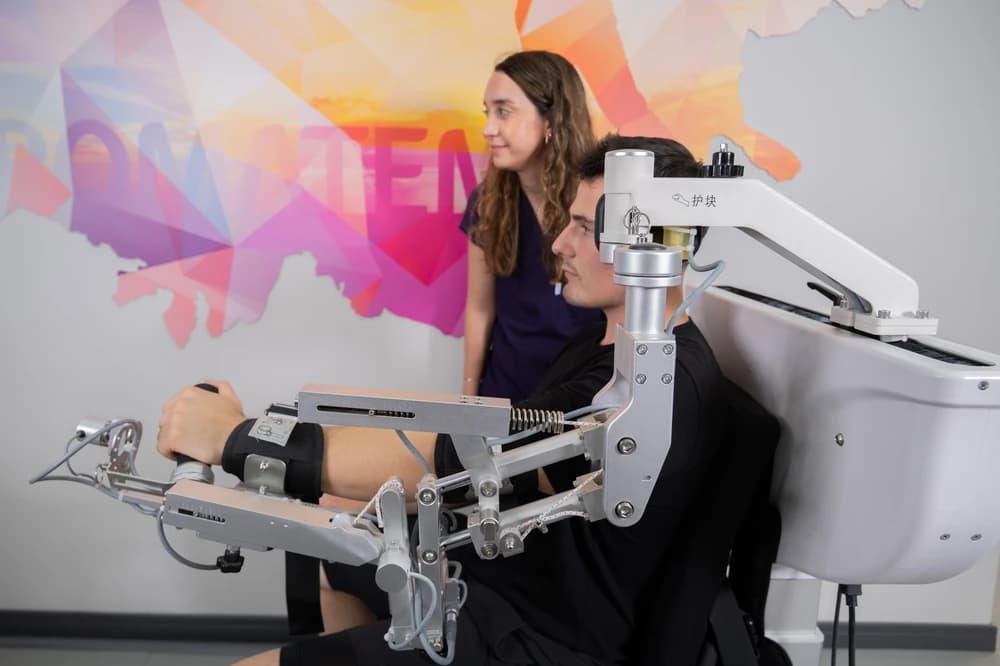
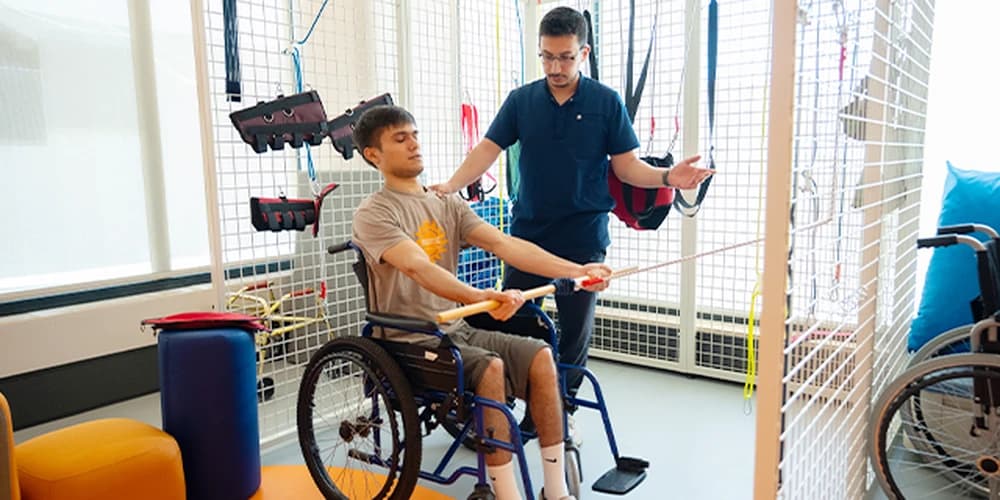
Technologies we use

Locations
Where you can receive this treatment




Related articles
Sports Will my shoulder dislocate again after the first time?
It depends mainly on age, sex and joint laxity. Younger people face a substantially higher chance of the shoulder dislocating again after a first traumatic injury. With physiotherapy alone, a substantial proportion of people do not dislocate again. Surgery to repair the torn labrum reduces the risk of further dislocation.Read moreNeurological How long does it take to recover from a stroke?
Most recovery after a stroke happens in the early months, when the brain is most able to reorganise, and it continues more slowly for a longer period after that. How far someone gets depends mainly on how severe the stroke was, where it happened and how much active therapy follows.Read moreNeurological Can you walk again after a stroke?
Many people walk again after a stroke, including many who cannot stand at first. The chances are highest when some leg movement returns early and when walking practice starts as soon as it is safe. Walking often comes back before full arm recovery, sometimes with a stick, splint or other support.Read more



