
Upper limb and hand
Hand and finger robot
A robot that moves each finger individually, from fully assisted movement to resistance training, for hands that cannot yet open or grip on their own. It also reads the force each finger produces, which serves as on-screen feedback and as an objective measure of progress.
Individual fingers, individually driven
Each fingertip attaches to its own magnetic slider. The device can move a finger passively, assist a movement the patient starts, or resist it — and it can do a different one of those for each finger in the same session. That granularity matters because after stroke the fingers rarely recover evenly.
It also reads the force each finger produces, which is used both as biofeedback on screen and as an objective measure. A patient who cannot yet produce visible movement can often produce measurable force, and seeing that on screen is the difference between a session that feels pointless and one that does not.
Who it is used for
Hand and finger impairment after stroke and brain injury, after tendon and nerve injury, after hand surgery, in cervical spinal cord injury, and in children with cerebral palsy. It is used from the stage where there is no active movement at all, in passive mode, through to resisted strengthening.
Fixed contracture that prevents the fingers from being positioned, unhealed fracture, or open wounds on the fingers rule it out until they are addressed.
The limits
Hand function is the hardest thing to recover after stroke and the area where results are most variable. This device improves the quality and quantity of hand practice; it does not overcome a severely damaged corticospinal tract.
We assess hand potential honestly at the start — including whether the realistic goal is functional grasp or a stable, pain-free, non-contracted hand — and we say which one we are working towards.
Fingers, individually
The device moves each finger independently, which allows training of grasp and release in a hand with minimal voluntary movement. It also measures finger force, so weakness is quantified rather than described.
Hand recovery is the slowest and least complete part of arm recovery after stroke, and honesty about that matters more here than anywhere else in the programme.
What does the research show for hand robots?
Most of the evidence comes from arm robotics as a whole. A Cochrane review of 45 trials with 1,619 people after stroke, covering devices that support shoulder, elbow or hand movements, found small improvements in arm function, strength and daily activities, and adverse events were rare 1. The authors add that it is still not known when, or how often, these devices should be used 1.
Trials of finger and hand robots specifically are few and small. A meta-analysis found only five randomised trials with 149 people; robot training improved motor scores compared with control therapy, but the authors note how few studies there are and call for more before firm conclusions are drawn 2.
Sources
- Mehrholz J, Pohl M, Platz T, Kugler J, et al. Electromechanical and robot-assisted arm training for improving activities of daily living, arm function, and arm muscle strength after stroke — Cochrane Database of Systematic Reviews (2018)
- Moggio L, de Sire A, Marotta N, Demeco A, et al. Exoskeleton versus end-effector robot-assisted therapy for finger-hand motor recovery in stroke survivors: systematic review and meta-analysis — Topics in Stroke Rehabilitation (2022)
Conditions this device is used for
The 5 conditions where this device is part of a routine programme, grouped by area. It is one tool inside the plan, never the plan itself.
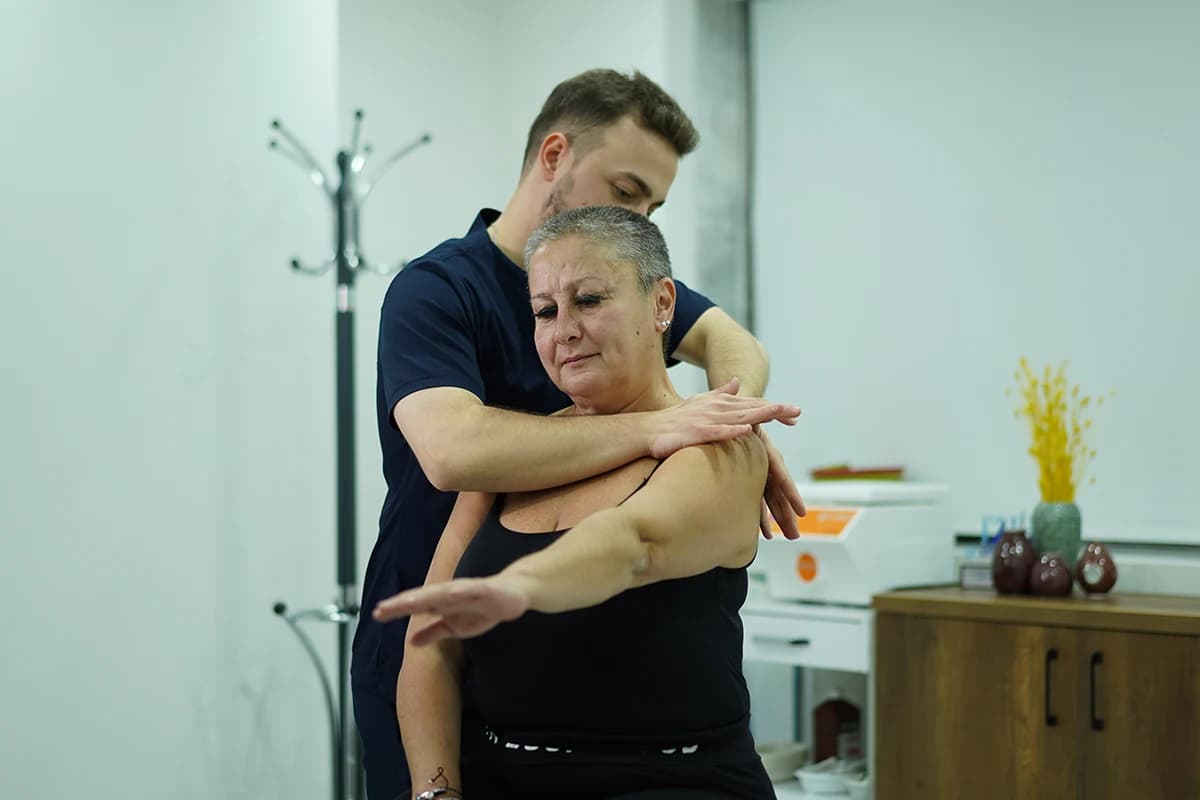
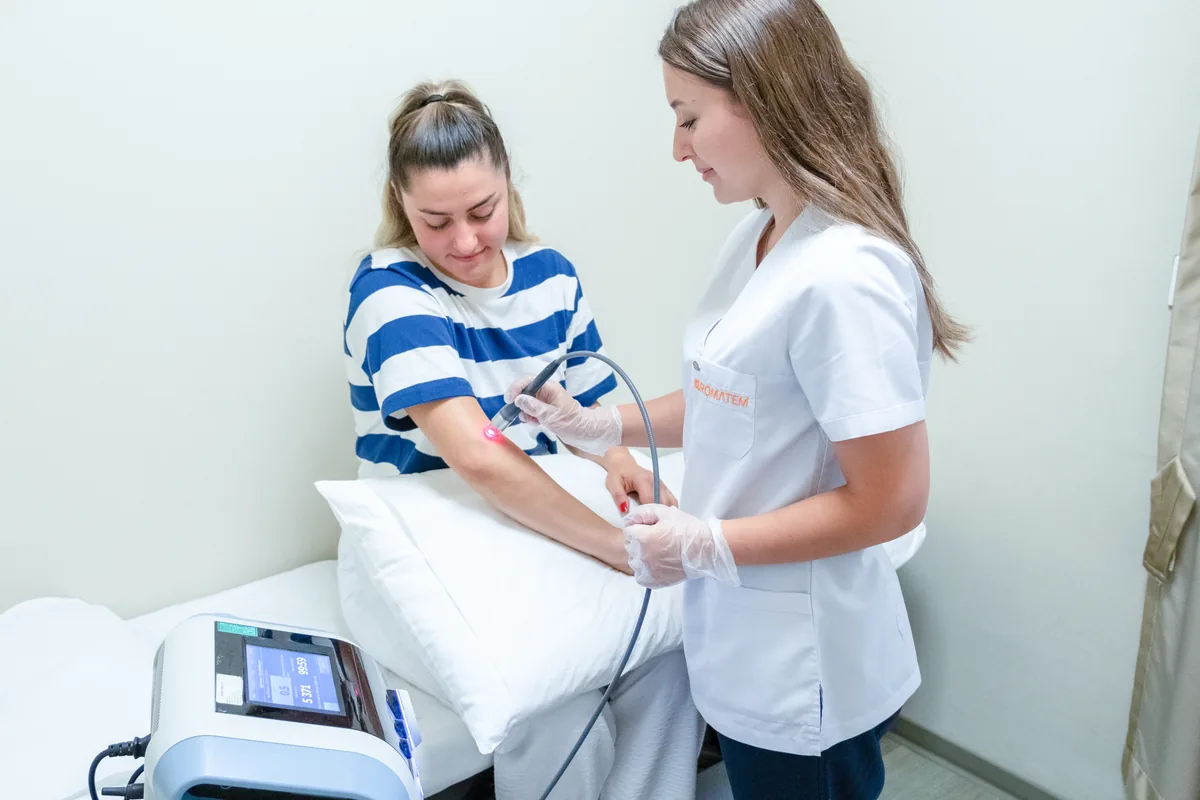
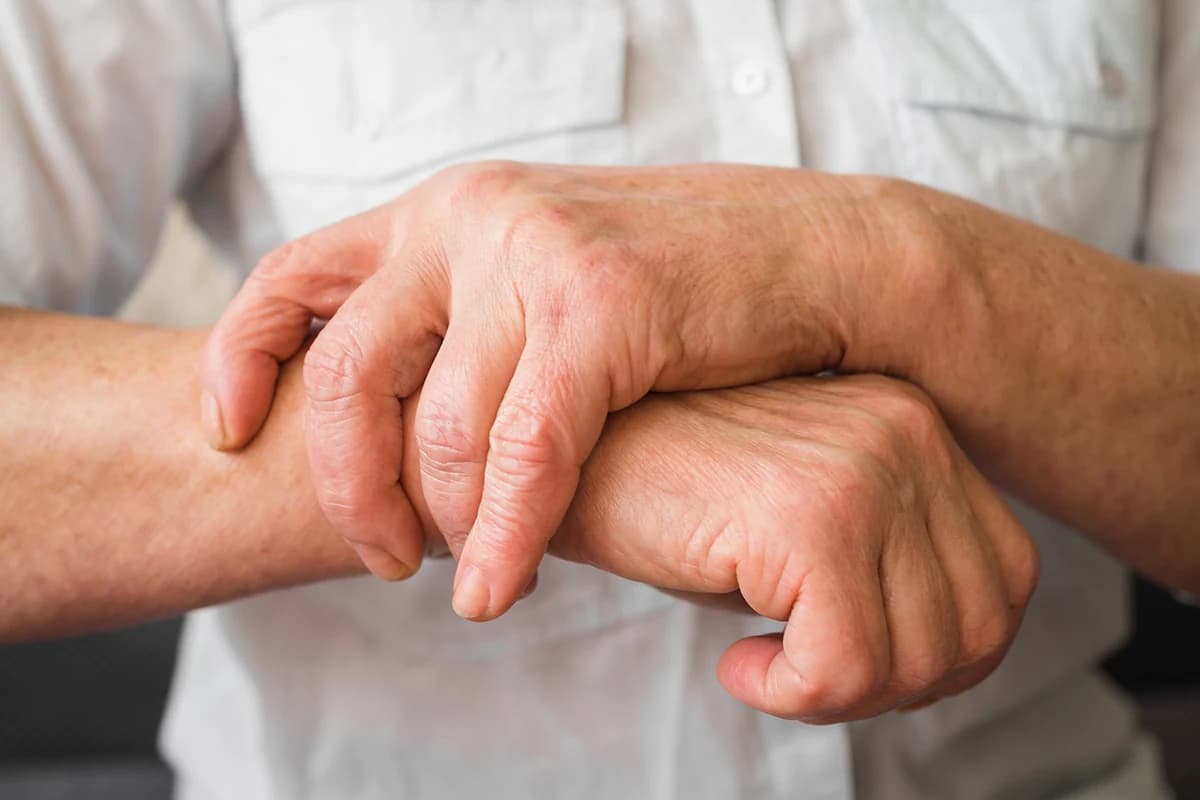
Devices are used inside a programme and chosen after examination — they are not booked separately.
Your path to this treatment
Nothing here is booked from a page. You send the records you have, a rehabilitation physician reads them, and you get a written answer — including when the answer is that an intensive programme will not help.
4 steps, start to finish
1.Send your records
A discharge summary from the hospital that treated the original event, and any imaging of the affected area — CT, MRI or X-ray.2.A written plan in 48 hours
A rehabilitation physician reviews the case and returns the expected duration, the recommended programme and the centre. Free, no obligation.3.Travel and admission
Where a visa is needed we issue an invitation letter and treatment confirmation naming the dates and the facility. You are met at the airport and driven to the centre by private vehicle or ambulance; a bed for one companion and interpreting during therapy are arranged.4.Treatment, then home
The programme runs, then you leave with a discharge report and a written home exercise plan. Your return journey is organised before you go, with scheduled video reviews so progress does not stop.
In their words
What patients say after a programme
Short videos filmed during therapy: a child’s rehabilitation after a brain tumour, suspended gait training after spinal cord injury, and learning to walk again after a fall. Individual results vary.
Dave Evans on his physical therapy here
Musculoskeletal physiotherapy
Paediatric rehabilitation after a brain tumour
Inside a physiotherapy session
Spinal cord injury — the rehabilitation process
Suspension-assisted gait training
Walking difficulty and restricted movement after a fall
Regaining gait and range of motion
Locations
Centres that have this device — pick one.










Questions people actually ask
About this device
Can it help a hand with no movement at all?
It can maintain range, reduce stiffness and provide sensory input, and in some people assist very early movement. It does not create voluntary control where the pathway is absent.
Is it used after hand surgery?
Sometimes, once the surgeon permits movement. The protocol governs and we work to it rather than around it.
How is progress measured?
Finger force and range recorded by the device, alongside functional hand tests. Both go into the discharge document.
Does it work for children?
Hand size is the limiting factor; it is used in older children where the device fits.
Is it safe?
Generally, yes. In the Cochrane review of robot-assisted arm and hand training, adverse events such as injury or pain were seldom reported, and people dropped out no more often than with other therapy 1. The precautions are local: fixed contracture, an unhealed fracture or open wounds on the fingers have to be dealt with first.



