

Medical condition
Mixed and Undifferentiated Connective Tissue Disease
Some patients have features of more than one autoimmune disease — lupus, scleroderma, myositis — without fitting neatly into any of them. Rehabilitation does not depend on settling the label: it is planned from what is actually affected, most often hand function, joint range, exercise capacity and fatigue.
Why the label is often unsettled
Autoimmune diseases overlap. A patient may have Raynaud's phenomenon, swollen fingers, joint pain and a positive antibody test without meeting full criteria for any single condition. Some evolve into a defined disease over years; others never do.
This is genuinely uncertain territory, and we would rather say so than imply a precision the field does not have.
Hands come first
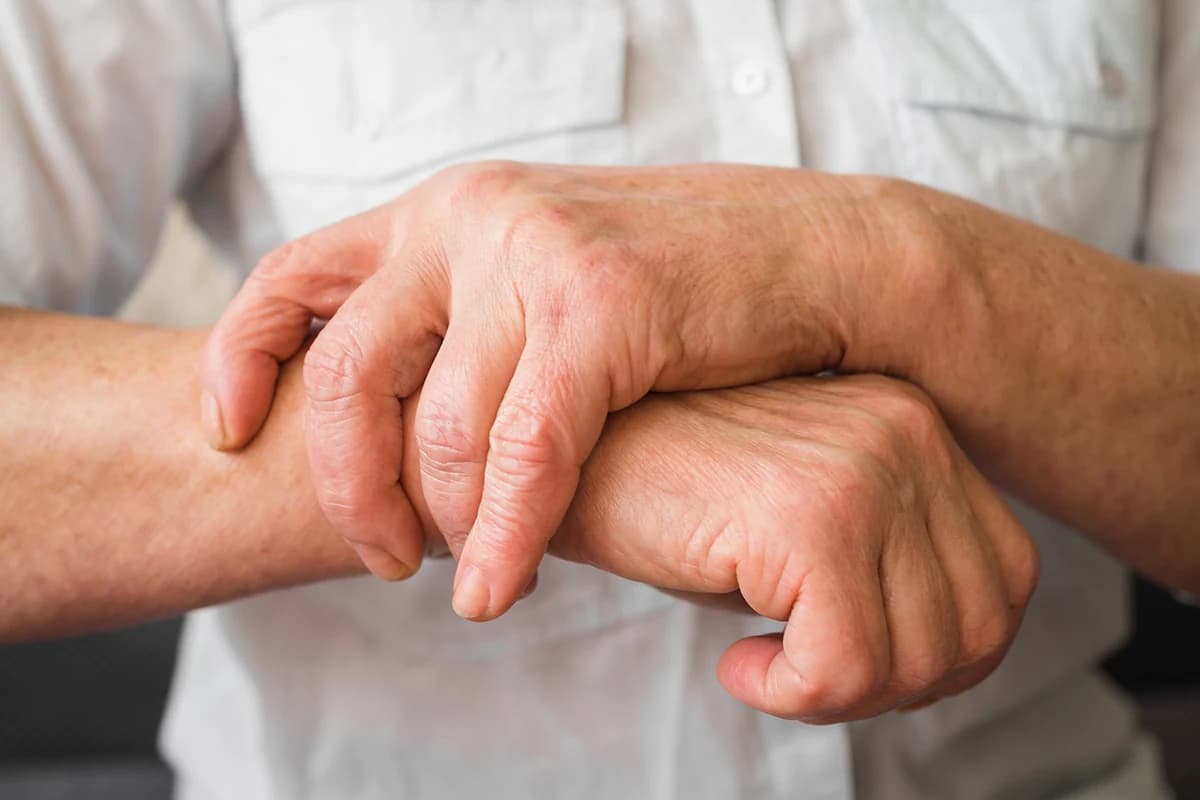
Skin tightening, swollen fingers and Raynaud's attacks reduce grip and dexterity early, and hand function is what patients notice losing. Occupational therapy, range-of-movement work, splinting where indicated and warmth management form the core of the programme.
Raynaud's changes how sessions are run: cold rooms, cold water and cold equipment provoke attacks, so hand work is done warm.
Lungs set the ceiling on exercise
Interstitial lung disease and pulmonary hypertension are the complications that most limit what a patient can safely do. Where either is suspected, exercise capacity is assessed formally and the programme is built to that result rather than to a standard protocol.
Where inflammatory muscle disease is part of the picture, supervised strength training does not have to wait for muscle enzymes to settle: in pooled myositis studies, exercise improved strength without raising creatine kinase at all stages of disease studied 5.
Lungs set the ceiling on what is achievable
Interstitial lung disease occurs across several of these conditions and it determines exercise capacity more than muscle or joints do.
This is why breathlessness is investigated rather than attributed to deconditioning, and why the exercise prescription is set from measured capacity rather than from symptoms alone.
Will it turn into lupus or another defined disease?
For most people it does not. Pooling six cohorts, a systematic review found that 28% of people with undifferentiated connective tissue disease developed a defined disease, most often lupus or rheumatoid arthritis, usually within five to six years, and that 18% of the others went into remission 3. In a cohort of 504 patients followed for at least five years, 20.2% progressed, most often to Sjögren’s syndrome or lupus, and anti-dsDNA or anti-Ro antibodies made progression more likely 4.
Outcomes in the pooled cohorts were generally good, with survival above 90% at ten years 3. Regular review still matters, because a change of diagnosis can change both the treatment and what rehabilitation needs to plan for.
What do hand exercises and keeping warm achieve?
Most of this evidence comes from systemic sclerosis, which shares skin tightening and Raynaud’s phenomenon with these overlap conditions. European recommendations advise hand and mouth exercises in systemic sclerosis, and support for physical exercise, stopping smoking and avoiding cold exposure in both lupus and systemic sclerosis 1. In the review behind them, exercise programmes improved hand function, mouth opening and aerobic capacity in systemic sclerosis, although the studies were of mixed quality 2.
These measures complement medication for Raynaud’s phenomenon, lung involvement or muscle disease; they do not replace it 1.
Frequently asked questions
Why is the diagnosis often unclear?
These conditions overlap, and features can be present without meeting full criteria for any single one. Treatment is directed at the problems present rather than at the label.
Why do the hands get most attention?
Skin tightening, Raynaud’s phenomenon and joint contracture affect hand function early, and hand function determines a large part of independence.
What helps Raynaud’s?
Warmth, avoiding cold exposure, stopping smoking, and medication where needed. Cold rooms and pools are planned around it.
Should breathlessness be investigated?
Yes, rather than assumed to be deconditioning. Interstitial lung disease is common in this group and it changes the programme.
Sources
- Parodis I, Girard-Guyonvarc'h C, Arnaud L, Distler O, et al. EULAR recommendations for the non-pharmacological management of systemic lupus erythematosus and systemic sclerosis — Annals of the Rheumatic Diseases (2024)
- Parodis I, Gomez A, Tsoi A, Chow JW, et al. Systematic literature review informing the EULAR recommendations for the non-pharmacological management of systemic lupus erythematosus and systemic sclerosis — RMD Open (2023)
- Rubio J, Kyttaris VC. Undifferentiated connective tissue disease: comprehensive review — Current Rheumatology Reports (2023)
- Apaydin H, Sağirkaya ŞÇ, Polat B, Armağan B, et al. Can baseline features predict progression to defined connective tissue disease? Insights from a minimum 5-year follow-up study of 504 patients with undifferentiated connective tissue disease: a retrospective study — Modern Rheumatology (2026)
- da Silva BISL, Dos Santos BRJ, Carneiro JA, Silva FMFE, et al. Physical exercise for dermatomyositis and polymyositis: a systematic review and meta-analysis — Clinical Rheumatology (2022)
Which therapies would I actually receive?
A therapy is a single method used inside a programme. It is measured in sessions and is not sold separately.
Technologies we use


Locations
Where you can receive this treatment



Related articles
Neurological How long does it take to recover from a stroke?
Most recovery after a stroke happens in the early months, when the brain is most able to reorganise, and it continues more slowly for a longer period after that. How far someone gets depends mainly on how severe the stroke was, where it happened and how much active therapy follows.Read moreNeurological Can you walk again after a stroke?
Many people walk again after a stroke, including many who cannot stand at first. The chances are highest when some leg movement returns early and when walking practice starts as soon as it is safe. Walking often comes back before full arm recovery, sometimes with a stick, splint or other support.Read moreNeurological Will my arm and hand recover after a stroke?
Arm and hand recovery after a stroke varies more than walking recovery. Early return of some shoulder or finger movement makes useful recovery much more likely. Repeated, meaningful practice of reaching, grasping and releasing is what drives improvement, and even a partly recovered hand can be trained to help with daily tasks.Read more



