
Day programme
Paediatric intensive rehabilitation
Block therapy for children with cerebral palsy or developmental motor disorders. Two to four week intensive cycles, repeated two or three times a year, with the parent trained alongside the child. The block builds new ability; the home programme between blocks is what holds it.
Blocks rather than continuous therapy
Intensive blocks of two to four weeks, repeated two or three times a year, concentrate practice into set periods, although in most controlled studies of young children, intensive and conventional therapy have produced similar improvements 2. The block establishes new ability; the home programme between blocks is what holds it.
This is why the parent trains alongside the child throughout, rather than waiting outside. What happens between blocks determines whether the block was worth it.
What a child's day contains
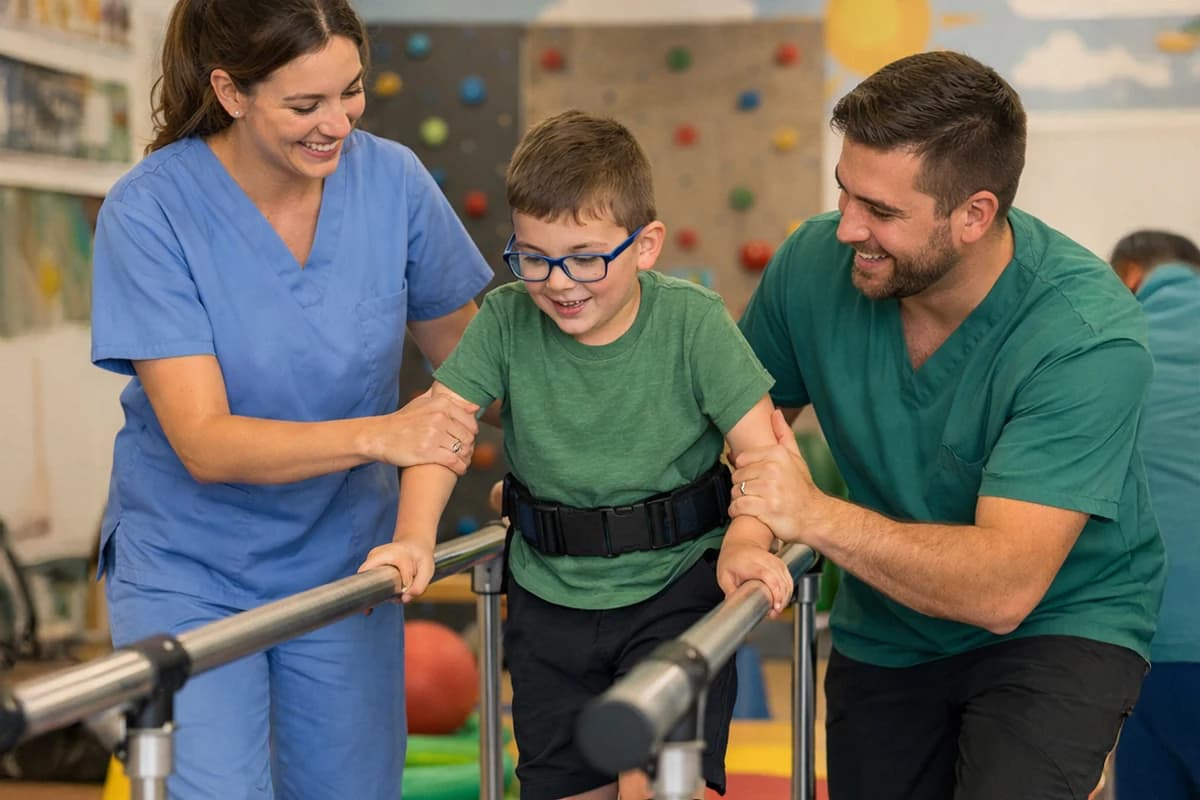
Three to four sessions daily, structured as play. Gross motor work matched to the child's current level rather than their age, hand function, robotic gait training scaled to a child's body, game-based virtual reality, hydrotherapy, and speech or occupational therapy where indicated.
Session length is set by attention rather than by protocol. A twenty-minute session a child engages with is worth more than a forty-minute session they resist.
Who it is for
Cerebral palsy, acquired brain injury, spinal cord injury, neuromuscular conditions, developmental motor delay, and brachial plexus injury. Age from around two years, though the specific technologies have their own size requirements.
Assessment before travel establishes which components are appropriate. Robotic gait training, for instance, depends on leg length and hip stability rather than on age.
What we will tell you honestly
What we think is achievable in the next twelve months, based on the assessment rather than on what you would like to hear — and when we think a block will not add enough to justify the travel and the cost.
Rehabilitation improves function. It does not remove cerebral palsy, and any programme that implies otherwise is selling something.
The parent is trained, not just informed
A child spends a few weeks here and the rest of the year at home. What the parent can do — handling, positioning, the home programme, how to make therapy part of daily routine — determines what the block is worth.
Parents attend the sessions that teach these things and practise them under supervision. This is the part of the programme most likely to be skipped elsewhere and most likely to determine the result.
School, siblings and the cost to the family
An intensive block interrupts school and separates families, and that cost is real. We plan blocks around school holidays where possible and we are honest when the timing of a block matters less than its content.
Where a family cannot manage repeated blocks, we say what a single block can and cannot achieve rather than encouraging a schedule they cannot sustain.
What does the research say about intensive therapy for cerebral palsy?
An international clinical practice guideline on improving physical function in cerebral palsy draws on three systematic reviews, 30 randomised trials and five before-after studies 1. To reach functional goals, it recommends four ingredients: goals chosen by the child and family, practice of whole tasks in real-life settings, support that empowers the family, and a team approach 1.
Evidence on intensity itself is less clear-cut. A systematic review of 38 controlled studies in young children found that in most of them, intensive training produced improvements similar to conventional therapy or to another intensive approach, while pooled analyses supported constraint-induced movement therapy for hand function 2. That puts the weight on what is practised and whether it continues at home, rather than on hours alone.
Sources
- Jackman M, Sakzewski L, Morgan C, Boyd RN, et al. Interventions to improve physical function for children and young people with cerebral palsy: international clinical practice guideline — Developmental Medicine & Child Neurology (2022)
- Tinderholt Myrhaug H, Østensjø S, Larun L, Odgaard-Jensen J, et al. Intensive training of motor function and functional skills among young children with cerebral palsy: a systematic review and meta-analysis — BMC Pediatrics (2014)
Conditions this programme treats
The 4 conditions this programme is built for, grouped by area.

The programme is chosen after a rehabilitation physician has read your records — not from this page.
Your path to this treatment
Nothing here is booked from a page. You send the records you have, a rehabilitation physician reads them, and you get a written answer — including when the answer is that an intensive programme will not help.
4 steps, start to finish
1.Send your records
A discharge summary from the hospital that treated the original event, and any imaging of the affected area — CT, MRI or X-ray.2.A written plan in 48 hours
A rehabilitation physician reviews the case and returns the expected duration, the recommended programme and the centre. Free, no obligation.3.Travel and admission
Where a visa is needed we issue an invitation letter and treatment confirmation naming the dates and the facility. You are met at the airport and driven to the centre by private vehicle or ambulance; a bed for one companion and interpreting during therapy are arranged.4.Treatment, then home
The programme runs, then you leave with a discharge report and a written home exercise plan. Your return journey is organised before you go, with scheduled video reviews so progress does not stop.
In their words
What patients say after a programme
Short videos filmed during therapy: a child’s rehabilitation after a brain tumour, suspended gait training after spinal cord injury, and learning to walk again after a fall. Individual results vary.
Dave Evans on his physical therapy here
Musculoskeletal physiotherapy
Paediatric rehabilitation after a brain tumour
Inside a physiotherapy session
Spinal cord injury — the rehabilitation process
Suspension-assisted gait training
Walking difficulty and restricted movement after a fall
Regaining gait and range of motion
Locations
Where this programme runs — pick a centre.



Questions people actually ask
About this programme
How often should blocks be repeated?
Commonly two or three times a year, adjusted to the child's goals and growth. The interval matters less than what happens at home between blocks.
Is my child too young to start?
Rarely. Early intervention takes advantage of a developing nervous system, and the programme is adapted to age — for very young children most of it is delivered through play and through the parent.
Will this cure cerebral palsy?
No. Cerebral palsy is a permanent condition and no programme changes that. What changes is function, independence and the prevention of secondary problems such as contracture and hip displacement — which is a great deal, and it is what we measure.
Does the child need to be able to cooperate?
Not in an adult sense. Therapists work with very young children and with children who have significant cognitive involvement; the approach changes rather than the eligibility.
Can siblings and both parents come?
A bed for one parent is provided in the child's room, and we can advise on arrangements for the wider family. Practically, one parent attending consistently and learning the programme matters more than everyone being present.



