
Medical condition
Kyphosis and Flat Back
Kyphosis is an increased forward curve of the upper spine; flat back is the loss of the normal lumbar curve. A flexible curve that the patient can correct responds to exercise. A structural curve — from Scheuermann disease or vertebral fracture — does not straighten with exercise, and treatment targets pain and function instead.
Flexible or structural — the whole plan turns on this
If the curve corrects when the patient extends the spine or lies flat, it is postural and exercise changes it. If it does not, the vertebrae themselves are wedged and no amount of strengthening will realign them.
The assessment establishes which it is before any programme starts. Promising posture correction to a patient with a structural curve is a common and avoidable dishonesty.
When a new curve appears in an older adult
An increasing kyphosis with height loss in an older adult can mean osteoporotic vertebral fractures, often silent ones, so they are looked for rather than assumed 1. The curve alone does not prove them: in a community study of 1,407 adults aged 50 to 96, only 36.2% of men and 36.9% of women with the most pronounced curves had a thoracic vertebral fracture 1. Where fractures are found or suspected, the priority changes entirely: bone density assessment and osteoporosis treatment come first, and the exercise programme is adapted to avoid loaded forward bending.
Spinal traction and end-range manipulation are not used where osteoporosis is established or suspected.
What the exercise programme contains
Thoracic extension mobility, strengthening of the spinal extensors and scapular muscles, hip flexor and pectoral flexibility, and retraining how the patient sits and works. Results are measured against a postural assessment rather than against how the patient feels they look.
In adolescents with Scheuermann disease, bracing during growth is a specialist decision and exercise is an addition to it, not a replacement.
A new curve in an older adult is a different question
Increasing thoracic curvature in later life is often blamed on osteoporotic fractures, yet many of the older adults most affected have no vertebral fracture 2. In a large community study, degenerative disc disease was the finding most often associated with the curve 1.
The assessment therefore covers bone density, fracture risk and back extensor strength, and loaded forward bending is removed from the exercise programme wherever bone is fragile.
Does kyphosis cause back pain?
Not necessarily. In a population study of 610 women aged 65 to 91, the 10% with the most pronounced curves had lower bone density and had lost more height, but they reported no more back pain or back-related disability than the others 4.
In a study of people with Scheuermann disease followed for an average of 32 years, back pain was more intense than in matched controls, yet they had no more days off work, interference with daily activities or use of pain medication 5. In later life, a larger curve is linked with lower physical function in older women, although most of the studies behind this are cross-sectional and cannot show cause 6.
Can exercise straighten the curve?
It can reduce a flexible curve, but the change is often modest. A 2021 meta-analysis of randomised trials found low- to moderate-quality evidence that structured exercise programmes of three months or less reduce thoracic hyperkyphosis, with a much larger effect in younger than in older adults, while in older adults longer programmes were not shown to reduce it 7.
However, a six-month trial in 99 adults aged 60 and over with a curve of at least 40 degrees found that spine strengthening and posture training reduced the Cobb angle by 3.0 degrees more than health education sessions and improved how participants felt about their appearance, but physical function did not differ between the groups 8.
Frequently asked questions
Can exercise reduce a kyphosis?
A flexible curve responds to extensor strengthening and mobility work. A structural curve from vertebral wedging does not straighten, and after osteoporotic vertebral fractures a Cochrane review found that exercise probably improves a timed mobility test only slightly, by less than would matter clinically, while its effect on pain is uncertain 3.
Is it caused by posture?
In adolescents, postural kyphosis exists and responds to training. Scheuermann’s disease is structural, and in older adults vertebral fracture is only one cause: most people with a pronounced curve do not have one 1.
Does it affect breathing?
Severe curvature can reduce chest expansion and lung capacity. This is measured where the curve is significant rather than assumed either way.
Which exercises should be avoided?
Loaded spinal flexion where osteoporosis or vertebral fracture is present — sit-ups, toe-touches, heavy forward-bending lifts.
Should an adolescent be braced?
Bracing is considered for Scheuermann’s kyphosis during growth in specific curve ranges. Postural kyphosis is managed with exercise.
Sources
- Schneider DL, von Mühlen D, Barrett-Connor E, Sartoris DJ. Kyphosis does not equal vertebral fractures: the Rancho Bernardo study — The Journal of Rheumatology (2004)
- Kado DM, Prenovost K, Crandall C. Narrative review: hyperkyphosis in older persons — Annals of Internal Medicine (2007)
- Gibbs JC, MacIntyre NJ, Ponzano M, Templeton JA, et al. Exercise for improving outcomes after osteoporotic vertebral fracture — Cochrane Database of Systematic Reviews (2019)
- Ettinger B, Black DM, Palermo L, Nevitt MC, et al. Kyphosis in older women and its relation to back pain, disability and osteopenia: the study of osteoporotic fractures — Osteoporosis International (1994)
- Murray PM, Weinstein SL, Spratt KF. The natural history and long-term follow-up of Scheuermann kyphosis — The Journal of Bone and Joint Surgery. American Volume (1993)
- Roghani T, Allen DD, Gladin A, Rahimi A, et al. The association between physical function and hyperkyphosis in older females: a systematic review and meta-analysis — Journal of Geriatric Physical Therapy (2024)
- Jenkins HJ, Downie AS, Fernandez M, Hancock MJ. Decreasing thoracic hyperkyphosis - which treatments are most effective? A systematic literature review and meta-analysis — Musculoskeletal Science and Practice (2021)
- Katzman WB, Vittinghoff E, Lin F, Schafer A, et al. Targeted spine strengthening exercise and posture training program to reduce hyperkyphosis in older adults: results from the study of hyperkyphosis, exercise, and function (SHEAF) randomized controlled trial — Osteoporosis International (2017)
Which therapies would I actually receive?
A therapy is a single method used inside a programme. It is measured in sessions and is not sold separately.

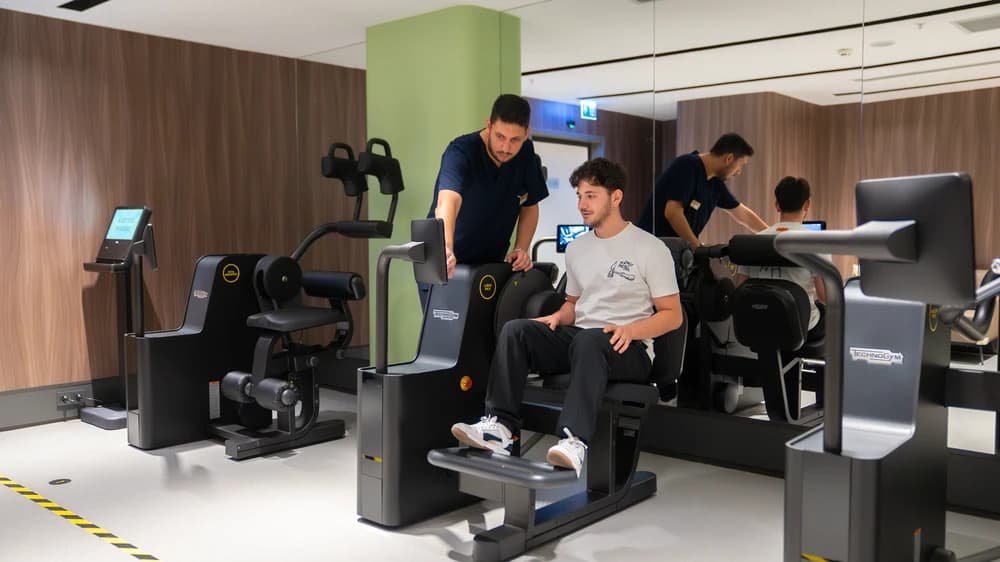
Technologies we use

Locations
Where you can receive this treatment




Related articles
Neurological How long does it take to recover from a stroke?
Most recovery after a stroke happens in the early months, when the brain is most able to reorganise, and it continues more slowly for a longer period after that. How far someone gets depends mainly on how severe the stroke was, where it happened and how much active therapy follows.Read moreNeurological Can you walk again after a stroke?
Many people walk again after a stroke, including many who cannot stand at first. The chances are highest when some leg movement returns early and when walking practice starts as soon as it is safe. Walking often comes back before full arm recovery, sometimes with a stick, splint or other support.Read moreNeurological Will my arm and hand recover after a stroke?
Arm and hand recovery after a stroke varies more than walking recovery. Early return of some shoulder or finger movement makes useful recovery much more likely. Repeated, meaningful practice of reaching, grasping and releasing is what drives improvement, and even a partly recovered hand can be trained to help with daily tasks.Read more



