
Other systems
Smart exercise gym
A training area where every station records load, repetitions and range, so an inpatient programme can be progressed on measured data. Each machine loads the prescribed weight automatically and physically stops at the safe range limit, which matters after joint replacement or ligament surgery.
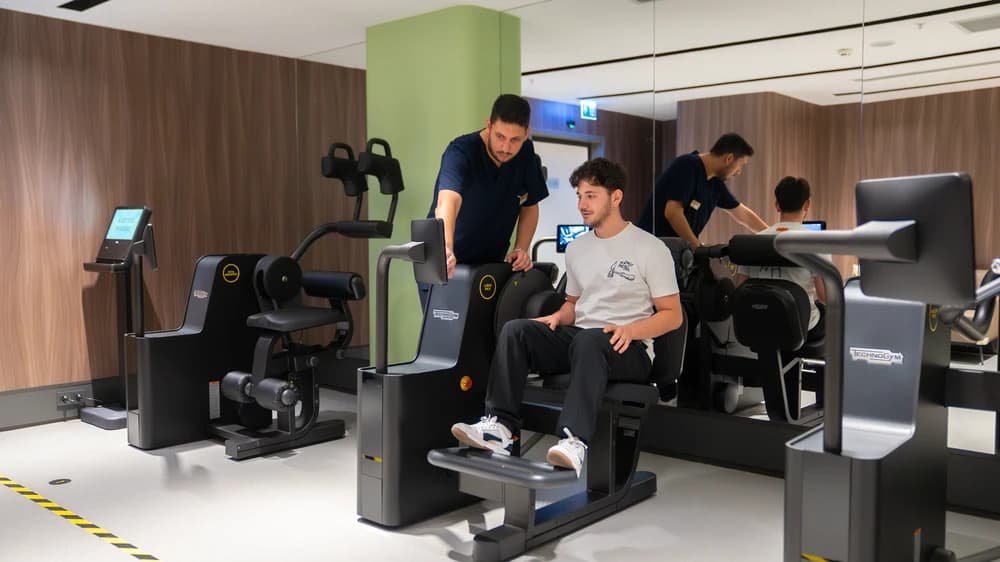
Connected equipment that sets and records the programme
Each machine reads the patient's identity and loads their prescribed weight, range limits and repetition target automatically. Every set performed is recorded. The therapist prescribes the programme once and adjusts it from the data rather than resetting equipment each session.
Range limits matter more than the automation: after joint replacement or ligament surgery there are angles that should not be loaded, and a machine that physically stops at the safe limit is more reliable than an instruction to be careful.
Who it is used for
Strength phases across most programmes — orthopaedic rehabilitation, post-surgical strengthening, sarcopenia and geriatric strength work, cardiac and pulmonary rehabilitation conditioning, and general reconditioning after prolonged illness.
It suits sarcopenia and older adults particularly well, because progressive overload requires accurate small increments and those are hard to deliver with free weights.
What the record is actually for
Adherence and progression are the two things that determine whether strength training works, and both are usually estimated. Recorded data makes them visible: whether the patient attended, whether the load actually increased, and whether progress stalled.
A stalled progression that shows up in week three can be investigated. One noticed at discharge cannot.
Progression that is recorded rather than remembered
Connected equipment sets the load for each exercise, records what was completed, and adjusts the plan. It removes the two commonest failures of gym-based rehabilitation: guessing the weight and never increasing it.
The data also travels — it becomes the home programme with real numbers attached rather than a printed sheet of drawings.
What the record is worth after discharge
The person leaves with the actual loads they were using rather than a sheet of exercise drawings. A therapist in another country can read it and continue from where the programme stopped.
That handover is the point. The commonest failure after an intensive block abroad is a home programme too vague to progress, and vague programmes stop being done within weeks.
How hard and how often should strength training be?
International exercise recommendations for older adults advise resistance training two to three times a week, starting with one or two sets and building up to two or three sets of eight to twelve repetitions, for the major muscle groups used in daily function 1. Programmes that progress to loads of about 70–80% of the most a person can lift once produce greater strength gains than those that stay light or moderate 1.
The load is raised as soon as a set stops feeling hard, so that training keeps pace with the person’s strength 1. Recorded sets make that moment visible rather than a matter of memory. For sarcopenia, an international guideline strongly recommends resistance-based training as treatment, and conditionally recommends a protein-rich diet or protein supplements alongside it 2.
Sources
- Izquierdo M, Merchant RA, Morley JE, Anker SD, et al. International exercise recommendations in older adults (ICFSR): expert consensus guidelines — Journal of Nutrition, Health and Aging (2021)
- Dent E, Morley JE, Cruz-Jentoft AJ, Arai H, et al. International clinical practice guidelines for sarcopenia (ICFSR): screening, diagnosis and management — Journal of Nutrition, Health and Aging (2018)
Conditions this device is used for
The 5 conditions where this device is part of a routine programme, grouped by area. It is one tool inside the plan, never the plan itself.
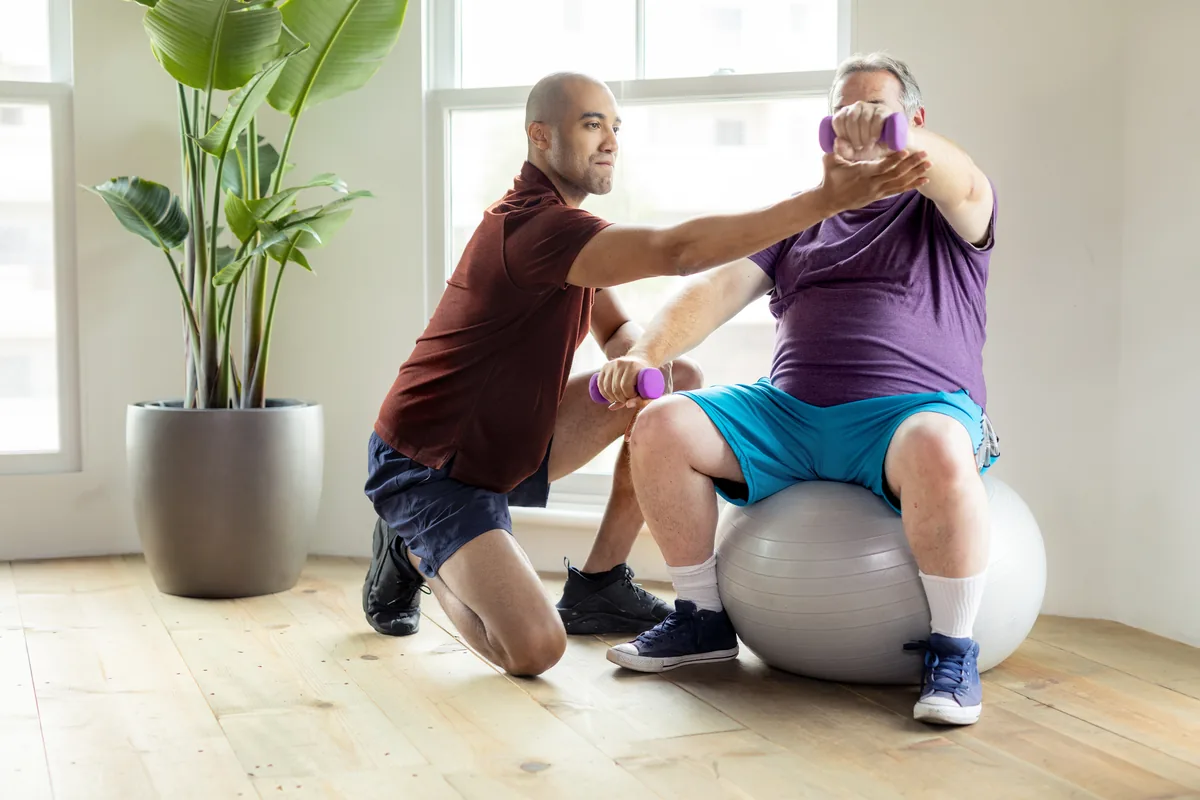
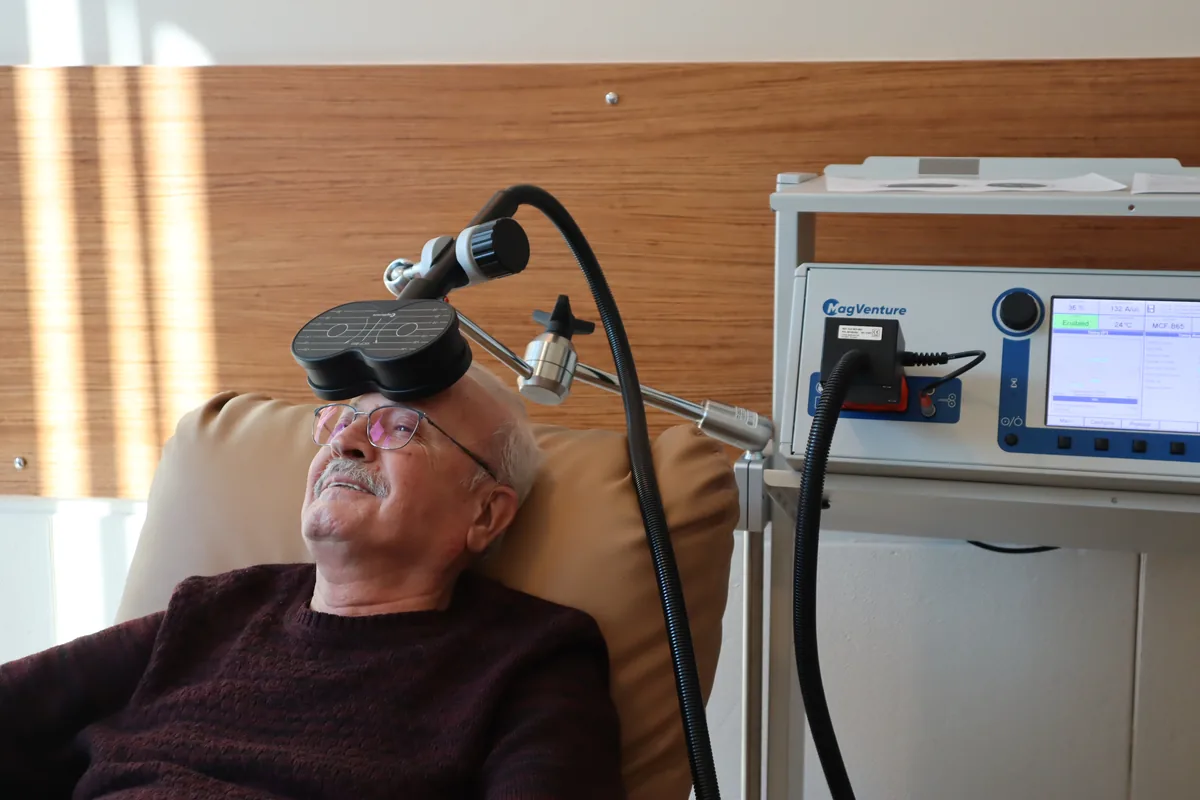



Devices are used inside a programme and chosen after examination — they are not booked separately.
Your path to this treatment
Nothing here is booked from a page. You send the records you have, a rehabilitation physician reads them, and you get a written answer — including when the answer is that an intensive programme will not help.
4 steps, start to finish
1.Send your records
A discharge summary from the hospital that treated the original event, and any imaging of the affected area — CT, MRI or X-ray.2.A written plan in 48 hours
A rehabilitation physician reviews the case and returns the expected duration, the recommended programme and the centre. Free, no obligation.3.Travel and admission
Where a visa is needed we issue an invitation letter and treatment confirmation naming the dates and the facility. You are met at the airport and driven to the centre by private vehicle or ambulance; a bed for one companion and interpreting during therapy are arranged.4.Treatment, then home
The programme runs, then you leave with a discharge report and a written home exercise plan. Your return journey is organised before you go, with scheduled video reviews so progress does not stop.
In their words
What patients say after a programme
Short videos filmed during therapy: a child’s rehabilitation after a brain tumour, suspended gait training after spinal cord injury, and learning to walk again after a fall. Individual results vary.
Dave Evans on his physical therapy here
Musculoskeletal physiotherapy
Paediatric rehabilitation after a brain tumour
Inside a physiotherapy session
Spinal cord injury — the rehabilitation process
Suspension-assisted gait training
Walking difficulty and restricted movement after a fall
Regaining gait and range of motion
Locations
Centres that have this device — pick one.



Questions people actually ask
About this device
Is this just a gym?
The equipment is similar; what differs is that load is prescribed after assessment, recorded automatically, and progressed on a schedule.
Who is it for?
Anyone in an active rehabilitation phase, from post-surgical recovery to sarcopenia and cardiac rehabilitation.
Do I need supervision?
Initially yes, to set load and technique. It becomes increasingly independent, which is the point.
Can I continue at home?
The programme travels with actual numbers. Whether the equipment exists locally is the practical question and it is addressed before discharge.
Is strength training safe for frail older people?
Yes, when it is supervised and built up gradually. International recommendations state that even extreme frailty is not a reason to avoid resistance training, but advise particular care in the first weeks, because even a small injury can take weeks to recover from and lead to the programme being abandoned 1.



