

Medical condition
Amputation
Amputation rehabilitation covers the work before a prosthesis — shaping the residual limb, preventing contractures, building the fitness that walking on a prosthesis demands — and the gait training that follows once one is fitted. A programme runs four to eight weeks and the timing depends on how well the limb has healed.
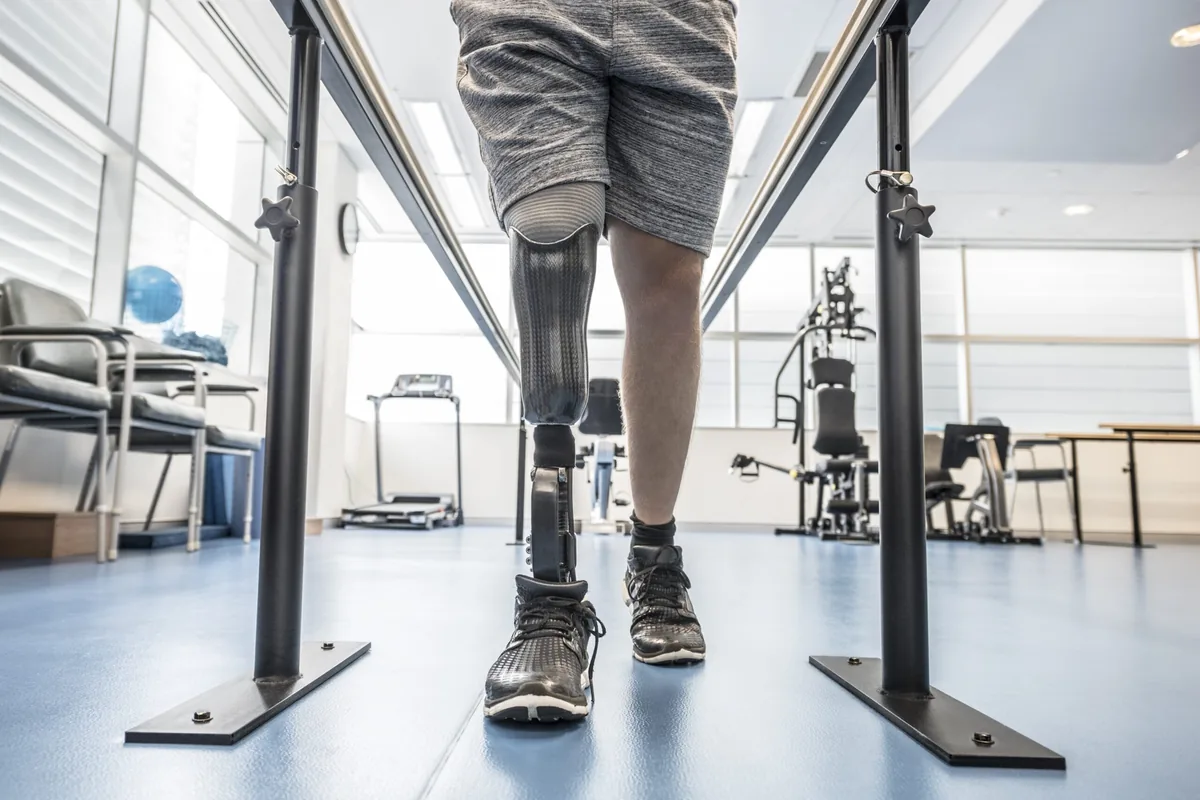
Rehabilitation starts before the prosthesis
The weeks between the operation and a fitted prosthesis are not waiting time. They decide whether the prosthesis will work: whether the residual limb is the right shape, whether the hip and knee still straighten, and whether the person has the cardiovascular fitness to walk on it.
Walking on a prosthesis costs considerably more energy than walking on two legs, and the cost rises the higher the amputation. A person who spent three months in a chair before their first fitting has usually lost the fitness required, and that loss is harder to reverse than it was to prevent.
So this phase is compression and shaping of the residual limb, stretching to prevent the hip and knee contractures that make a prosthesis unusable, strengthening the remaining limb, balance work, and general conditioning.
Timing: why we ask when the operation was
A definitive prosthesis is usually fitted between six and eighteen months after surgery, once the wound has healed and the swelling has settled into a stable shape 4. Some people receive a temporary prosthesis earlier, within weeks, specifically to keep them upright and conditioned.
This matters more for someone travelling than for someone local. If you fly in three weeks after an amputation expecting to leave walking on a definitive limb, the timeline is against you — not because of the programme but because of wound healing and limb volume.
What an early block can do is prepare: shaping, contractures, fitness, and the assessment that determines the right components. What it cannot do is compress biology. We would rather say that before you book than explain it on arrival.
Not everyone is a candidate, and pretending otherwise is unkind
Prosthetic prescription is graded by expected function — internationally by levels running from no realistic prospect of walking, through walking on level surfaces at a fixed speed, up to unlimited community walking and higher-demand activity. The level determines which knee, foot and ankle components are appropriate.
That grading is not a judgement of effort. It reflects the other things going on: cardiac and respiratory capacity, the state of the other limb, vision, cognition, and how much of the leg remains. A component prescribed above someone's realistic level is heavier, harder and often ends up in a cupboard.
For people who are not prosthetic candidates, the programme is not smaller — it is different: transfers, wheelchair skills, the other limb, skin protection and independence at home. Those goals are worth travelling for too.
Fitting is half of it; gait training is the other half
A well-made prosthesis fitted to an untrained person produces a limp, a sore residual limb and a device that gets abandoned. Learning to walk on it is a training process — loading, balance, stepping, then stairs, slopes and uneven ground.
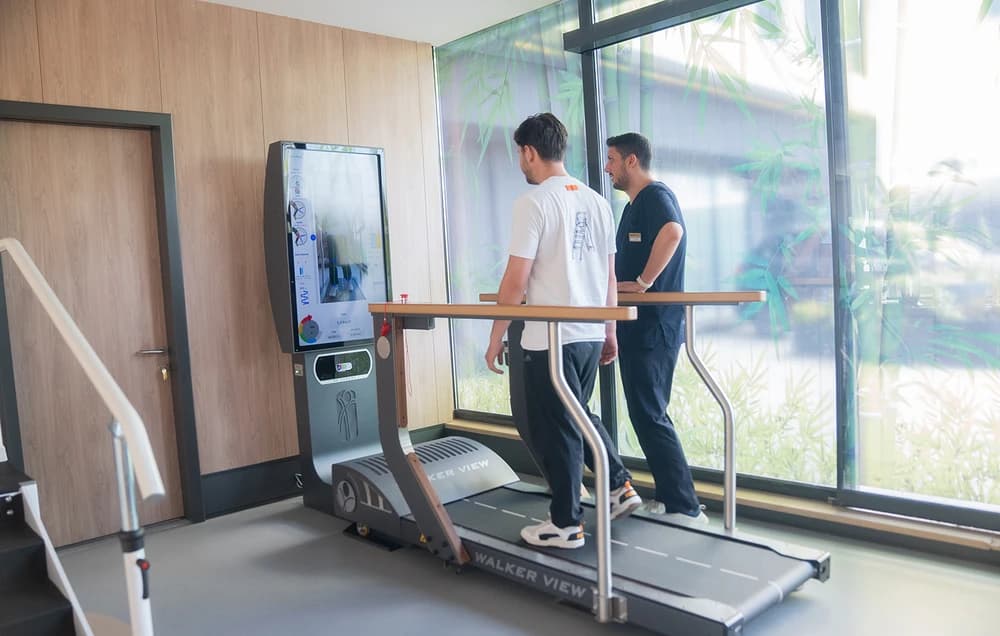
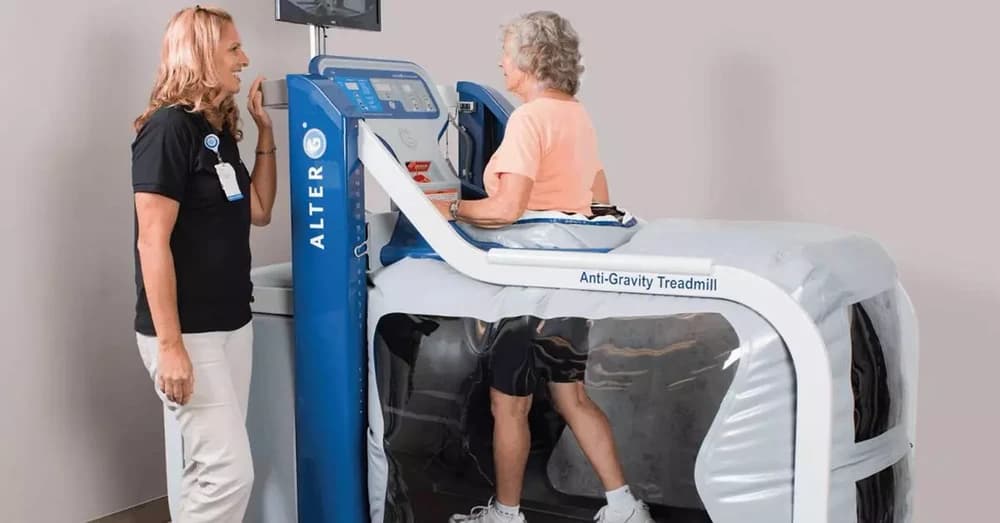
Gait analysis is used to see what is actually happening rather than what it looks like, and the alignment is adjusted from that. The anti-gravity treadmill allows loading to be introduced gradually where the limb is not yet ready for full weight.
Phantom limb pain, honestly
Sensation from the missing limb is normal and near-universal. Pain in it is common and can be severe. It is real pain generated by the nervous system, not imagination, and saying so matters because many people are told the opposite.
Treatment combines desensitisation, early prosthetic use, medication where indicated, and graded motor imagery — of which mirror therapy is one part. Mirror therapy is cheap, safe and easy to do at home, and the evidence for it is weaker than its popularity suggests: it does not appear to give more immediate relief than motor imagery alone, though a daily programme within a wider graded approach may help.
We include it on that basis, and we describe it that way rather than presenting it as a solved problem.
The other limb, and the reason it decides the next ten years
Where the amputation was caused by vascular disease or diabetes, the remaining limb is under the same threat, and it now carries more load. Protecting it — skin checks, footwear, glycaemic control, circulation — is not an add-on to the programme; over a ten-year horizon it may be the most valuable part of it.
For traumatic amputation in a younger person the long-term issues are different: overuse of the sound side, back pain, and socket fit changing as the limb continues to remodel for six to eighteen months 4.
What the programme covers
Four to eight weeks, three to five hours a day. Residual limb care and shaping, contracture prevention, strengthening and conditioning, balance, transfers and wheelchair skills where relevant, gait training with the prosthesis, gait analysis, and management of phantom pain.
Prosthetic and orthotic provision is part of the wider service; what is appropriate and when is determined by the assessment rather than promised in advance. Where a device is recommended, it is quoted separately before anything is made.
Understanding Amputation
Before treatment, the questions people actually ask first — what happens, how recovery behaves over time, and whether it is ever too late. Each opens the full article.
- How we treat amputationWhat happens before the prosthesis, what happens with it, and what is decided by assessment rather than promised.
- What to expectFrom the operation date to walking, and what the timeline can and cannot be compressed to.
- Questions patients askWhat comes up in the first conversation.
Frequently asked questions
How soon after the operation can I come?
Early is good for the preparatory work — shaping, contractures, fitness — and that phase can start within weeks. A definitive prosthesis is usually a six to eighteen month matter, because the limb has to heal and settle first 4. Tell us the operation date and the reply will be specific about what a block at that point can achieve.
Will I walk again?
For most people with a below-knee amputation and reasonable general health, yes. Above the knee is harder and costs much more energy. Where vascular disease, heart or lung problems are present the answer is more cautious, and a physician should give it from the records rather than a website.
Do you make the prosthesis?
Prosthetic and orthotic provision is part of the wider service. What is appropriate for you, and whether it is made here or at home, is decided at assessment — components are prescribed to expected function, and prescribing above that produces a device people stop using.
Why does the programme spend time on my other leg?
Because it now does more work, and where the amputation was caused by diabetes or vascular disease it is under the same threat. Protecting the remaining limb is one of the highest-value things a programme can do.
Is phantom limb pain permanent?
It often reduces over time and it can be managed. It is genuine pain produced by the nervous system rather than something imagined. Treatment combines desensitisation, early prosthetic use, medication where indicated and graded motor imagery.
Does mirror therapy work?
The evidence is weaker than its reputation. It does not appear to relieve pain more than motor imagery alone in the short term, though a daily programme inside a wider graded motor imagery approach may help. It is safe, free and easy to do at home, so it is worth trying — with realistic expectations.
I am not going to walk. Is a programme still worth it?
Yes, and the goals change rather than shrink: transfers, wheelchair skills, protecting the remaining limb and skin, and independence at home. Those determine daily life at least as much as walking does.
My prosthesis does not fit any more. Can you help?
A residual limb continues to change shape for six to eighteen months, and sockets stop fitting 4. That is a common reason for a shorter block: reassessment, alignment, gait retraining and a socket review.
Can a companion come?
Yes. A bed for one companion is provided in the patient's room. In the early phase the companion often learns the limb care and bandaging, which is difficult to do one-handed after an upper limb amputation.
Sources
- Lower Limb Prosthetics — American Academy of Physical Medicine and Rehabilitation — PM&R KnowledgeNow (2023)
- Is mirror therapy all it is cracked up to be? Current evidence and future directions — International Association for the Study of Pain (2021)
- Pre-Fitting Management of the Patient with a Lower Limb Amputation — Physiopedia (2023)
- Overview of Limb Prosthetics — Merck Manual Professional Edition (2026)
Which therapies would I actually receive?
A therapy is a single method used inside a programme. It is measured in sessions and is not sold separately.


Technologies we use
Locations
Where you can receive this treatment



Related articles
Amputee How soon after an amputation can a prosthesis be fitted?
The first prosthesis usually comes weeks after surgery, once the wound has healed and the limb has stopped changing shape. What decides the date is healing, swelling and skin condition rather than a calendar. The rehabilitation that makes the prosthesis usable starts long before it arrives.Read moreAmputee What is phantom limb pain, and how is it treated?
Phantom limb pain is pain felt in the part of a limb that has been amputated. It is common after amputation. It is real pain arising from changes in the nerves and brain. Treatment combines medicines, residual limb care, prosthetic fitting, mirror therapy and other techniques that retrain the brain.Read moreAmputee How long does it take to learn to walk with a prosthetic leg?
Learning to walk with a prosthetic leg usually takes several months and continues to improve for a year or more. Progress depends on the amputation level, the cause, general fitness, the residual limb and the prosthesis. Rehabilitation starts before the prosthesis is fitted and focuses on strength, balance, walking practice and preventing falls, which are common.Read more



