
Other systems
Functional balance and coordination system
A moving platform with screen feedback that measures how balance is lost and trains the specific correction that is missing. The assessment shows which balance system is failing — vision, the inner ear or sensation from the feet and joints — and training then targets that one.
Balance measured, then challenged
A force platform records how the body sways while standing — under different conditions, with eyes open and closed, on firm and unstable surfaces. That produces a numerical balance profile rather than an impression, and identifies which of the three balance systems is failing: vision, inner ear, or sensation from the feet and joints.
The same platform then delivers training tasks that challenge balance in the specific direction and condition the assessment identified as weak.
Who it is used for
Balance disorders after stroke and brain injury, in Parkinson's disease and multiple sclerosis, in peripheral neuropathy where foot sensation is lost, in vestibular disorders, and in older adults with falls or fear of falling.
It is also used after ankle and knee injury, where joint position sense is impaired and single-leg balance remains deficient long after strength has returned.
Why identifying the failing system changes treatment
Someone whose balance depends heavily on vision needs different training from someone with vestibular loss or with numb feet. Generic balance exercises help all three a little; targeted training helps the affected one substantially more.
Falls are reduced most by programmes that genuinely challenge balance and involve more than three hours of exercise a week 2. Comfortable balance exercises do little, which is why falls guidelines ask for exercises that are challenging but safe, reviewed and progressed regularly as ability improves 3.
Training the strategy, not just the score
The platform provides visual feedback during balance tasks, which allows practice at a difficulty just beyond current ability — where balance actually improves.
It also identifies whether a person is relying on vision to compensate for a deficit elsewhere, which changes what should be trained.
How difficulty is progressed
By narrowing the base of support, removing vision, adding an unstable surface, adding head movement, and finally adding a cognitive task — because real-world balance failures happen while thinking about something else.
That last progression is frequently omitted, and it is the one that most resembles the situations in which people actually fall.
Does training with screen feedback work better than ordinary balance exercise?
Not clearly. Balance exercise itself has strong evidence behind it for preventing falls in older adults 1. Evidence that a platform’s feedback adds to it is much thinner. A Cochrane review of force-platform feedback after stroke found that it made standing weight more even between the legs, but did not improve sway, clinical balance scores or independence 4. Its seven trials were small, with 246 participants in total 4.
The platform’s practical value therefore lies elsewhere: showing which balance system is failing, setting the difficulty precisely, keeping practice at the edge of ability and recording whether anything changed between the first and last session. The balance exercise itself does the work, and it has to be hard enough and frequent enough to matter.
Sources
- Sherrington C, Fairhall NJ, Wallbank GK, Tiedemann A, et al. Exercise for preventing falls in older people living in the community — Cochrane Database of Systematic Reviews (2019)
- Sherrington C, Michaleff ZA, Fairhall N, Paul SS, et al. Exercise to prevent falls in older adults: an updated systematic review and meta-analysis — British Journal of Sports Medicine (2017)
- Montero-Odasso M, van der Velde N, Martin FC, Petrovic M, et al. World guidelines for falls prevention and management for older adults: a global initiative — Age and Ageing (2022)
- Barclay-Goddard R, Stevenson T, Poluha W, Moffatt MEK, et al. Force platform feedback for standing balance training after stroke — Cochrane Database of Systematic Reviews (2004)
Conditions this device is used for
The 17 conditions where this device is part of a routine programme, grouped by area. It is one tool inside the plan, never the plan itself.
 Traumatic Brain Injury
 Multiple Sclerosis
 Peripheral Neuropathy
 Falls and Frailty
 Balance and Vestibular Disorders
 Dementia
 ALS and Motor Neurone Disease
 Pressure Injuries and Skin Protection
 Behçet's Disease
 Ankle Sprain and Chronic Ankle Instability
 Collateral Ligament Injury (MCL and LCL)
 Spina Bifida
 Muscular Dystrophy in Children
 Bow Legs and Knock Knees
 Intoeing (In-Toed Walking)
 Toe Walking in Children
 Myopathy and Muscle Disease
Devices are used inside a programme and chosen after examination — they are not booked separately.
Your path to this treatment
Nothing here is booked from a page. You send the records you have, a rehabilitation physician reads them, and you get a written answer — including when the answer is that an intensive programme will not help.
4 steps, start to finish
1.Send your records
A discharge summary from the hospital that treated the original event, and any imaging of the affected area — CT, MRI or X-ray.2.A written plan in 48 hours
A rehabilitation physician reviews the case and returns the expected duration, the recommended programme and the centre. Free, no obligation.3.Travel and admission
Where a visa is needed we issue an invitation letter and treatment confirmation naming the dates and the facility. You are met at the airport and driven to the centre by private vehicle or ambulance; a bed for one companion and interpreting during therapy are arranged.4.Treatment, then home
The programme runs, then you leave with a discharge report and a written home exercise plan. Your return journey is organised before you go, with scheduled video reviews so progress does not stop.
In their words
What patients say after a programme
Short videos filmed during therapy: a child’s rehabilitation after a brain tumour, suspended gait training after spinal cord injury, and learning to walk again after a fall. Individual results vary.
Dave Evans on his physical therapy here
Musculoskeletal physiotherapy
Paediatric rehabilitation after a brain tumour
Inside a physiotherapy session
Spinal cord injury — the rehabilitation process
Suspension-assisted gait training
Walking difficulty and restricted movement after a fall
Regaining gait and range of motion
Locations
Centres that have this device — pick one.



Questions people actually ask
About this device
Can balance really be improved?
Yes, at any age. It is one of the more reliably successful areas in rehabilitation and it reduces falls 1.
Is it safe if I am unsteady?
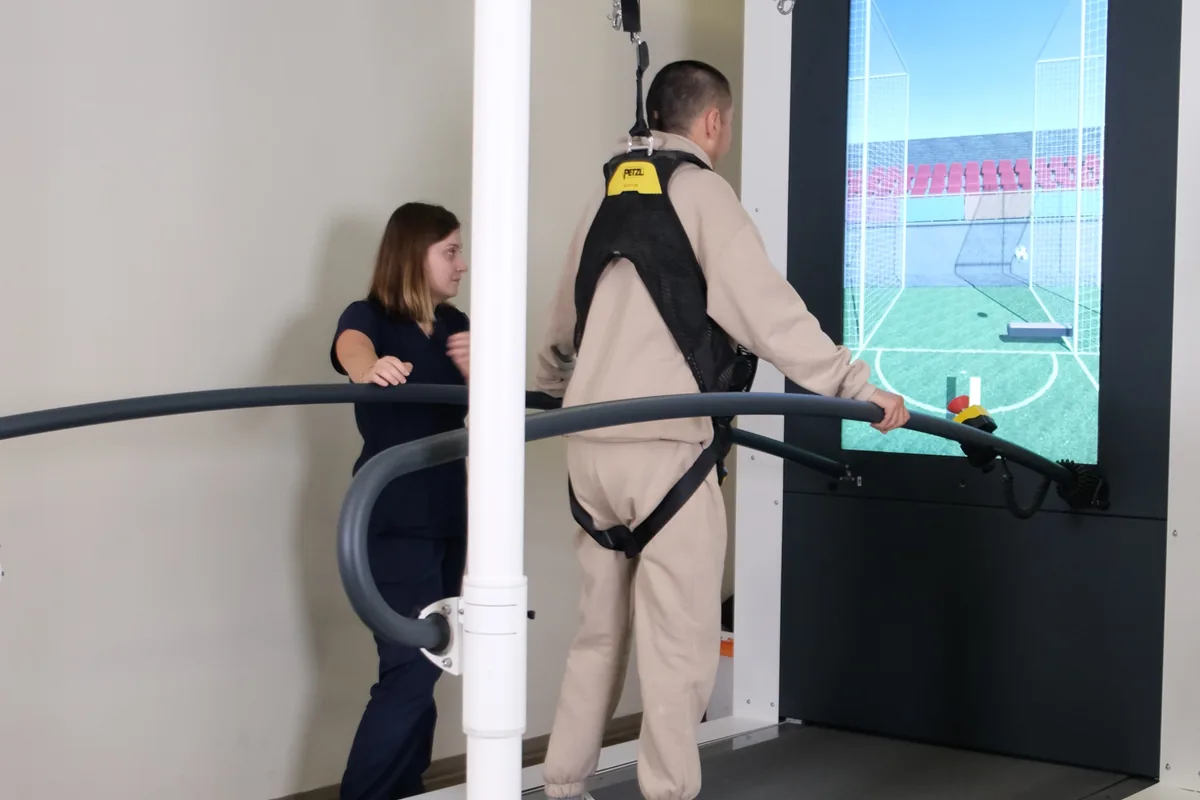
Support and a harness are used where needed. Training happens at the edge of ability by design, which is why the safety arrangements matter.
How many sessions?
Balance improves with regular, challenging practice. For falls prevention, guidelines recommend sessions three or more times a week, progressed in difficulty for at least 12 weeks and continued longer for greater effect 3. Practice then continues at home.
Does it help vertigo?
Vestibular rehabilitation is a related but distinct programme. The platform supports it and the specific exercises differ.
Will balance training stop me from falling?
It lowers the risk but cannot remove it. In older adults living at home, balance and functional exercises reduce the rate of falls by 24%, with high-certainty evidence 1. Because falls have several causes, guidelines also recommend a wider assessment for people at high risk, covering medicines, vision, feet and footwear, and hazards at home 3.



