

Medical condition
Myopathy and Muscle Disease
Myopathy is disease of the muscle itself — inflammatory, metabolic, drug-induced or inherited — producing weakness that is usually worst in the shoulders and hips. Rehabilitation cannot treat the cause, which is the neurologist’s task, but carefully dosed exercise preserves function and endurance, and the wrong dose makes weakness worse, which is why it is prescribed and measured.
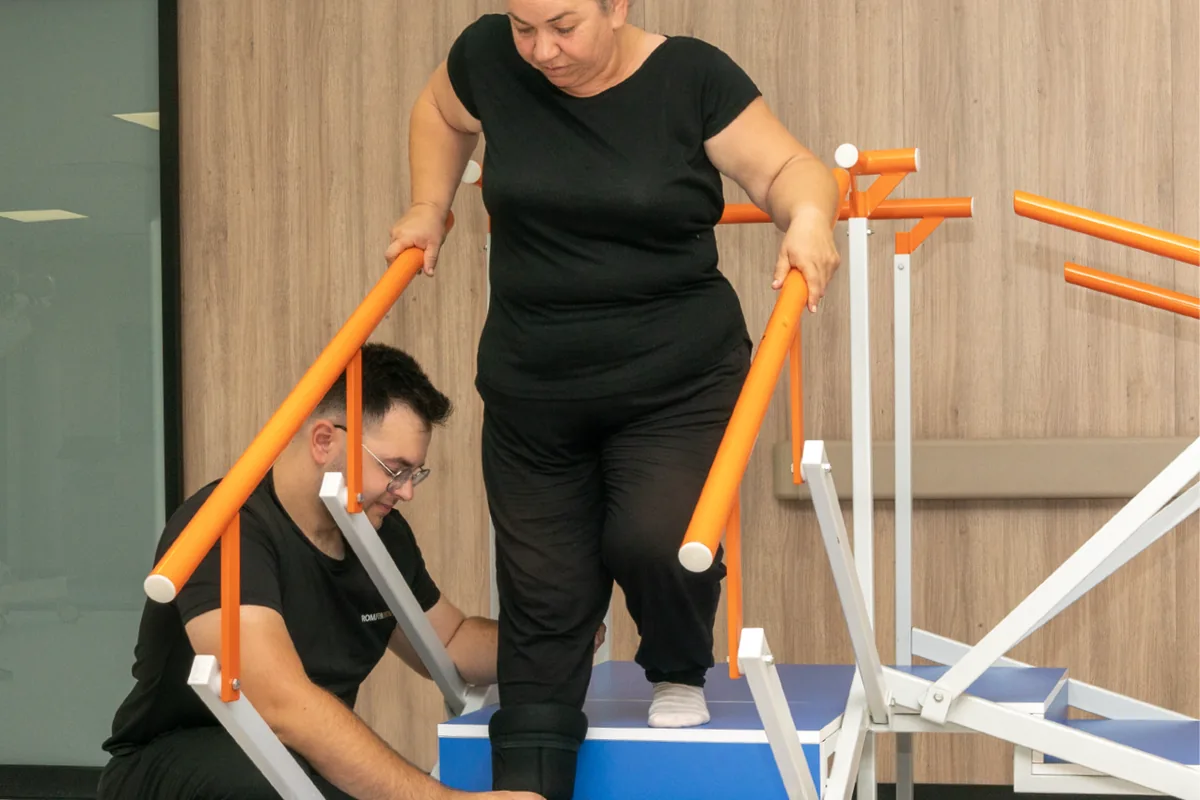
Which myopathy, and why it matters
Inflammatory myopathies such as polymyositis and dermatomyositis respond to immunosuppression and can improve substantially; metabolic myopathies impose limits on how energy can be used; steroid myopathy improves as the dose comes down; the inherited muscular dystrophies of adult life progress at their own pace. The exercise prescription is different in each, and it cannot be written without the diagnosis.
That is why the neurologist stays in the room. Disease activity, enzyme levels and the drug regimen decide how much load the muscle can take this week, and the programme is adjusted to that rather than to a fixed schedule.
Exercise that helps and exercise that harms
Moderate resistance and endurance training has not been found to accelerate muscle disease, which was the fear for decades, but how much it helps depends on the diagnosis 12. Exercise to exhaustion and heavy eccentric loading of already-weak muscles are avoided, and the line between helpful and harmful training is a matter of dose.
The programme therefore starts below what the patient can do and rises on measured strength and on how the muscle responds over the following days, with hydrotherapy carrying much of the early work because water removes the load of body weight.
Function, breathing and swallowing
Proximal weakness shows up as difficulty rising from a chair, climbing stairs, lifting the arms and turning in bed, and those tasks are trained directly. Where the disease involves the breathing muscles or the swallow, respiratory therapy and speech and language therapy are part of the programme from the start rather than added when a problem appears.
Energy conservation — planning the day so that the muscle is not spent on the wrong things — is taught, because for many patients it changes daily life more than any single exercise.
What is measured and what you take home
Strength by dynamometer, timed function tests, walking distance and a fatigue scale, at the start and end of the block. Change is reported as numbers, and the home programme that follows carries the same dose rules so the gains are held without provoking a relapse.
Progressive conditions are reviewed on a schedule, and the programme is rewritten as the disease moves, with equipment provided ahead of need rather than after a fall.
Does exercise help in every type of myopathy?
Not equally. In dermatomyositis and polymyositis, a meta-analysis of 19 studies with 298 patients found that exercise moderately improved muscle strength and aerobic capacity without raising muscle enzyme levels, and no disease flares were reported at any stage of the disease 2. The certainty of that evidence was downgraded, but the authors conclude that exercise is probably safe 2.
For inherited muscle diseases the picture is less clear. A Cochrane review of 14 trials found that strength training alone may make little or no difference in facioscapulohumeral and myotonic dystrophy, that aerobic training may improve aerobic capacity in facioscapulohumeral dystrophy, and that the overall evidence remains uncertain 1.
Frequently asked questions
Is exercise safe with a muscle disease?
Yes, at the right dose and with the diagnosis known. Moderate training is generally well tolerated, and the usual side effects in trials were muscle soreness or joint complaints 1. Training to exhaustion is avoided. We set the dose from measurement and adjust it with your neurologist.
Can rehabilitation cure the myopathy?
No. It preserves and improves function while the cause is treated or, in progressive disease, while it runs its course. We do not claim more than that.
Why do I feel weaker after exercising?
Weakness lasting into the next day means the dose was too high. That signal is built into the programme, and the load comes down before it goes up again.
Is steroid weakness the disease or the drug?
Often both, and the distinction changes management. Proximal weakness with normal inflammatory markers suggests the drug; it improves with dose reduction and resistance training.
Can I exercise during a flare of myositis?
Usually yes, at an adjusted load. In dermatomyositis and polymyositis, trials found that exercise did not raise muscle enzyme levels and reported no flares at any stage of the disease, although the certainty of this evidence is limited 2. During a flare the load is lowered and then built up again with the specialist treating the inflammation.
Sources
- Voet NB, van der Kooi EL, van Engelen BG, Geurts AC. Strength training and aerobic exercise training for muscle disease — Cochrane Database of Systematic Reviews (2019)
- da Silva BISL, Dos Santos BRJ, Carneiro JA, Silva FMFE, et al. Physical exercise for dermatomyositis and polymyositis: a systematic review and meta-analysis — Clinical Rheumatology (2022)
Technologies we use

Locations
Where you can receive this treatment





Related articles
Neurological How long does it take to recover from a stroke?
Most recovery after a stroke happens in the early months, when the brain is most able to reorganise, and it continues more slowly for a longer period after that. How far someone gets depends mainly on how severe the stroke was, where it happened and how much active therapy follows.Read moreNeurological Can you walk again after a stroke?
Many people walk again after a stroke, including many who cannot stand at first. The chances are highest when some leg movement returns early and when walking practice starts as soon as it is safe. Walking often comes back before full arm recovery, sometimes with a stick, splint or other support.Read moreNeurological Will my arm and hand recover after a stroke?
Arm and hand recovery after a stroke varies more than walking recovery. Early return of some shoulder or finger movement makes useful recovery much more likely. Repeated, meaningful practice of reaching, grasping and releasing is what drives improvement, and even a partly recovered hand can be trained to help with daily tasks.Read more



