
Gait and lower limb
Sensor-based dynamic gait and reaction training
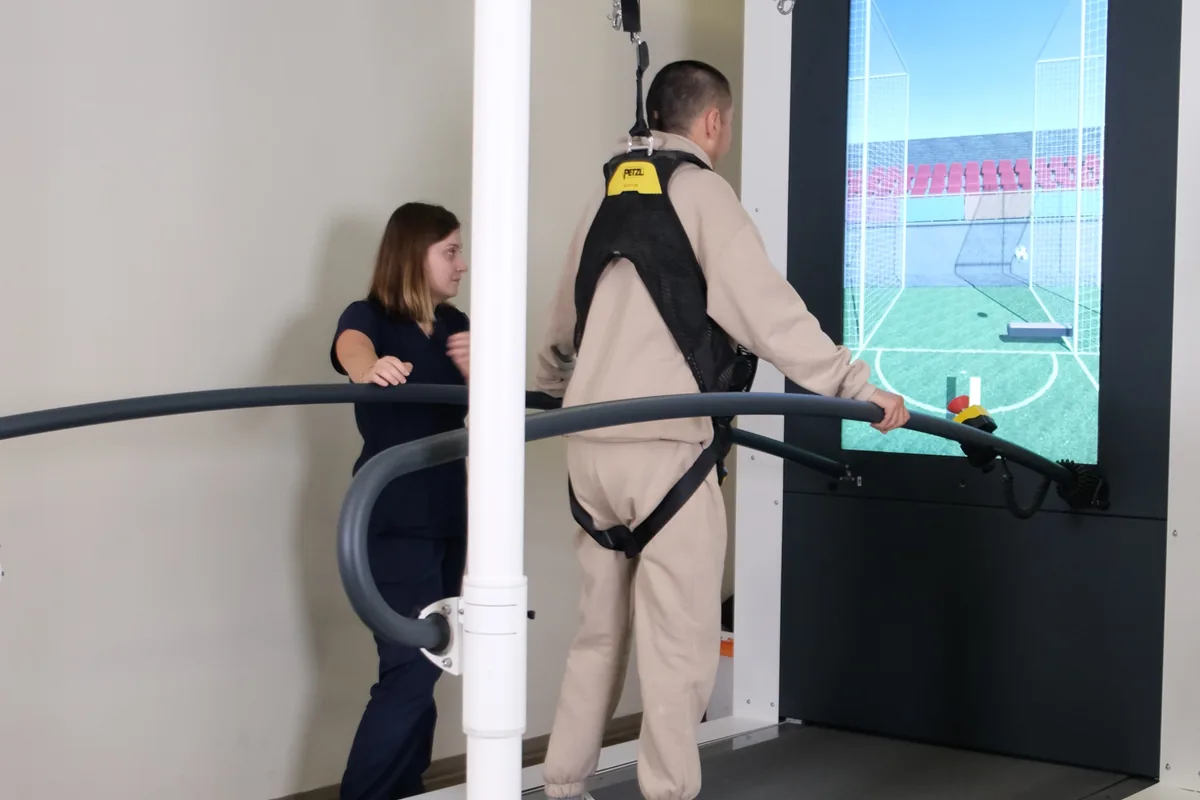
An augmented-reality treadmill that projects obstacles, stepping targets and tasks onto the belt, so walking and balance are trained on everyday scenarios rather than on a plain moving surface. Falls happen when someone has to react, so the system trains the reaction, not just the rhythm.
Walking on a belt that answers back
Sensors in the treadmill track every step — length, timing, symmetry and where the foot lands — while a projector draws targets, obstacles and paths onto the belt in front of the patient. The task changes with the walker: a stepping stone to reach, a hurdle to clear, a sudden object to avoid, a second task to solve while walking.
That is the difference from an ordinary treadmill. Steady-state walking on a flat belt is the easiest walking there is; the falls that matter happen when someone has to react — to a kerb, a child, a wet patch, a question. This system trains the reaction, not just the rhythm.
Who it is used for
Walking and balance problems after stroke, in Parkinson's disease, in multiple sclerosis and after brain injury; unsteady walking in older adults with a history of falls; and recovery of confident walking after joint replacement or a long period off the feet.
It requires the ability to stand and take steps, with or without a harness for safety. Where that is not yet possible, the robotic gait trainer comes first and this system follows.
What a session looks like
The therapist sets the scenario — obstacle courses, narrowing paths, targets that appear at random, tasks that have to be answered aloud while walking — and the difficulty is raised as performance improves. Because the belt is instrumented, each session records how the walking actually changed, not how it looked.
Sessions are short and demanding. Reacting while walking is tiring in a way that steady walking is not, and that fatigue is a sign the right thing is being trained.
What is measured
Step length and its symmetry, cadence, variability from step to step, how quickly the foot is placed when a target appears, and how walking changes when a second task is added. Those numbers are recorded at the start and end of the programme and appear in the discharge report.
Step-to-step variability and slower performance under a second task have both been linked to repeated falls in older adults 4. No single gait or balance test predicts falls with high certainty, and there is moderate evidence that plain walking speed also helps to predict them 5. That is why all three are reported together.
What does the research show?
Trials of this particular system are small, and their results are mixed. In a trial of 40 people after stroke, 5 weeks of training on it improved standard walking speed no more than an overground obstacle programme, although it delivered about twice as many steps per session and gave a larger but short-lived gain in walking speed on an obstacle-filled walkway 1. In 36 people with hereditary spastic paraplegia, 5 weeks of the same kind of training did not improve obstacle negotiation more than a waiting period 2.
When all participants in the stroke trial were considered together, walking adaptability and dual-task performance improved, with lasting gains in adaptability, while standard walking speed did not change 1.
Sources
- Timmermans C, Roerdink M, Meskers CGM, Beek PJ, et al. Walking-adaptability therapy after stroke: results of a randomized controlled trial — Trials (2021)
- van de Venis L, van de Warrenburg B, Weerdesteyn V, Geurts ACH, et al. Gait-adaptability training in people with hereditary spastic paraplegia: a randomized clinical trial — Neurorehabilitation and Neural Repair (2023)
- Mirelman A, Rochester L, Maidan I, Del Din S, et al. Addition of a non-immersive virtual reality component to treadmill training to reduce fall risk in older adults (V-TIME): a randomised controlled trial — The Lancet (2016)
- Curtin NL, Lauinger A, Montz F, Murphy T, et al. Can dual-task assessment be used to discriminate recurrent fallers in older populations? A systematic review — Journal of the American Medical Directors Association (2026)
- Beck Jepsen D, Robinson K, Ogliari G, Montero-Odasso M, et al. Predicting falls in older adults: an umbrella review of instruments assessing gait, balance, and functional mobility — BMC Geriatrics (2022)
Conditions this device is used for
The 4 conditions where this device is part of a routine programme, grouped by area. It is one tool inside the plan, never the plan itself.

Devices are used inside a programme and chosen after examination — they are not booked separately.
Your path to this treatment
Nothing here is booked from a page. You send the records you have, a rehabilitation physician reads them, and you get a written answer — including when the answer is that an intensive programme will not help.
4 steps, start to finish
1.Send your records
A discharge summary from the hospital that treated the original event, and any imaging of the affected area — CT, MRI or X-ray.2.A written plan in 48 hours
A rehabilitation physician reviews the case and returns the expected duration, the recommended programme and the centre. Free, no obligation.3.Travel and admission
Where a visa is needed we issue an invitation letter and treatment confirmation naming the dates and the facility. You are met at the airport and driven to the centre by private vehicle or ambulance; a bed for one companion and interpreting during therapy are arranged.4.Treatment, then home
The programme runs, then you leave with a discharge report and a written home exercise plan. Your return journey is organised before you go, with scheduled video reviews so progress does not stop.
In their words
What patients say after a programme
Short videos filmed during therapy: a child’s rehabilitation after a brain tumour, suspended gait training after spinal cord injury, and learning to walk again after a fall. Individual results vary.
Dave Evans on his physical therapy here
Musculoskeletal physiotherapy
Paediatric rehabilitation after a brain tumour
Inside a physiotherapy session
Spinal cord injury — the rehabilitation process
Suspension-assisted gait training
Walking difficulty and restricted movement after a fall
Regaining gait and range of motion
Locations
Centres that have this device — pick one.






Questions people actually ask
About this device
How is this different from a normal treadmill?
A normal treadmill trains steady walking. This one projects obstacles and targets onto the belt and measures how you react to them.
Is it safe if I am afraid of falling?
A safety harness is used whenever there is any fall risk, and the belt stops the moment it is needed. Fear of falling is itself a reason to use the system, in graded steps.
Do I get the measurements?
Yes. The gait figures from the first and last sessions are part of the discharge document, in a form another clinician can interpret.
Can it be used with a walking aid?
Usually. The aid is recorded as part of the measurement so that sessions are compared like with like.
Will it stop me falling?
It cannot promise that. In a trial of 302 older adults at high risk of falling, adding an on-screen virtual obstacle course to treadmill training reduced falls over the following 6 months compared with treadmill training alone 3. Trials of belt-projection systems like this one are smaller and have mainly measured walking and obstacle skills 12.



