
Day programme
Amputee rehabilitation
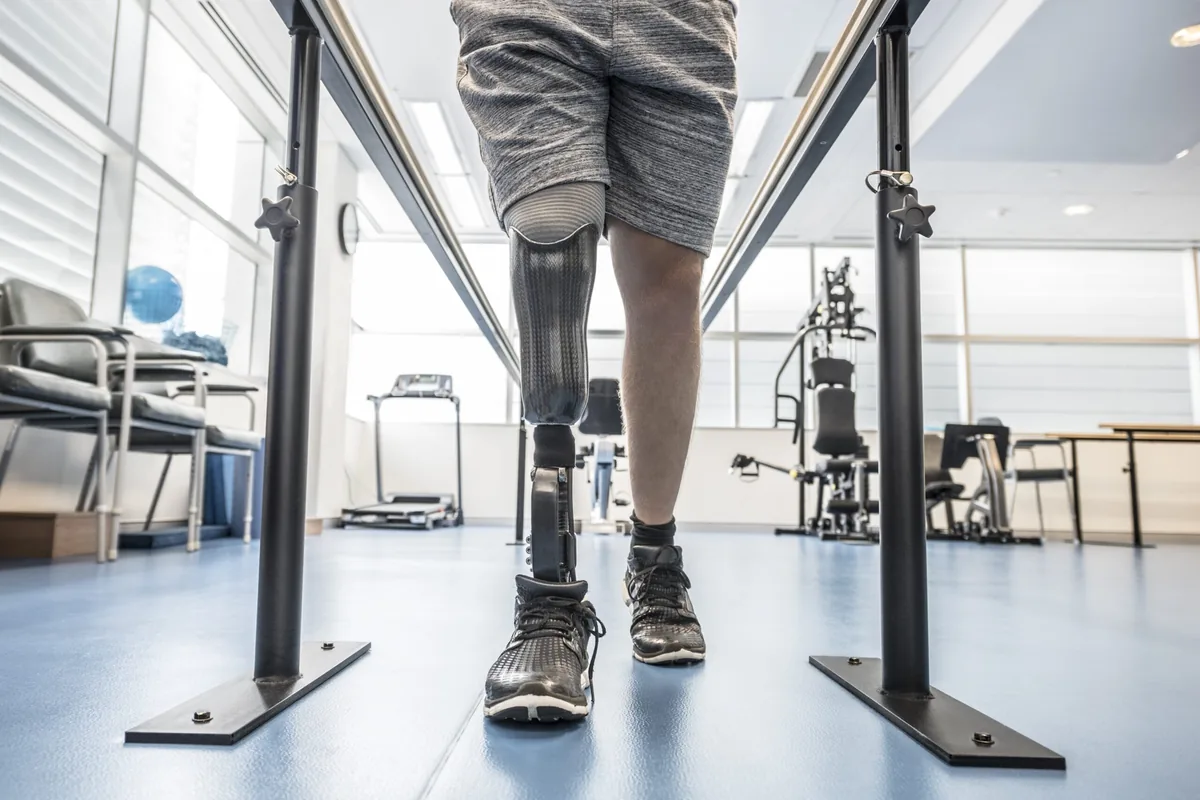
Rehabilitation before and after prosthetic fitting, for upper and lower limb amputation. It covers residual limb care, prosthetic training, gait and balance, and the daily tasks that a prosthesis has to be able to do. Instrumented gait analysis shows what the sound side and lower back are compensating for.
The work starts before the prosthesis
Residual limb shaping, wound and skin care, joint range and the strength of the remaining limb decide how well a prosthesis will fit and how soon it can be used.
Time spent here is not a delay; a limb that is not ready produces a socket that has to be remade.
Gait training is measured, not eyeballed
Instrumented gait analysis shows what a prosthetic user is compensating with, which is usually the sound side and the lower back. Those compensations are what cause pain years later.
Sessions work on symmetry and load distribution rather than only on walking distance.
What the evidence supports
Structured exercise outperforms ordinary prosthetic training. A meta-analysis of 15 randomised trials with 594 participants found that specific exercise programmes improved walking distance (two-minute walk test, mean difference 8.4 metres, 95% confidence interval 2.5 to 14.2) and walking speed (0.10 m/s, 0.03 to 0.16) compared with traditional prosthetic training 1. An earlier review reached the same practical conclusion: resisted and functional training beat supervised walking 2.
Results for balance were inconsistent across the same trials 1, which is worth stating because balance confidence is what most prosthetic users say they want. It improves in practice for many people, but the trial evidence does not yet support promising it, so we measure it rather than predict it.
Who it suits
Upper and lower limb amputation at any stage: before fitting, during prosthetic training, and years later when pain, a weight change or a new socket has altered how someone walks. Coming back for a block after several years is normal rather than a sign that something went wrong.
What decides the realistic goal is the level of amputation, the reason for it, cardiovascular capacity and the state of the remaining limb. For amputation caused by vascular disease or diabetes, protecting the other foot is part of the treatment plan and not an afterthought, because that is what determines whether there is a second amputation.
Duration and what to expect
Four to eight weeks, three to five hours a day. Walking speed, walking distance and how long the socket is tolerated are recorded at the start and repeated at the end, so the change is a measurement rather than an impression.
If the socket turns out to be the limiting factor, the report says so plainly. No amount of gait training compensates for a socket that does not fit, and continuing to train around one produces the compensations that cause back and sound-side pain later.
The sound side is part of the treatment
Prosthetic users load the intact limb more than the prosthetic one, and that asymmetry is where hip, knee and lower back pain appear years later. Instrumented gait analysis shows how large it is; sessions then work on load distribution and symmetry, not only on distance covered.
The home programme reflects the same priority: strength and loading work for both sides, and for anyone with vascular disease or diabetes, daily inspection and offloading of the remaining foot with a stated review interval.
Sources
- Abou L, Fliflet A, Zhao L, Du Y, Rice L. The effectiveness of exercise interventions to improve gait and balance in individuals with lower limb amputations: a systematic review and meta-analysis — Clinical Rehabilitation (2022)
- Wong CK, Ehrlich JE, Ersing JC, et al. Exercise programs to improve gait performance in people with lower limb amputation: a systematic review — Prosthetics and Orthotics International (2016)
Conditions this programme treats
The 4 conditions this programme is built for, grouped by area.
The programme is chosen after a rehabilitation physician has read your records — not from this page.
Your path to this treatment
Nothing here is booked from a page. You send the records you have, a rehabilitation physician reads them, and you get a written answer — including when the answer is that an intensive programme will not help.
4 steps, start to finish
1.Send your records
A discharge summary from the hospital that treated the original event, and any imaging of the affected area — CT, MRI or X-ray.2.A written plan in 48 hours
A rehabilitation physician reviews the case and returns the expected duration, the recommended programme and the centre. Free, no obligation.3.Travel and admission
Where a visa is needed we issue an invitation letter and treatment confirmation naming the dates and the facility. You are met at the airport and driven to the centre by private vehicle or ambulance; a bed for one companion and interpreting during therapy are arranged.4.Treatment, then home
The programme runs, then you leave with a discharge report and a written home exercise plan. Your return journey is organised before you go, with scheduled video reviews so progress does not stop.
In their words
What patients say after a programme
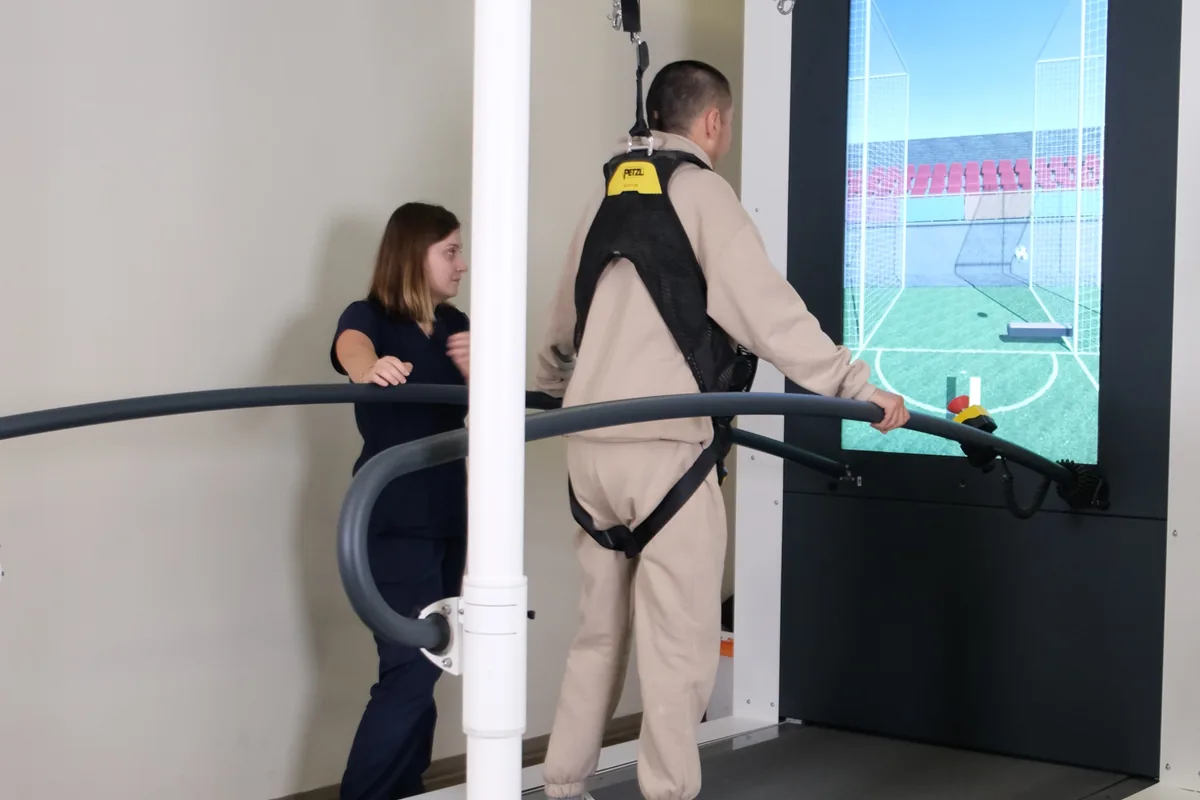
Short videos filmed during therapy: a child’s rehabilitation after a brain tumour, suspended gait training after spinal cord injury, and learning to walk again after a fall. Individual results vary.
Dave Evans on his physical therapy here
Musculoskeletal physiotherapy
Paediatric rehabilitation after a brain tumour
Inside a physiotherapy session
Spinal cord injury — the rehabilitation process
Suspension-assisted gait training
Walking difficulty and restricted movement after a fall
Regaining gait and range of motion
Locations
Where this programme runs — pick a centre.







Questions people actually ask
About this programme
When can I start walking on a prosthesis?
When the wound has healed and the limb has been shaped enough to hold a socket. That is an assessment finding rather than a number of weeks, and rushing it produces a socket that has to be remade.
Will I walk normally again?
That depends on the level, the cause, your fitness and the other limb. What the trials show is that structured training produces measurable gains in speed and distance over ordinary practice 1. We measure yours at the start and the end rather than predicting them.
Will a more advanced prosthetic component make the difference?
The component matters and so does what you can do with it. A knee or foot that suits a high activity level gives nothing to someone whose limiting factor is strength, socket comfort or confidence — which is what the assessment separates before anything is recommended.
What is done about the other leg?
It is treated deliberately, not incidentally. Loading is measured and trained, and where the amputation was caused by vascular disease or diabetes, skin checks, footwear and offloading for the remaining foot are written into the plan.
Can I continue at home?
Yes, and the plan is specific for a reason: reviews found that resisted and functional training was more effective than simply walking more 2. So the home programme is loaded exercise with a progression, not a daily distance target.



