
Medical condition
Scoliosis
Scoliosis is a three-dimensional curvature of the spine. In growing children, bracing and scoliosis-specific exercise can reduce curve progression. In adults, treatment targets pain and function rather than the curve, which no longer progresses in the same way. General fitness exercise does not affect curve progression; curve-specific programmes are what count.
Growing spine and adult spine are different problems
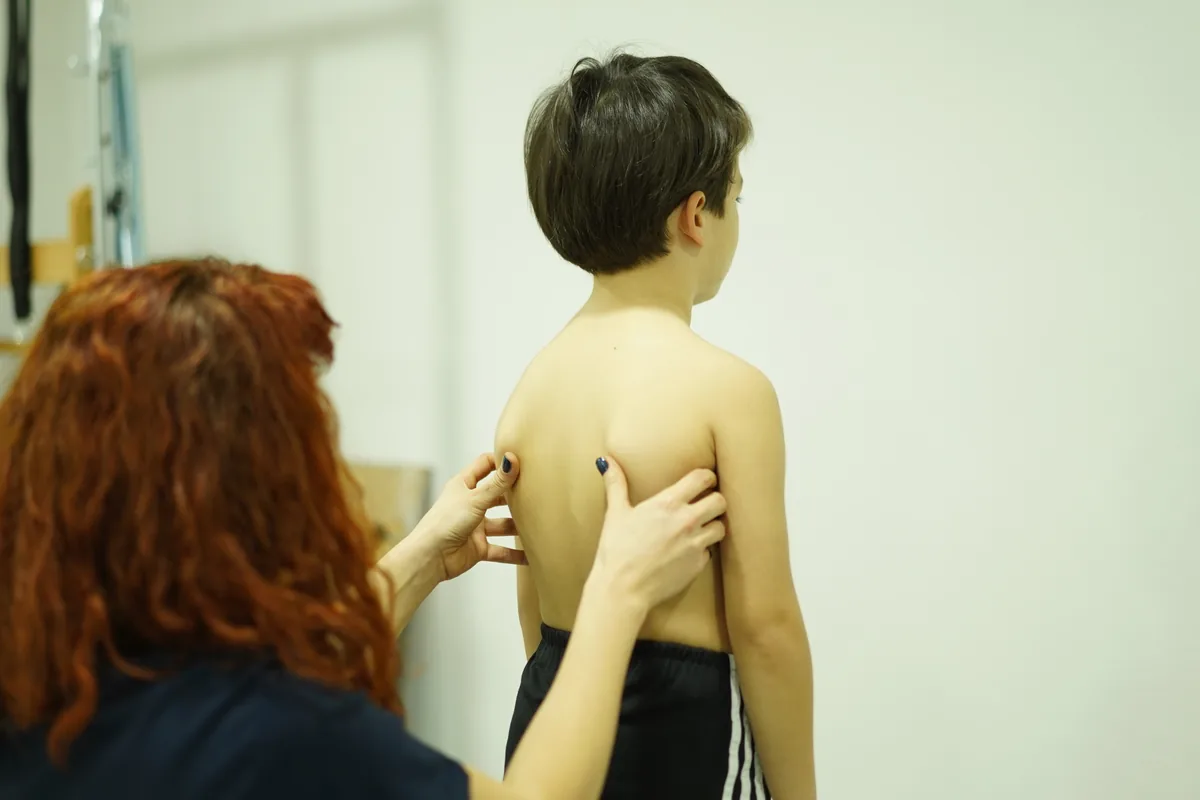
In an adolescent, the concern is progression during growth. Curve magnitude, skeletal maturity and growth remaining determine the risk, and monitoring is scheduled around growth rather than around symptoms.
In an adult, the curve is largely fixed unless degeneration drives new deformity. The goals shift entirely to pain, function, and where relevant respiratory capacity.
What changes progression in adolescents
Bracing has good evidence for reducing the risk of progression to a surgical threshold in curves within a defined range during growth, and effectiveness depends heavily on hours worn per day.
Scoliosis-specific exercise approaches — three-dimensional, curve-pattern-specific programmes rather than general exercise — have reasonable and growing evidence as an adjunct. General fitness exercise does not affect curve progression, and saying otherwise raises false expectations.
What rehabilitation offers adults
Pain management, trunk and hip strengthening, postural endurance, and maintaining function. Where degenerative changes and stenosis are contributing, those are addressed directly.
Curve correction is not a realistic goal in a mature skeleton, and we say so rather than sell a programme against it.
When surgery enters the discussion
In adolescents, curves progressing beyond a defined threshold despite bracing. In adults, progressive deformity with neurological compromise or pain that has not responded to conservative management.
Rehabilitation before and after spinal surgery meaningfully affects recovery, and prehabilitation is worth the weeks it takes.
How curves are measured and followed
The curve is measured in degrees from a standing X-ray, and a single measurement means little on its own — what matters is whether it is changing, and how much growth remains.
In an adolescent, remaining growth is the strongest predictor of progression, which is why monitoring intervals are set by skeletal maturity rather than by the calendar. In adults the question is different: curves progress slowly if at all, and the reason for treatment is usually pain or function rather than the angle.
Bracing: what it does and does not do
In a growing spine with a curve in the moderate range, bracing reduces the likelihood of progression to the point where surgery is considered. It works by resisting progression during growth; it does not straighten an established curve.
Its effectiveness depends heavily on hours worn, which makes the practical and psychological side of wearing it a clinical issue rather than a detail. Bracing has no role once growth is complete.
Scoliosis-specific exercise
General exercise is good for the back and does not change a curve. Scoliosis-specific approaches are different: they train correction of the three-dimensional deformity, breathing into the concavity, and holding corrected positions during daily activity.
The evidence base is stronger than it was and weaker than for bracing. We are straightforward about that — this work is offered for what it reliably provides, which is better trunk control, strength and postural awareness, alongside a possible effect on progression.
Pain, appearance and what actually troubles people
In adolescents the curve is usually not painful, and the concern is appearance and the fear of what will happen later. In adults, pain and reduced endurance are the reasons for coming, and they correlate poorly with the size of the curve.
Treating the number rather than the person is the common error here. The programme is aimed at what the person cannot do or cannot tolerate, and the curve is monitored alongside.
Frequently asked questions
Can exercise straighten a scoliosis?
No. No exercise programme corrects an established structural curve. What it can do is improve strength, control and endurance, and in growing spines it may contribute alongside bracing to limiting progression.
Does carrying a heavy school bag cause scoliosis?
No. Idiopathic scoliosis is not caused by bags, posture or sleeping position, and the belief that it is produces a great deal of unnecessary guilt in families.
Will my child need surgery?
Most do not. Surgery is considered for curves that progress beyond a substantial threshold despite bracing, or that are already large at presentation. Regular monitoring exists precisely so that this is decided on evidence rather than on fear.
Is scoliosis painful in adolescence?
Usually not. Significant pain in an adolescent with scoliosis needs investigation rather than reassurance, because it can point to a cause other than idiopathic curvature.
What about adults with a curve diagnosed years ago?
Adult curves change slowly and the reason to treat is symptoms rather than the angle. Strength, endurance and load management address the pain and function; the curve itself is monitored.
How often should the curve be re-checked?
During growth, at intervals set by maturity and by how fast the curve has been changing — typically every six to twelve months 1. After growth is complete, far less frequently unless symptoms change.
Sources
- 2016 SOSORT guidelines: orthopaedic and rehabilitation treatment of idiopathic scoliosis during growth — Scoliosis and Spinal Disorders (2018)
Which therapies would I actually receive?
A therapy is a single method used inside a programme. It is measured in sessions and is not sold separately.

Technologies we use




Locations
Where you can receive this treatment






Related articles
Orthopaedic Does scoliosis get worse in adulthood?
Some adult scoliosis curves stay stable for life, while others progress slowly, particularly larger curves and curves caused by age-related wear of the spine. Pain, stiffness and leg symptoms matter more than the curve angle alone. Exercise, pain management and regular monitoring suit many adults, and surgery is considered for progressive deformity or significant disability.Read morePaediatric When does scoliosis in children need a brace?
A brace is usually considered for children and adolescents who are still growing and have a moderate curve that is at risk of progressing. In a major trial, bracing reduced progression to the surgical threshold, and the benefit increased with more hours of daily wear. Small curves are usually monitored, and very large curves may need surgery.Read moreNeurological How long does it take to recover from a stroke?
Most recovery after a stroke happens in the early months, when the brain is most able to reorganise, and it continues more slowly for a longer period after that. How far someone gets depends mainly on how severe the stroke was, where it happened and how much active therapy follows.Read more



