
Medical condition
Psoriatic Arthritis
Psoriatic arthritis is an inflammatory arthritis associated with psoriasis. Early disease-modifying treatment substantially reduces long-term joint damage, so prompt rheumatology assessment matters. Exercise is a core part of management rather than an optional extra. Whole-finger swelling, heel pain and nail changes are clues even when the skin psoriasis is minimal.
How it presents, and why it is missed
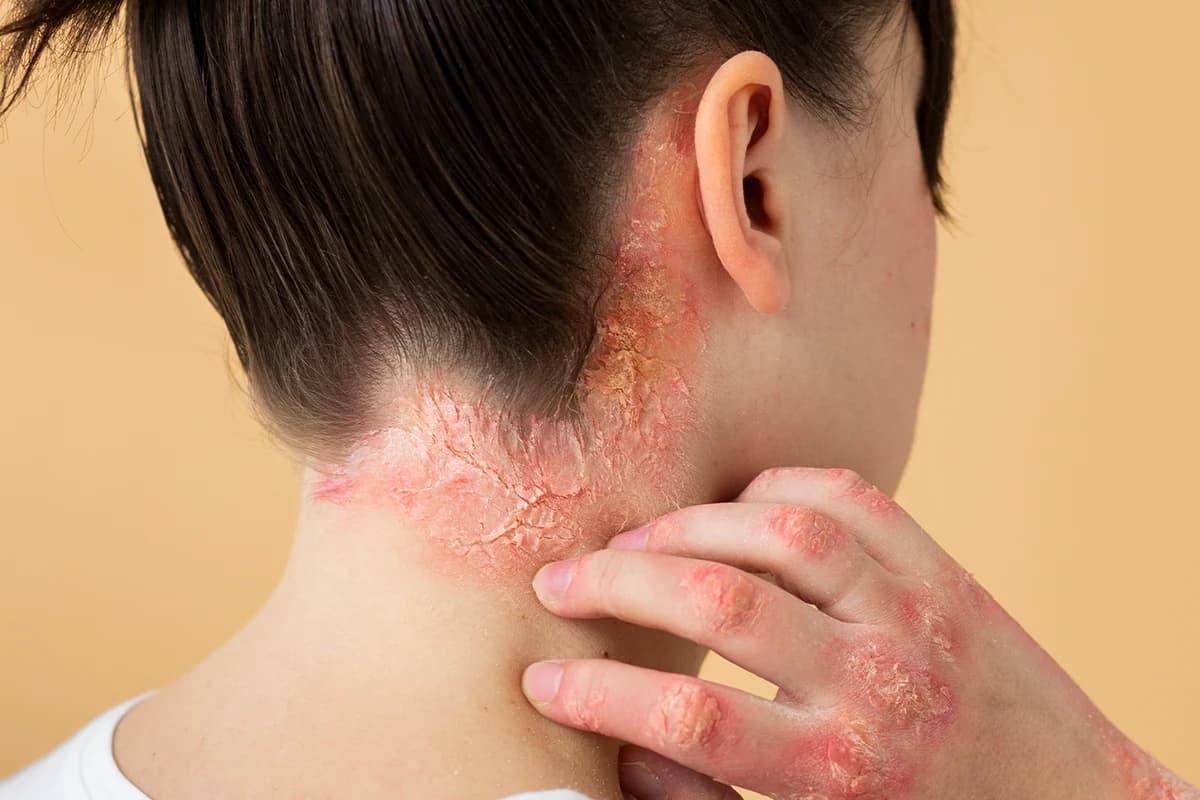
Joint pain and swelling with prolonged morning stiffness, often asymmetrical. Swelling of a whole finger or toe — dactylitis — is characteristic. Pain at tendon insertions, particularly the heel. Nail pitting or separation. Inflammatory back pain in some patients.
The skin psoriasis can be minimal, hidden in the scalp or behind the ears, or can appear years after the joints. Absence of obvious psoriasis is a common reason for delay.
Why early treatment matters
Joint damage can start early: in a cohort of 283 people with psoriatic arthritis, those first seen by a rheumatologist more than six months after symptoms began were more likely to have peripheral joint erosions and worse long-term physical function 2.
This is the single most important thing on this page: if the pattern described above fits you, ask for a rheumatology assessment rather than treating it as mechanical pain.
What rehabilitation contributes alongside medication
Maintaining range and strength, joint protection technique, managing enthesitis with graded loading rather than rest, and cardiovascular exercise — cardiovascular risk is raised in psoriatic arthritis and exercise addresses it directly.
Where the spine is involved, the exercise programme resembles that used in axial spondyloarthritis and is a core treatment rather than an adjunct.
Living with a fluctuating disease
Disease activity varies, and a programme has to flex with it. During a flare, load is reduced and range work maintained; between flares, strengthening progresses.
Fatigue is a genuine feature of inflammatory disease and is frequently underestimated. Pacing is part of the plan rather than a sign of poor motivation.
What distinguishes it from rheumatoid arthritis
Involvement of the joints at the ends of the fingers, swelling of an entire digit, pain where tendons attach to bone, and spinal involvement. Skin and nail changes may be minor or precede the arthritis by years.
These differences matter because treatment choices differ and because a patient with mild psoriasis and joint pain is frequently assessed without anyone asking about the skin.
What kind of exercise helps, and what can it not change?
European recommendations treat physical activity as an integral part of standard care throughout the course of inflammatory arthritis, including the spondyloarthritis group to which psoriatic arthritis belongs 3. The general public-health targets apply: at least 150 minutes of moderate aerobic activity a week, muscle strengthening on at least two days, and flexibility and balance work, adapted to the joints involved 4. Activity below those levels can still help people who cannot reach them 4.
In 49 trials across inflammatory arthritis and osteoarthritis, aerobic and strength training produced moderate gains in fitness and strength, and none found detrimental effects such as increased disease activity, though a few reported transient increases in pain 4. What exercise cannot do is switch off the inflammation that erodes joints. That is the role of disease-modifying medication, which European guidance recommends starting rapidly in peripheral arthritis 5.
Frequently asked questions
Can I have it without obvious psoriasis?
Yes. Arthritis can precede skin disease, and psoriasis can be limited to the scalp, navel or natal cleft where it is easily missed.
What is dactylitis?
Swelling of an entire finger or toe rather than one joint, characteristic of this condition and a marker of more active disease.
Does exercise damage the joints?
No. Appropriate exercise improves function and does not accelerate damage; uncontrolled inflammation does.
Why does my heel hurt?
Enthesitis — inflammation where the tendon attaches to bone — is common at the Achilles and plantar fascia and needs different treatment from mechanical tendinopathy.
Does it affect the spine?
In a proportion of people, producing inflammatory back pain. That changes both the medication and the exercise programme.
Sources
- Spondyloarthritis in over 16s: diagnosis and management (NG65) — National Institute for Health and Care Excellence (2017)
- Haroon M, Gallagher P, FitzGerald O. Diagnostic delay of more than 6 months contributes to poor radiographic and functional outcome in psoriatic arthritis — Annals of the Rheumatic Diseases (2015)
- Rausch Osthoff AK, Niedermann K, Braun J, Adams J, et al. 2018 EULAR recommendations for physical activity in people with inflammatory arthritis and osteoarthritis — Annals of the Rheumatic Diseases (2018)
- Rausch Osthoff AK, Juhl CB, Knittle K, Dagfinrud H, et al. Effects of exercise and physical activity promotion: meta-analysis informing the 2018 EULAR recommendations for physical activity in people with rheumatoid arthritis, spondyloarthritis and hip/knee osteoarthritis — RMD Open (2018)
- Gossec L, Kerschbaumer A, Ferreira RJO, Aletaha D, et al. EULAR recommendations for the management of psoriatic arthritis with pharmacological therapies: 2023 update — Annals of the Rheumatic Diseases (2024)
Which therapies would I actually receive?
A therapy is a single method used inside a programme. It is measured in sessions and is not sold separately.


Technologies we use




Locations
Where you can receive this treatment






Related articles
Rheumatologic Should you exercise during a rheumatoid arthritis flare?
Yes, but not the same exercise. During a flare the work shifts to gentle range of motion, positioning and protecting the inflamed joint, while strengthening and loading wait. Stopping altogether costs strength that takes far longer to rebuild than the flare takes to settle.Read moreRheumatologic How is psoriatic arthritis different from rheumatoid arthritis?
Both are inflammatory types of arthritis, but psoriatic arthritis usually occurs with psoriasis and may cause swollen whole fingers or toes, nail changes, tendon pain and spine involvement, often affecting joints unevenly. Rheumatoid arthritis typically affects small joints of both hands and feet symmetrically and is often linked with specific blood antibodies.Read moreNeurological How long does it take to recover from a stroke?
Most recovery after a stroke happens in the early months, when the brain is most able to reorganise, and it continues more slowly for a longer period after that. How far someone gets depends mainly on how severe the stroke was, where it happened and how much active therapy follows.Read more



