
Medical condition
Gout
Gout is caused by uric acid crystals in a joint and is fully controllable with urate-lowering medication taken to a target blood level. Rehabilitation manages the joint damage and function after repeated attacks; it does not replace the medical treatment that prevents them.
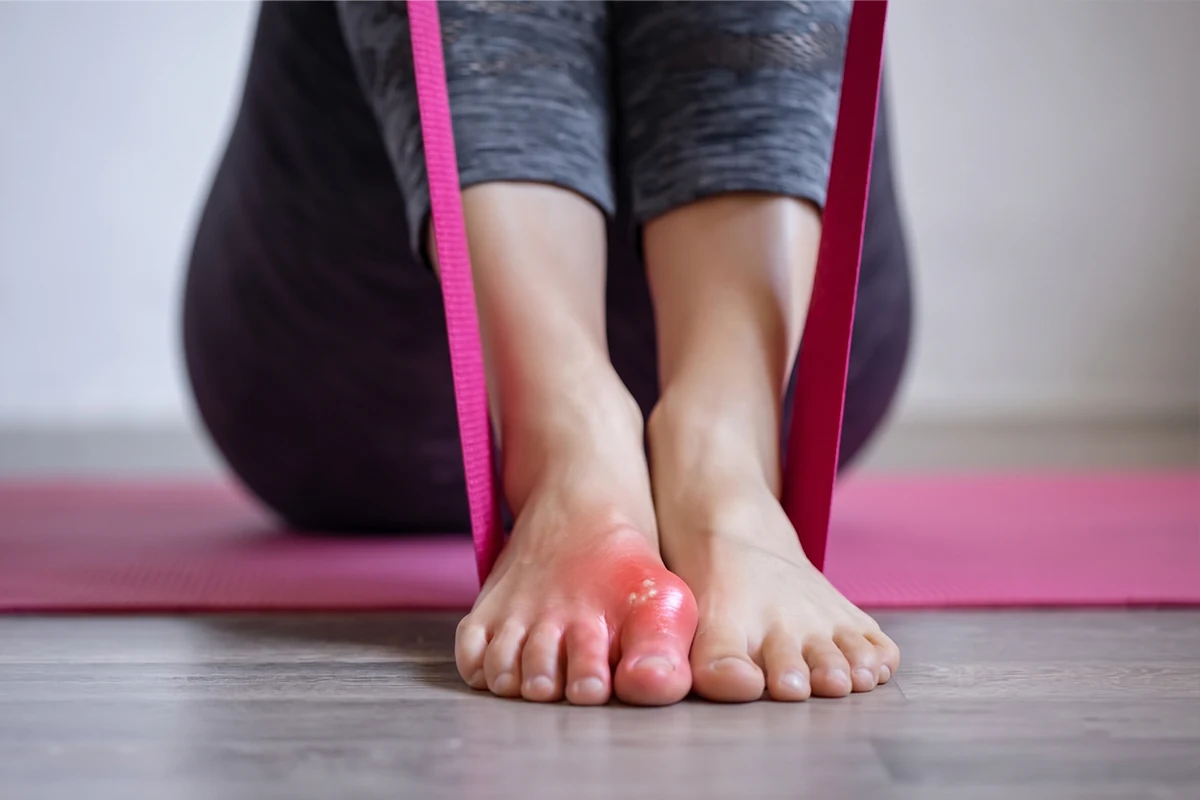
An acutely hot, swollen joint
A sudden, severe attack — most classically the base of the big toe — with a joint that is red, hot, swollen and exquisitely painful, often waking the person at night. A typical attack reaches its peak in less than 24 hours 2.
A single hot swollen joint can also be septic arthritis, an emergency infection that can rapidly damage the joint. UK guidance calls for immediate referral whenever it is suspected 1. The two can look identical and the distinction is made by joint aspiration, not by assumption.
Why it recurs, and why that is preventable
Gout is the most treatable form of inflammatory arthritis. Urate-lowering therapy taken continuously, titrated to a target serum urate level, prevents attacks and dissolves existing crystal deposits over time.
Despite that, adherence is poor and long-term control is often not achieved — frequently because treatment is started during an attack, stopped when it settles, and never titrated to target.
What rehabilitation contributes
During an attack: rest, protection and pain management, not exercise. Between attacks: restoring range and strength in joints affected by repeated inflammation, gait retraining where the foot or knee has been involved, and footwear advice.
In long-standing gout with tophi and joint damage, function-focused rehabilitation and joint protection matter as much as in other forms of arthritis.
What actually helps and what is overstated
There is not enough evidence that any specific diet prevents flares or lowers serum urate, so diet is not a substitute for medication in established gout 1. Weight management, reducing alcohol — particularly beer — and reducing sugar-sweetened drinks all help at the margin.
We say this plainly because patients are frequently given a restrictive diet instead of adequate medical treatment, and then blamed when attacks continue.
Rehabilitation between attacks, not during them
During an acute attack the joint is not exercised — it is rested, elevated and treated medically. Movement is reintroduced as inflammation settles.
The rehabilitation work happens between attacks: restoring range and strength lost during them, and addressing the weight, activity and cardiovascular risk that accompany the condition.
What does treating to target involve?
Urate-lowering medicine is started at a low dose and increased step by step, guided by monthly blood tests, until serum urate is below 360 micromol/litre (6 mg/dl) 1. A lower target, below 300 micromol/litre (5 mg/dl), is considered for people with tophi, chronic gouty arthritis or continuing flares, and once the target is reached treatment usually continues for life 1.
Starting treatment can itself trigger flares, so guidance recommends preventive anti-inflammatory medicine for at least three to six months 3. UK guidance offers colchicine first for this 1. Losing excess weight is also recommended for people who are overweight 3. But only keeping urate below target clears the crystals, so exercise, weight loss and diet support the plan without replacing it 1.
Frequently asked questions
Is gout caused by diet alone?
No. Diet contributes modestly; genetics and kidney handling of urate dominate. Blaming diet alone leaves the real driver untreated.
Should I exercise during an attack?
No. Rest the joint during the acute phase and resume as it settles. A typical attack settles within 14 days 2.
Why does it keep coming back?
Because urate-lowering treatment is often not started or not taken to target. Recurrent attacks damage joints permanently, so this is worth pursuing.
Is it only the big toe?
No — knee, ankle, midfoot, wrist and elbow are all affected, and in older people it can be polyarticular and mistaken for other arthritis.
Does it cause permanent damage?
Untreated, yes. Repeated attacks cause joint erosion and tophi, both of which are preventable with adequate treatment.
Sources
- Gout: diagnosis and management (NG219) — National Institute for Health and Care Excellence (2022)
- Neogi T, Jansen TL, Dalbeth N, Fransen J, et al. 2015 Gout classification criteria: an American College of Rheumatology/European League Against Rheumatism collaborative initiative — Annals of the Rheumatic Diseases (2015)
- FitzGerald JD, Dalbeth N, Mikuls T, Brignardello-Petersen R, et al. 2020 American College of Rheumatology guideline for the management of gout — Arthritis Care & Research (2020)
Which therapies would I actually receive?
A therapy is a single method used inside a programme. It is measured in sessions and is not sold separately.
Technologies we use




Locations
Where you can receive this treatment






Related articles
Rheumatologic What triggers a gout attack?
Gout attacks are triggered when uric acid crystals in a joint provoke sudden inflammation. Common triggers include alcohol, meals rich in purines such as red meat and seafood, dehydration, illness and some medicines. In studies of people with gout, higher alcohol and purine intake increased the short-term risk of attacks. Long-term urate-lowering treatment prevents most attacks.Read moreNeurological How long does it take to recover from a stroke?
Most recovery after a stroke happens in the early months, when the brain is most able to reorganise, and it continues more slowly for a longer period after that. How far someone gets depends mainly on how severe the stroke was, where it happened and how much active therapy follows.Read moreNeurological Can you walk again after a stroke?
Many people walk again after a stroke, including many who cannot stand at first. The chances are highest when some leg movement returns early and when walking practice starts as soon as it is safe. Walking often comes back before full arm recovery, sometimes with a stick, splint or other support.Read more



