
Medical condition
Golfer's Elbow (Medial Epicondylitis)
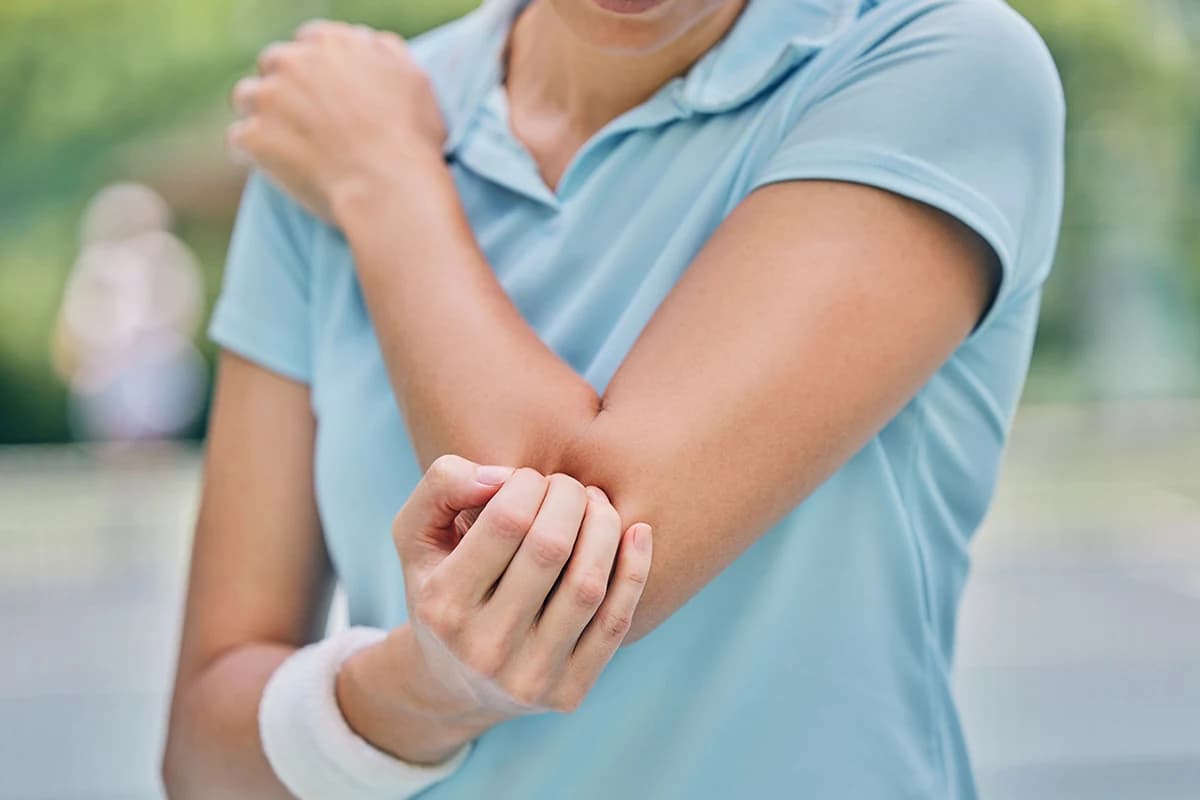
Golfer's elbow is pain at the inner elbow where the wrist flexor tendons attach. Despite the name, most patients have never played golf — it comes from repeated gripping and wrist flexion. It is a tendon that has failed to remodel under load, not an inflammation, and progressive loading is the treatment.
Not inflammation, despite the name
The suffix "-itis" is a historical mistake. Tissue samples show degenerative change and disorganised collagen, not inflammatory cells. This is why anti-inflammatory treatment gives short-lived relief and why rest alone leaves the tendon just as unable to tolerate load as before.
The practical consequence: the tendon has to be loaded to recover, gradually and in a controlled way, and that takes months rather than weeks.
What actually works
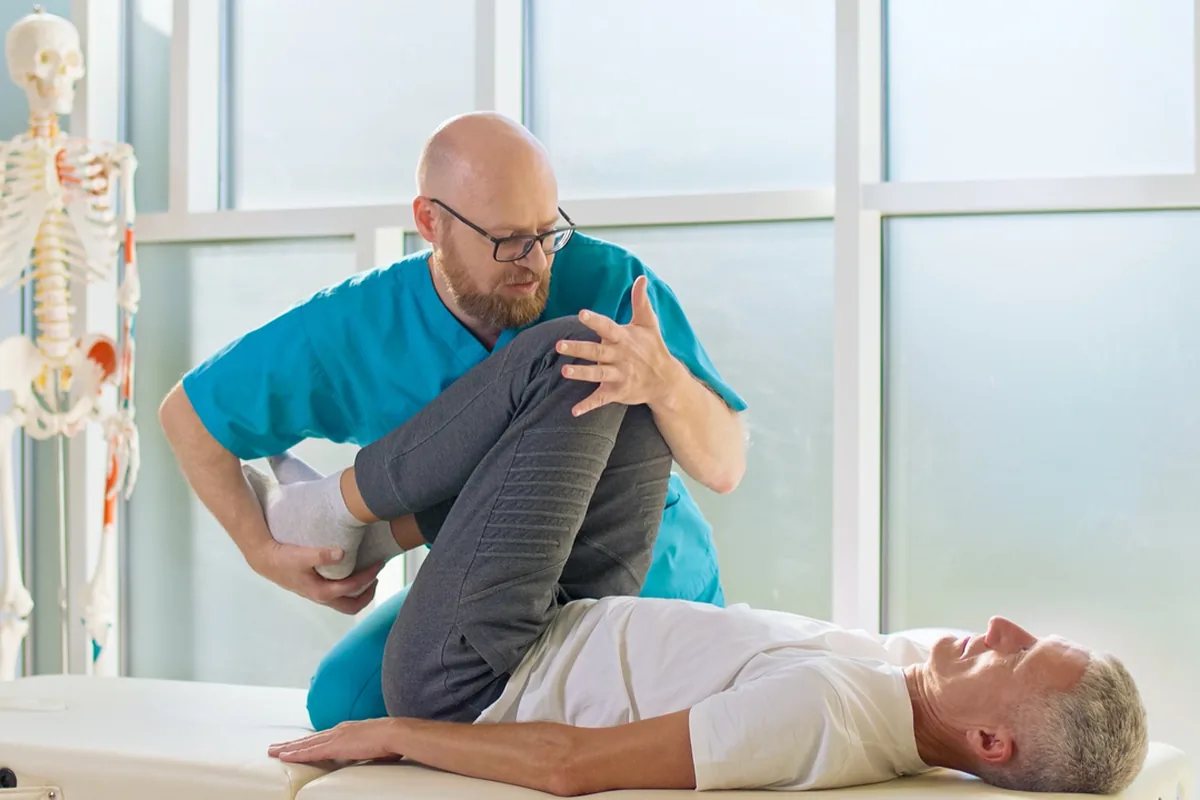
Progressive resistance work for the wrist flexors and pronators, combined with correcting the load that caused it — grip size, technique, workstation, or the training error in a throwing athlete. Shockwave therapy has little supporting evidence at the inner elbow: in an early study of 30 patients with long-standing golfer's elbow, only 7 had a good or excellent result at one year, clearly worse than identically treated tennis elbow 1.
Corticosteroid injection reduces pain only in the short term: in a randomised trial at the inner elbow, the benefit seen at six weeks had gone by three months 2. In tennis elbow, a larger randomised trial found that an injection led to worse results at one year than a placebo injection 3. We will say that to a patient asking for an injection rather than simply providing one.
What else can cause inner elbow pain
Ulnar nerve irritation at the elbow produces pain in a similar area but with tingling in the ring and little fingers. Medial collateral ligament injury in throwing athletes is a different problem with different consequences. Both are checked before treating the tendon.
The nerve that complicates it
The ulnar nerve runs immediately behind the inner elbow, and irritation there produces tingling in the ring and little fingers alongside the tendon pain.
When both are present the treatment has to address each, and loading a tendon while an irritated nerve is being compressed by the same activity does not work. This is checked at assessment rather than assumed.
How strong is the evidence for golfer's elbow treatments?
Thinner than for tennis elbow, because far fewer trials have been done at the inner elbow. A systematic review of exercise and manual therapy for elbow tendon pain found 12 randomised trials, and every one of them was in tennis elbow 4. A 2026 review of eccentric exercise for golfer's elbow found only five studies, with 143 patients in total: pain and function improved, but the certainty of the evidence was low 5. In practice, treatment borrows its principles from tennis elbow and other tendon problems, and progress is judged on the individual patient's pain and grip rather than on a published timetable.
What if it does not settle — is surgery an option?
For most people it does not come to that: non-operative treatment has high success rates, and surgery is reserved for symptoms that persist despite a thorough course of it 6. A systematic review of 16 studies covering 479 elbows reported surgical success rates between 63% and 100% and a complication rate of 4.3% 6.
The review rated its evidence as low level, and it could not establish whether open, arthroscopic or percutaneous surgery is better 6. Because the ulnar nerve runs just behind the inner elbow, nerve symptoms are assessed before any procedure is considered.
Frequently asked questions
Is it caused by golf?
In a minority. Occupational gripping, lifting and repetitive forearm work account for most cases, and the name misleads people who have never played.
How is it different from tennis elbow?
Location. Golfer’s elbow affects the tendons on the inner side, tennis elbow the outer. The mechanism and the treatment principles are the same.
How long does it take?
Consistent loading over a period of weeks to months for meaningful change, often longer for full resolution.
Are injections useful?
What if I have tingling in my fingers?
That suggests ulnar nerve involvement alongside the tendon problem, and it changes the programme. It is worth mentioning rather than assuming it is part of the same thing.
Sources
- Krischek O, Hopf C, Nafe B, Rompe JD. Shock-wave therapy for tennis and golfer's elbow — 1 year follow-up — Archives of Orthopaedic and Trauma Surgery (1999)
- Stahl S, Kaufman T. The efficacy of an injection of steroids for medial epicondylitis: a prospective study of sixty elbows — The Journal of Bone and Joint Surgery (American volume) (1997)
- Coombes BK, Bisset L, Brooks P, Khan A, et al. Effect of corticosteroid injection, physiotherapy, or both on clinical outcomes in patients with unilateral lateral epicondylalgia: a randomized controlled trial — JAMA (2013)
- Hoogvliet P, Randsdorp MS, Dingemanse R, Koes BW, et al. Does effectiveness of exercise therapy and mobilisation techniques offer guidance for the treatment of lateral and medial epicondylitis? A systematic review — British Journal of Sports Medicine (2013)
- See ZH, Loo CE, Jaafar Z. Eccentric exercise therapy for medial epicondylitis: a systematic review of clinical outcomes — Complementary Therapies in Medicine (2026)
- Arevalo A, Rao S, Willier DP, Schrock CI, et al. Surgical techniques and clinical outcomes for medial epicondylitis: a systematic review — The American Journal of Sports Medicine (2023)
Which therapies would I actually receive?
A therapy is a single method used inside a programme. It is measured in sessions and is not sold separately.
Technologies we use




Locations
Where you can receive this treatment





Related articles
Neurological How long does it take to recover from a stroke?
Most recovery after a stroke happens in the early months, when the brain is most able to reorganise, and it continues more slowly for a longer period after that. How far someone gets depends mainly on how severe the stroke was, where it happened and how much active therapy follows.Read moreNeurological Can you walk again after a stroke?
Many people walk again after a stroke, including many who cannot stand at first. The chances are highest when some leg movement returns early and when walking practice starts as soon as it is safe. Walking often comes back before full arm recovery, sometimes with a stick, splint or other support.Read moreNeurological Will my arm and hand recover after a stroke?
Arm and hand recovery after a stroke varies more than walking recovery. Early return of some shoulder or finger movement makes useful recovery much more likely. Repeated, meaningful practice of reaching, grasping and releasing is what drives improvement, and even a partly recovered hand can be trained to help with daily tasks.Read more



