

Medical condition
After Spinal Surgery
Rehabilitation after spinal surgery follows the operating surgeon's protocol, which differs substantially between a discectomy, a decompression and a fusion. Structured rehabilitation after lumbar surgery improves function more than no programme or usual care, although the trial evidence is of low to moderate quality. The operation note and the surgeon's protocol are requested in writing before admission.

The operation determines the programme
After a discectomy, early mobilisation and a graded return to activity are appropriate and recovery is relatively quick. After a decompression, walking tolerance is the main target. After a fusion, there is a protected period while the fusion consolidates and loading is restricted for months.
Applying a discectomy protocol after a fusion risks the construct. This is why we ask for the operation note and the surgeon's protocol in writing before admission rather than inferring it from the procedure name.
What the evidence supports
After lumbar disc surgery, exercise programmes starting four to six weeks after the operation reduce pain and disability faster than no treatment, and higher-intensity programmes do slightly better than low-intensity ones, but the evidence is of low or very low quality 2. Programmes started immediately after surgery have not proved better than their comparison treatments, and no trial has linked exercise to more reoperations 2.
Whether prehabilitation before planned lumbar surgery improves recovery is uncertain: a 2021 meta-analysis found that preoperative cognitive behavioural programmes added nothing to usual care, and only one trial of preoperative exercise was available, showing a short-term benefit 5.
What the programme contains
Early walking progression, trunk and hip strengthening within the permitted range, movement retraining for daily tasks — getting out of bed, lifting, bending — and graded return to work and activity.
Fear of movement is common and specifically addressed. Many patients protect the back long after it is necessary, and that avoidance becomes the limiting factor rather than the surgery.
What to report rather than wait on
New or worsening leg weakness, new numbness around the groin, loss of bladder or bowel control, wound discharge, or fever. These are surgical concerns and need same-day contact with the operating team.
Increasing rather than decreasing pain after an initial improvement is also worth reporting rather than working through.
The protocol comes from the surgeon, not from us
What was fused, what was decompressed, whether instrumentation was used and what the weight-bearing and bending restrictions are — these govern the first phase entirely.
Where the surgeon is abroad we work to their written protocol and report back. Where a restriction is unclear we ask rather than assume, because the cost of guessing falls on the surgery.
Does rehabilitation help after decompression or fusion?
After decompression for lumbar spinal stenosis, yes, modestly. A Cochrane review of three trials with 373 patients found moderate-quality evidence that active rehabilitation improves function and back pain more than usual care, both within six months and at 12 months, when leg pain was also lower 3. The authors judged the effects small to medium, and no relevant adverse events were reported 3.
After lumbar fusion the evidence is thinner. Two small trials of programmes combining exercise with cognitive behavioural therapy found less disability and less fear-avoidance behaviour than usual care, in the short and the longer term, but the evidence is of low quality 4. After fusion, any programme also has to work within the restrictions the surgeon sets while the bone heals.
Frequently asked questions
When can rehabilitation start after spinal surgery?
Early mobilisation usually begins in hospital. Structured rehabilitation typically starts within weeks, at a point set by the operation and the surgeon.
Will surgery fix my pain completely?
Frequently it improves leg pain more reliably than back pain. Satisfaction afterwards is linked to whether expectations are met: they often exceed the actual result, and in the better-quality studies a larger gap meant lower satisfaction 6.
What should I report rather than wait?
New or worsening weakness, changes in bladder or bowel control, fever, or a wound that becomes red, hot or discharges. Those need same-day contact.
Is exercise safe after fusion?
Yes, within the protocol, and it is necessary — the muscles deconditioned by pain and surgery do not recover on their own.
How long is recovery?
For most procedures it takes several months before the final picture is clear, longer after multi-level fusion. Progress is not linear and plateaus are normal.
Sources
- Low back pain and sciatica in over 16s: assessment and management (NG59) — National Institute for Health and Care Excellence (2020)
- Oosterhuis T, Costa LOP, Maher CG, de Vet HCW, et al. Rehabilitation after lumbar disc surgery — Cochrane Database of Systematic Reviews (2014)
- McGregor AH, Probyn K, Cro S, Doré CJ, et al. Rehabilitation following surgery for lumbar spinal stenosis — Cochrane Database of Systematic Reviews (2013)
- Greenwood J, McGregor A, Jones F, Mullane J, et al. Rehabilitation following lumbar fusion surgery: a systematic review and meta-analysis — Spine (2016)
- Janssen ERC, Punt IM, Clemens MJ, Staal JB, et al. Current prehabilitation programs do not improve the postoperative outcomes of patients scheduled for lumbar spine surgery: a systematic review with meta-analysis — Journal of Orthopaedic & Sports Physical Therapy (2021)
- Witiw CD, Mansouri A, Mathieu F, Nassiri F, et al. Exploring the expectation-actuality discrepancy: a systematic review of the impact of preoperative expectations on satisfaction and patient reported outcomes in spinal surgery — Neurosurgical Review (2018)
Which therapies would I actually receive?
A therapy is a single method used inside a programme. It is measured in sessions and is not sold separately.
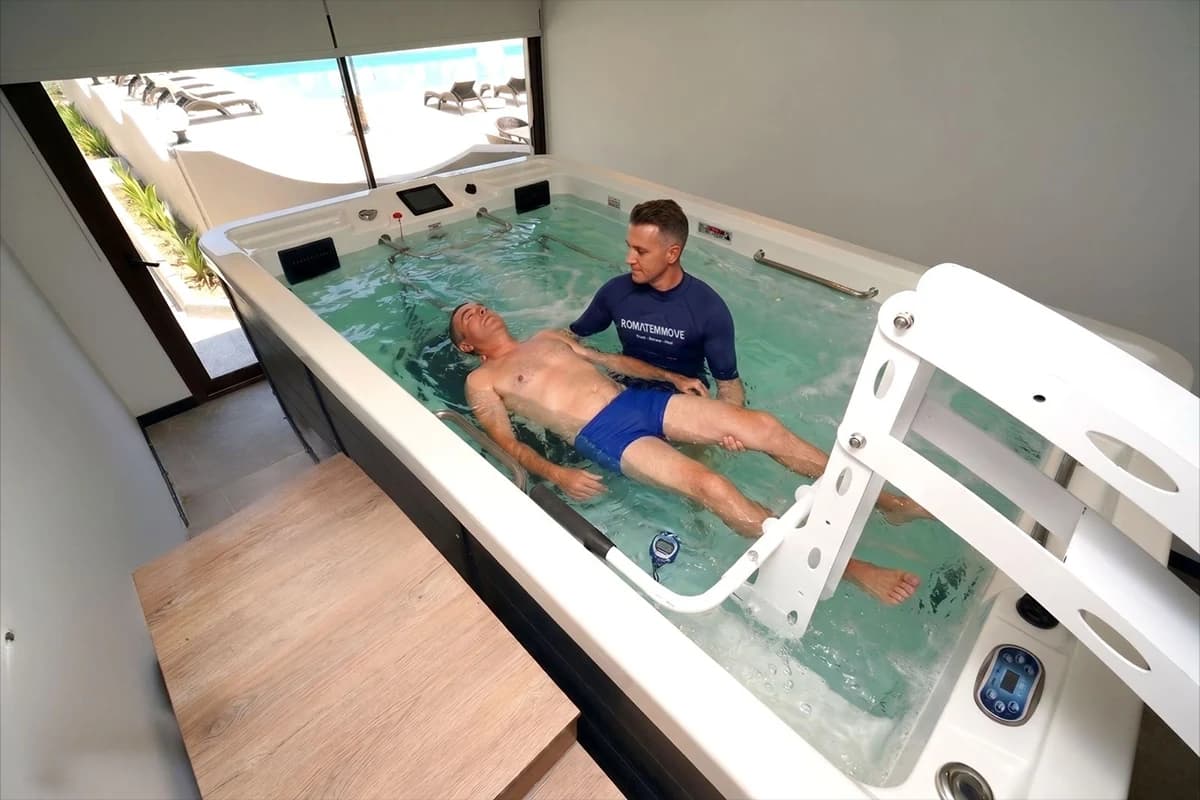

Technologies we use




Locations
Where you can receive this treatment






Related articles
Orthopaedic What is recovery like after lumbar spinal fusion?
Recovery after lumbar spinal fusion takes months. Most people walk within a day or two, return to light activities within weeks, and continue improving for a long time as the bones fuse. Rehabilitation that combines exercise with approaches that address fear of movement may reduce disability more than usual care.Read moreNeurological How long does it take to recover from a stroke?
Most recovery after a stroke happens in the early months, when the brain is most able to reorganise, and it continues more slowly for a longer period after that. How far someone gets depends mainly on how severe the stroke was, where it happened and how much active therapy follows.Read moreNeurological Can you walk again after a stroke?
Many people walk again after a stroke, including many who cannot stand at first. The chances are highest when some leg movement returns early and when walking practice starts as soon as it is safe. Walking often comes back before full arm recovery, sometimes with a stick, splint or other support.Read more



