
Medical condition
Achilles Tendinopathy
Achilles tendinopathy is a load-related degenerative tendon condition, not an inflammation. Progressive loading — heavy, slow and sustained over months — is the treatment with the strongest evidence. Sudden severe pain with a snapping sensation is a rupture and needs same-day assessment.
Recognising it, and recognising what it is not
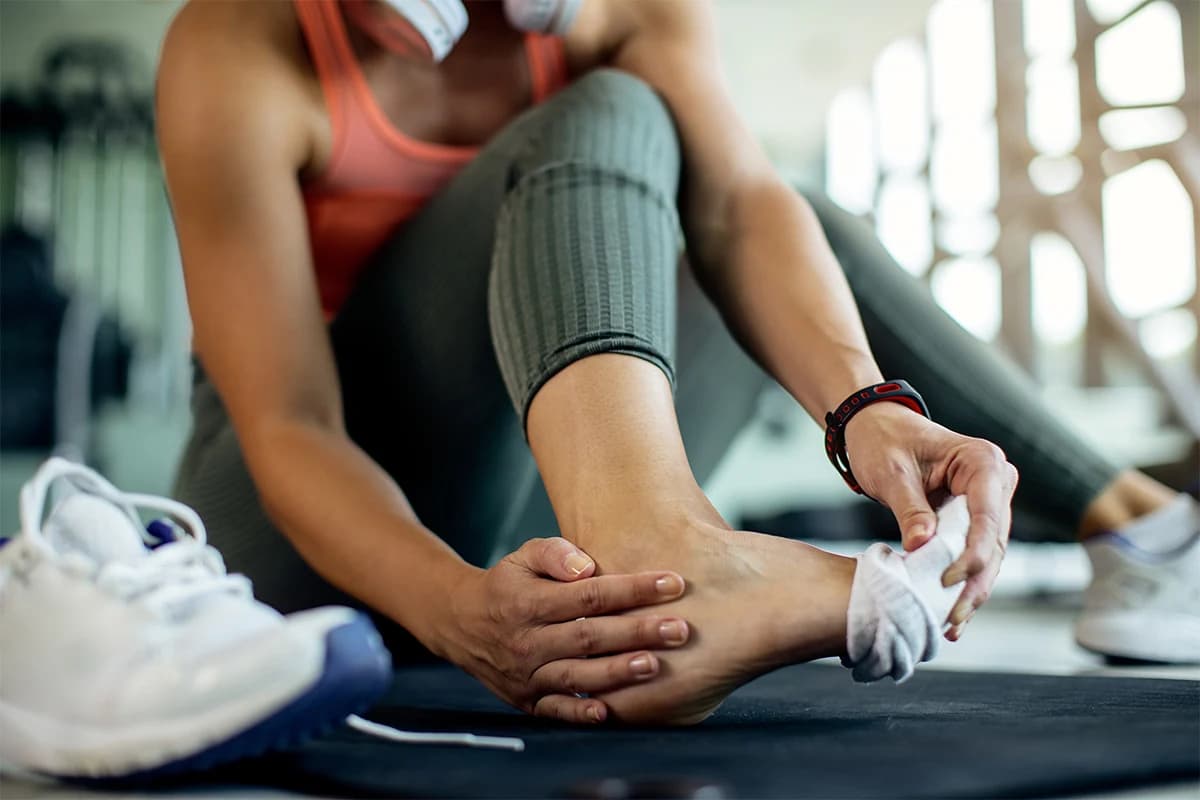
Pain and stiffness in the tendon, worst in the morning and at the start of activity, often warming up as you move and returning afterwards. A thickened, tender area either mid-tendon or at the heel bone insertion.
A sudden sharp pain with a sense of being struck or kicked in the back of the ankle, with difficulty pushing off, is an Achilles rupture. That needs same-day assessment, not a rehabilitation appointment.
Mid-portion and insertional behave differently
Mid-portion tendinopathy, a few centimetres above the heel, responds well to the standard loading protocols including exercises through full dorsiflexion.
Insertional tendinopathy, at the attachment to the heel bone, is aggravated by that same full dorsiflexion. It needs loading within a reduced range and often a heel raise. Treating the two identically is a common reason a programme fails.
The loading programme
In the irritable phase, loading starts at a level the tendon tolerates; isometric holds are well tolerated, although a trial of 91 patients found they gave no immediate pain relief 2. Heavy slow resistance calf work follows — typically three sessions a week for at least twelve weeks 1. Load is progressed on a schedule; some pain during and shortly after exercise is acceptable.
Running or jumping volume is reduced rather than stopped where possible, because complete rest reduces tendon capacity and symptoms return on resumption.
Timeframes and risks
Twelve weeks is the minimum for a fair trial and many people need longer 1. Shockwave therapy is a reasonable adjunct to loading in persistent mid-portion cases, where a systematic review found moderate-quality evidence for it; for insertional tendinopathy that evidence is lacking 3.
Corticosteroid injection into or around the Achilles is avoided — it is associated with tendon rupture. Fluoroquinolone antibiotics also raise rupture risk and are worth mentioning if you are taking one.
Why the two types need different loading
Mid-portion tendinopathy tolerates full range loading including heel drops below the step. Insertional tendinopathy, at the bone, is aggravated by that same movement because it compresses the tendon against the heel bone.
Loading for insertional problems is kept within a neutral range at first. Applying the mid-portion protocol unchanged to an insertional tendon is a common error: in an early series, twelve weeks of full-range eccentric training gave a satisfactory result in 89% of mid-portion tendons but only 32% of insertional ones 4.
Can I keep running while the tendon recovers?
Often yes, at a reduced and monitored load. In a randomised trial of 38 patients, those who kept running and jumping while following a pain-monitoring model did as well over 12 months as those who stopped these activities for the first six weeks 5. Both groups followed the same progressive calf-loading programme, so the running was an addition to the exercises rather than a replacement for them 5.
Returning to full sport is a separate step. Recovery can take up to a year and recurrence is common, especially during the return to sport, so the plan takes into account the severity of symptoms, the impairments that remain and the demands of the sport 6.
Frequently asked questions
How long does it take?
Should I stop running?
Reduce rather than stop. The load that does not flare symptoms the next morning is the starting point, and it is built up from there.
Is a steroid injection an option?
Around the Achilles it is generally avoided — the rupture risk with steroid in this tendon is a genuine concern.
What about heel raises in shoes?
They reduce load on the tendon and help symptoms in the short term, particularly in insertional problems. They are a support during loading rather than a treatment.
When should I worry about rupture?
A sudden sharp pain with a sense of being struck at the back of the ankle, and difficulty pushing off. That needs assessment the same day.
Sources
- Achilles Pain, Stiffness, and Muscle Power Deficits: Midportion Achilles Tendinopathy Revision 2018 — Journal of Orthopaedic & Sports Physical Therapy (2018)
- van der Vlist AC, van Veldhoven PLJ, van Oosterom RF, Verhaar JAN, et al. Isometric exercises do not provide immediate pain relief in Achilles tendinopathy: a quasi-randomized clinical trial — Scandinavian Journal of Medicine & Science in Sports (2020)
- Paantjens MA, Helmhout PH, Backx FJG, van Etten-Jamaludin FS, et al. Extracorporeal shockwave therapy for mid-portion and insertional Achilles tendinopathy: a systematic review of randomized controlled trials — Sports Medicine – Open (2022)
- Fahlström M, Jonsson P, Lorentzon R, Alfredson H. Chronic Achilles tendon pain treated with eccentric calf-muscle training — Knee Surgery, Sports Traumatology, Arthroscopy (2003)
- Silbernagel KG, Thomeé R, Eriksson BI, Karlsson J. Continued sports activity, using a pain-monitoring model, during rehabilitation in patients with Achilles tendinopathy: a randomized controlled study — The American Journal of Sports Medicine (2007)
- Silbernagel KG, Crossley KM. A proposed return-to-sport program for patients with midportion Achilles tendinopathy: rationale and implementation — Journal of Orthopaedic & Sports Physical Therapy (2015)
Which therapies would I actually receive?
A therapy is a single method used inside a programme. It is measured in sessions and is not sold separately.
Technologies we use




Locations
Where you can receive this treatment






Related articles
Sports Should you rest or exercise with Achilles tendon pain?
For most people with Achilles tendinopathy, progressive loading exercise works better than complete rest. Exercise programmes such as heavy slow resistance or eccentric calf training improve pain and function over a period of weeks. Activity can often continue with adjustments. Sudden pain with a snap and weakness may indicate a rupture and needs urgent assessment.Read moreNeurological How long does it take to recover from a stroke?
Most recovery after a stroke happens in the early months, when the brain is most able to reorganise, and it continues more slowly for a longer period after that. How far someone gets depends mainly on how severe the stroke was, where it happened and how much active therapy follows.Read moreNeurological Can you walk again after a stroke?
Many people walk again after a stroke, including many who cannot stand at first. The chances are highest when some leg movement returns early and when walking practice starts as soon as it is safe. Walking often comes back before full arm recovery, sometimes with a stick, splint or other support.Read more



