

Medical condition
Knee Osteoarthritis (Gonarthrosis)
Knee osteoarthritis is wear of the joint cartilage with pain, stiffness and a knee that gives less than it used to. Exercise-based rehabilitation is the best-evidenced treatment short of surgery: it reduces pain and improves function in most people, and a measured programme tells you whether a replacement can wait.
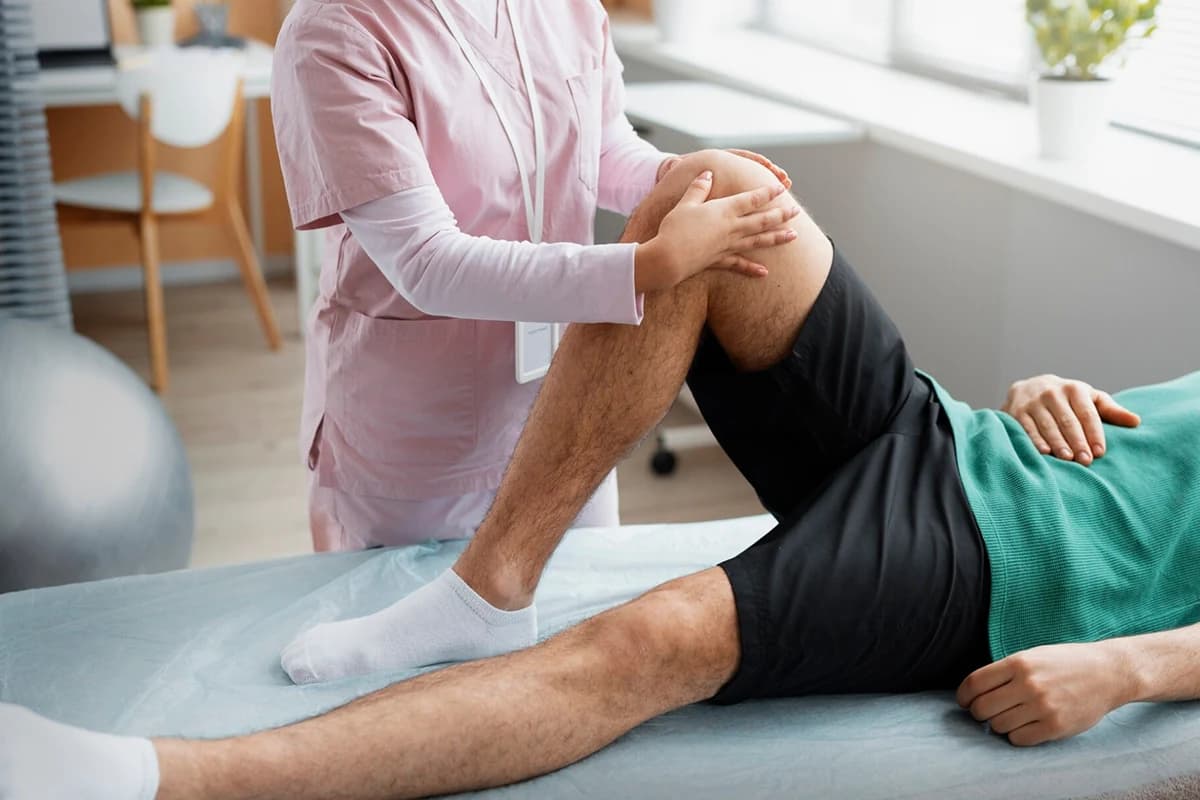
What is happening in the knee
The cartilage that lets the joint surfaces glide has thinned, the bone beneath it has thickened and the joint lining is intermittently inflamed. The pain comes from the bone and the lining, not the cartilage, which is why an X-ray that looks terrible can belong to a knee that hurts little, and the reverse.
What the patient notices is stiffness after sitting, pain on stairs — coming down more than going up — swelling after a long day, and a knee that no longer straightens or bends fully. Muscle around the joint wastes quickly once the knee is used less, and that weakness then adds its own pain.
Exercise is the treatment, not the warm-up to it
Corticosteroid injections give only short-term relief 3 and arthroscopic surgery is recommended against in nearly all worn knees 2, whereas exercise, including strengthening of the thigh muscles, has high-quality evidence for reducing pain in knee osteoarthritis, with the benefit still measurable two to six months after the programme ends 1. The programme is built on that: progressive loading of the quadriceps and hip muscles, range work, and walking retraining.
Hydrotherapy lets a painful knee begin loading in water before it tolerates the same work on land, and is where most programmes start. Laser, shockwave and radiofrequency are used for pain so that the exercise can happen, not instead of it.
What we measure, and what it decides
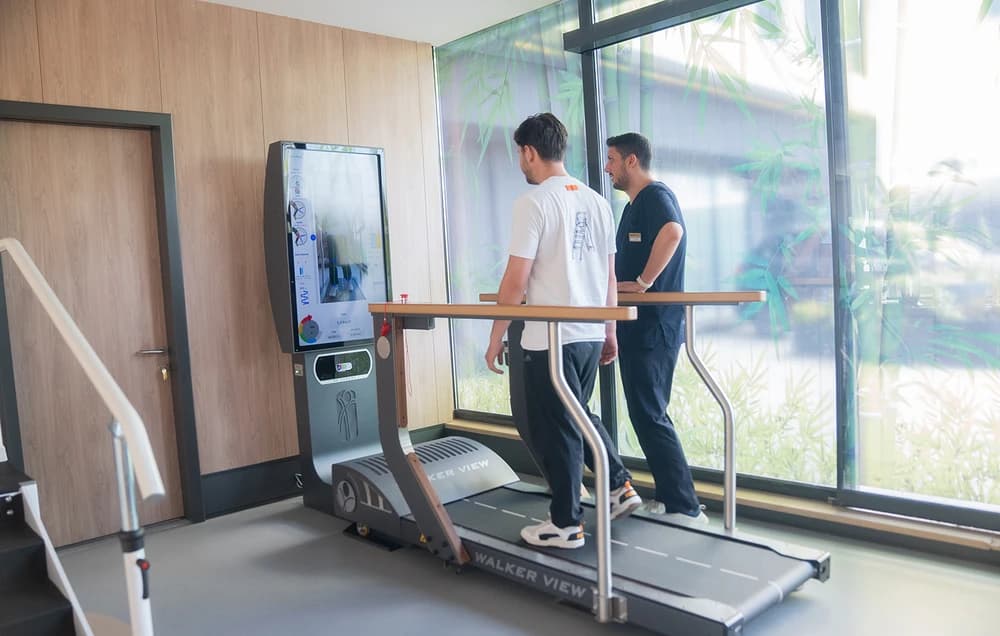
Range of motion, thigh strength, walking speed, the time it takes to rise from a chair and climb a flight of stairs, and a validated knee score are recorded at the start and the end. The gait laboratory shows how the other knee and the back are compensating, which matters for the joint that is not yet painful.
Those figures are what we use to answer the question most patients arrive with: whether a replacement can wait. A knee that improves measurably on the programme can usually wait; one that does not, despite good adherence, is telling you something, and we say so.
When the joint is beyond rehabilitation
Night pain that no longer responds, a joint that has lost most of its range, or a deformity that is progressing are the signs that the knee has passed the point where exercise can hold it. At that stage rehabilitation is planned around the operation: exercise before a replacement improves strength and function afterwards, although the effect fades and is mostly confined to the first six months 6.
Weight matters: in a trial of overweight older adults with knee osteoarthritis, each kilogram of weight lost was associated with about four kilograms less load on the knee with every step 4, and the dietitian is part of the programme where that applies.
Frequently asked questions
Will exercise damage a worn knee further?
Do injections help?
Is arthroscopy an option?
For osteoarthritis, no. Trials have shown no benefit over exercise, and guidelines strongly recommend against it 2.
How do I know when I need a replacement?
When pain and function fail to improve on a properly delivered programme, especially with night pain and loss of range. The measurements from the programme are the evidence, and they go with you to the surgeon.
Can both knees be treated together?
Yes, and usually should be, because the less painful knee is carrying the extra load.
Sources
- Fransen M, McConnell S, Harmer AR, Van der Esch M, et al. Exercise for osteoarthritis of the knee — Cochrane Database of Systematic Reviews (2015)
- Siemieniuk RAC, Harris IA, Agoritsas T, Poolman RW, et al. Arthroscopic surgery for degenerative knee arthritis and meniscal tears: a clinical practice guideline — BMJ (2017)
- Kolasinski SL, Neogi T, Hochberg MC, Oatis C, et al. 2019 American College of Rheumatology/Arthritis Foundation guideline for the management of osteoarthritis of the hand, hip, and knee — Arthritis Care & Research (2020)
- Messier SP, Gutekunst DJ, Davis C, DeVita P. Weight loss reduces knee-joint loads in overweight and obese older adults with knee osteoarthritis — Arthritis & Rheumatism (2005)
- Bricca A, Juhl CB, Steultjens M, Wirth W, et al. Impact of exercise on articular cartilage in people at risk of, or with established, knee osteoarthritis: a systematic review of randomised controlled trials — British Journal of Sports Medicine (2019)
- Keogh JAJ, Keng I, Dhillon DS, Bourgeault-Gagnon Y, et al. The effects of structured prehabilitation on postoperative outcomes following total hip and total knee arthroplasty: an overview of systematic reviews and meta-analyses of randomized controlled trials — Journal of Orthopaedic & Sports Physical Therapy (2025)
Which therapies would I actually receive?
A therapy is a single method used inside a programme. It is measured in sessions and is not sold separately.
Technologies we use



Locations
Where you can receive this treatment






Related articles
 Orthopaedic
How long does recovery take after a knee replacement?
Most people move quickly from a walking frame to managing without an aid indoors. The part patients are rarely told is that strength and confidence keep improving for a long time afterwards, and that the early weeks of the programme set how far that improvement goes.Read moreOrthopaedic Why does my knee hurt when going down stairs?
Knee pain going down stairs often comes from the joint behind the kneecap, known as patellofemoral pain, or from knee osteoarthritis. Descending stairs places high load on the front of the knee. Strengthening the hip and thigh muscles, adjusting activity levels and, in the short term, taping or foot orthoses usually help reduce pain.Read moreRheumatologic Is walking good for knee osteoarthritis?
Yes, for most people walking is safe and helpful with knee osteoarthritis. Exercise reduces pain and improves function, and in a large observational study people who walked for exercise were less likely to develop frequent knee pain. Start at a comfortable distance, build up gradually and combine walking with strengthening exercises for greater benefit.Read more



