

Medical condition
Hip Osteoarthritis (Coxarthrosis)
Hip osteoarthritis causes groin or thigh pain, a stiff hip that makes socks and shoes difficult, and a shortening stride. Strengthening the muscles around the hip and restoring range reduces pain and improves function, and can delay replacement; when the joint is beyond that, rehabilitation is planned around the operation rather than instead of it.
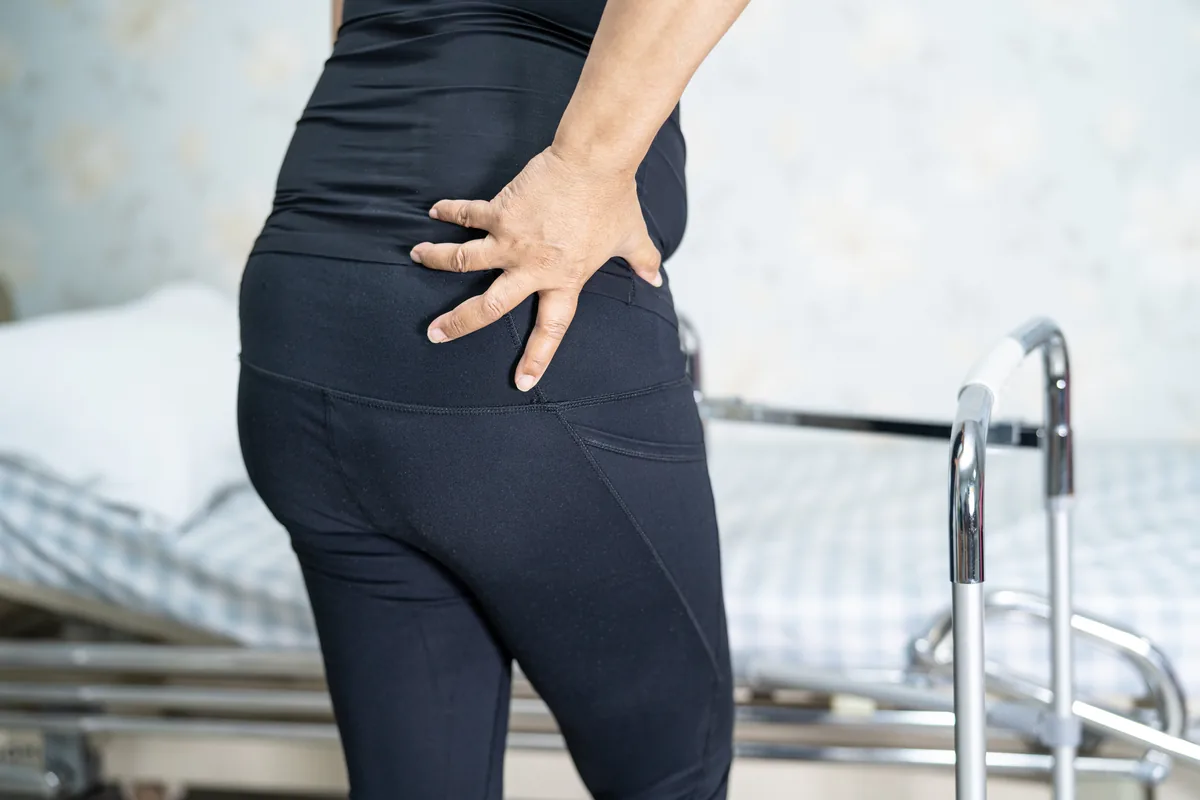
Why hip arthritis is often missed
The hip refers its pain to the groin, the front of the thigh and sometimes the knee, so a painful hip is regularly treated as a back or knee problem for months. The signs that point to the hip are stiffness rather than instability, difficulty reaching the foot, a limp that appears with distance, and pain on turning the leg inwards.
By the time the diagnosis is made, the muscles around the joint — the gluteals above all — have usually weakened, and that weakness produces the limp and the back pain that come with it.
What the programme works on
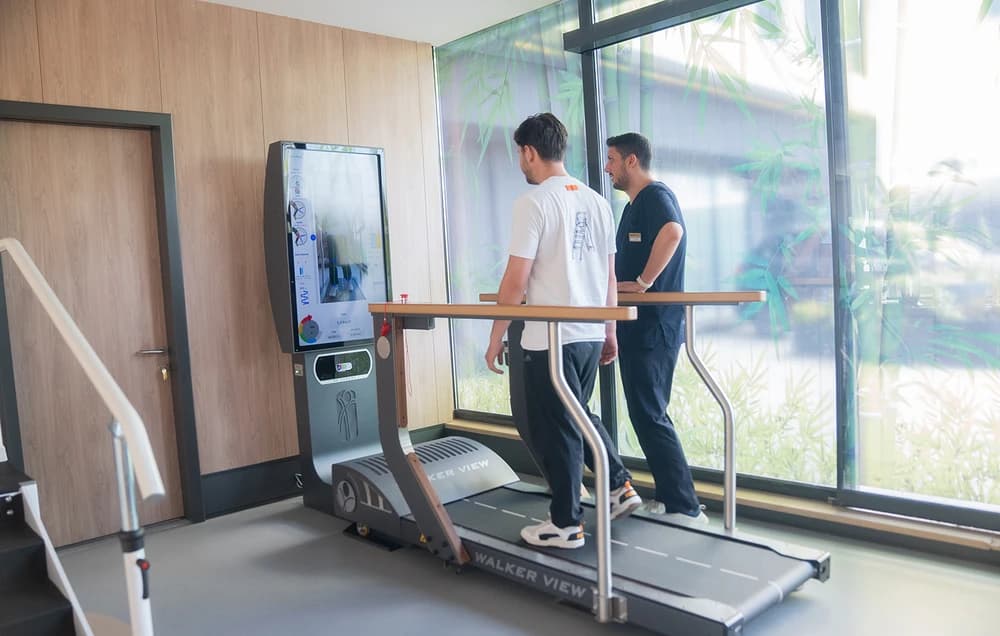
Strength in the muscles that control the hip, range of motion, and the way the leg is used in walking and in rising from a chair. Hydrotherapy starts the loading where land exercise is too painful; the functional training system and the gait laboratory take it on from there.
Pain treatments — laser, radiofrequency, and where indicated an image-guided injection — are used to make the exercise possible. They are not the programme.
What is measured
Hip range, gluteal strength, walking speed and stride, the chair-rise test and a validated hip score, at the start and the end. The gait analysis shows the compensation in the back and the other leg, which is where the next problem would otherwise come from.
The figures are reported whether or not they moved, because a hip that does not improve on a well-delivered programme is a hip that is telling you the timing of surgery.
Around a replacement
Hip replacement is one of the most successful operations in medicine 5, and the case for it is made by pain and function, not by the X-ray. When the assessment shows the joint is past conservative treatment, the programme shifts to preparing for surgery: exercise before a replacement improves strength and function afterwards, although the effect fades and is mostly confined to the first six months 4.
Rehabilitation after the operation is described on its own page, and the two can be planned as one journey with a written plan for both halves.
How much does exercise help an arthritic hip?
Enough to matter, although the average effect is modest. A Cochrane review found high-quality evidence from nine trials with 549 participants that land-based exercise reduced hip pain by about 8 points on a 0–100 scale and improved function by about 7 points, with one additional person benefiting for every six treated 1. The pain reduction was still present three to six months after supervised treatment ended 1.
Quality of life showed no clear gain, but only three small trials measured it 1. Guidelines also note that supervised programmes tend to work better than exercise done alone at home 3.
Frequently asked questions
Is walking good or bad for an arthritic hip?
Good, within the distance that does not leave the hip worse the next day. That distance grows as the muscles strengthen, and we set it from measurement rather than guesswork.
Can exercise delay a hip replacement?
It can: in a randomised trial of 109 people with hip osteoarthritis, adding 12 weeks of exercise therapy to patient education reduced the need for a replacement over six years by 44% 2. It cannot reverse the wear, and when the joint is past that point the programme prepares you for surgery instead.
Why does my knee hurt if the problem is the hip?
The hip shares a nerve supply with the knee and refers pain there. Examining the hip usually settles it.
Do I need an injection first?
Only if pain prevents exercise. An image-guided steroid injection, which guidelines recommend for the hip 3, can open a short window for the programme; it does not replace it.
Should I use a walking stick?
Often, if pain or a limp is limiting how far you can walk. The American College of Rheumatology strongly recommends a cane for people with hip or knee osteoarthritis whose walking, joint stability or pain is affected enough to need an assistive device 3. It supports the strengthening programme rather than replacing it.
Sources
- Fransen M, McConnell S, Hernandez-Molina G, Reichenbach S. Exercise for osteoarthritis of the hip — Cochrane Database of Systematic Reviews (2014)
- Svege I, Nordsletten L, Fernandes L, Risberg MA. Exercise therapy may postpone total hip replacement surgery in patients with hip osteoarthritis: a long-term follow-up of a randomised trial — Annals of the Rheumatic Diseases (2015)
- Kolasinski SL, Neogi T, Hochberg MC, Oatis C, et al. 2019 American College of Rheumatology/Arthritis Foundation guideline for the management of osteoarthritis of the hand, hip, and knee — Arthritis Care & Research (2020)
- Keogh JAJ, Keng I, Dhillon DS, Bourgeault-Gagnon Y, et al. The effects of structured prehabilitation on postoperative outcomes following total hip and total knee arthroplasty: an overview of systematic reviews and meta-analyses of randomized controlled trials — Journal of Orthopaedic & Sports Physical Therapy (2025)
- Learmonth ID, Young C, Rorabeck C. The operation of the century: total hip replacement — The Lancet (2007)
Which therapies would I actually receive?
A therapy is a single method used inside a programme. It is measured in sessions and is not sold separately.
Technologies we use



Locations
Where you can receive this treatment






Related articles
Orthopaedic How long does recovery take after a hip replacement?
Most people walk with an aid soon after a hip replacement and return to most daily activities within a few months. Strength, walking distance and confidence usually continue to improve for a long time afterwards. Early mobilisation, a structured exercise programme and following your surgeon's advice support a steady recovery.Read moreNeurological How long does it take to recover from a stroke?
Most recovery after a stroke happens in the early months, when the brain is most able to reorganise, and it continues more slowly for a longer period after that. How far someone gets depends mainly on how severe the stroke was, where it happened and how much active therapy follows.Read moreNeurological Can you walk again after a stroke?
Many people walk again after a stroke, including many who cannot stand at first. The chances are highest when some leg movement returns early and when walking practice starts as soon as it is safe. Walking often comes back before full arm recovery, sometimes with a stick, splint or other support.Read more



