

Medical condition
Frozen Shoulder
Frozen shoulder passes through a painful phase and a stiff phase, and the treatment differs between them. Applying stretching too early prolongs the condition, which is why staging the diagnosis matters. Restriction in every direction, with night pain, distinguishes it from a rotator cuff problem.
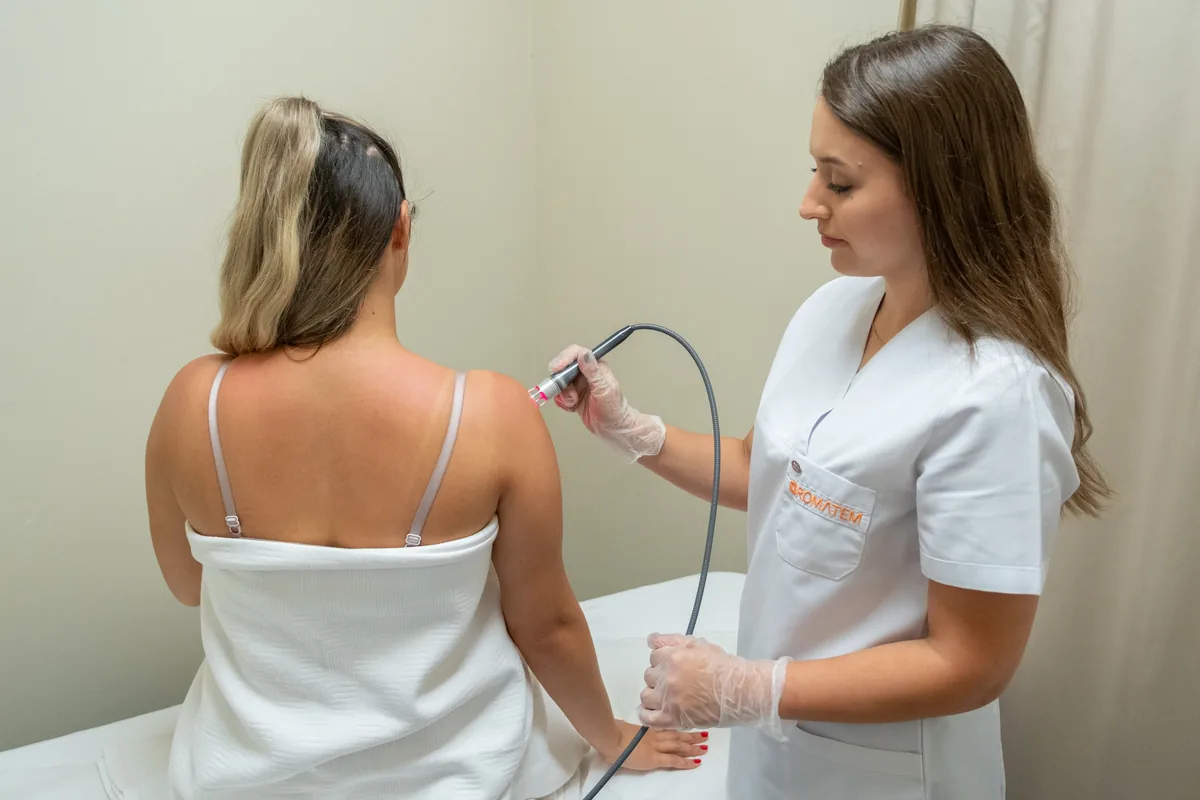
Two phases, two different treatments
Frozen shoulder passes through a painful phase, in which the shoulder hurts constantly and particularly at night, and a stiff phase, in which pain settles but movement is severely restricted in every direction.
The treatments are different, and applying the wrong one prolongs the condition. Aggressive stretching during the painful phase increases inflammation and makes the stiffness worse. This is why staging the diagnosis comes before treating it.
How to recognise it
Restriction in every direction, including passive movement performed by someone else, distinguishes frozen shoulder from a rotator cuff problem, where some directions remain free. Night pain that wakes the person when lying on that side is characteristic.
It is more common in people with diabetes and thyroid disease, and in that group it tends to last longer.
What to expect
Frozen shoulder resolves in most people, but slowly — often over a year or more 2. Treatment shortens that and limits how much range is lost in the meantime; it does not make it a short condition.
During the painful phase: pain control, gentle movement within the pain-free range, and injection where indicated. During the stiff phase: progressive mobilisation and stretching, which can be demanding and needs to be sustained.
Who gets it, and why that matters
Frozen shoulder occurs most often between forty and sixty, more frequently in women, and substantially more often in people with diabetes — where it also tends to be more stubborn and to last longer 2. Thyroid disease and a period of shoulder immobilisation after injury or surgery are the other common associations.
We check blood glucose in anyone presenting with it who has not been tested, because undiagnosed diabetes is found often enough to be worth looking for and because it changes what the programme should expect.
The painful phase: settle it, do not stretch it
In the first phase the capsule is inflamed and the dominant problem is pain, including pain at night that wakes you. Aggressive stretching here increases inflammation and lengthens the whole course. This is the single most common treatment error in frozen shoulder.
What helps is pain control, gentle movement within a comfortable range to prevent additional stiffness, activity modification, and — where pain is severe — an intra-articular corticosteroid injection, which is most useful early rather than late.
The stiff phase: now stretching is the treatment
Once pain settles and stiffness dominates, the priority reverses. Sustained, progressive stretching at end range, joint mobilisation and strengthening through the recovered range are what restore movement, and they need to be done regularly rather than intensively once a week.
Progress is measured in degrees of external rotation and elevation rather than in how the session felt, because this is a condition where subjective impressions mislead in both directions.
Procedures, and when they are considered
Hydrodilatation, manipulation under anaesthetic and arthroscopic capsular release exist for shoulders that remain severely restricted after an adequate course of rehabilitation. They are not first-line and they do not remove the need for the rehabilitation that follows them — the range gained under anaesthetic is lost within weeks without it.
If a procedure is being considered, the question worth asking is what the therapy plan for the following six weeks is. Without one, the procedure buys very little.
Frequently asked questions
Will stretching harder speed it up?
During the painful phase, no — it makes it worse and prolongs the condition. During the stiff phase, sustained mobilisation is the treatment. This is why identifying the phase comes first.
How long does frozen shoulder last?
Longer than most people are told. The natural course commonly runs one to two years across both phases 2, and while treatment shortens it and makes it far more tolerable, no treatment resolves it in a few weeks. Anyone promising that is describing a different condition.
Why does stretching make it worse?
In the painful inflammatory phase, forcing range increases irritation of the capsule and can prolong that phase. Timing is what determines whether stretching helps or harms, which is why the phase has to be identified before the programme is written.
Does it come back?
Recurrence in the same shoulder is uncommon. Involvement of the other shoulder at some later point happens in a minority of people, more often in diabetes.
Will I get full movement back?
Most people recover function that is close to normal, though a small residual restriction in external rotation is common and usually does not limit daily life. Getting there is more reliable with a structured programme than with time alone.
Is an injection worth having?
In the painful phase, often yes — it can reduce pain enough for movement work to begin, which is the point of it. Its value drops in the stiff phase, where the problem is mechanical rather than inflammatory.
I have diabetes — is this different for me?
It is generally more painful, stiffer and longer-lasting, and it responds more slowly. That is not a reason to expect a poor result; it is a reason to plan for a longer course and to be more careful about the timing of stretching.
Sources
- Rehabilitation of Frozen Shoulder: A Systematic Review and Meta-Analysis of Multifactorial Interventions — Pain Research and Management (2026)
- Adhesive Capsulitis: Diagnosis and Management — American Family Physician (2019)
Which therapies would I actually receive?
A therapy is a single method used inside a programme. It is measured in sessions and is not sold separately.

Technologies we use



Locations
Where you can receive this treatment





Related articles
Orthopaedic How long does frozen shoulder last?
Frozen shoulder often lasts for years, and some people keep a degree of stiffness long term. Pain usually eases before movement returns. The old belief that it always resolves fully on its own is not well supported. Education, stretching within comfort, and in selected cases a steroid injection can reduce pain and improve movement.Read moreNeurological How long does it take to recover from a stroke?
Most recovery after a stroke happens in the early months, when the brain is most able to reorganise, and it continues more slowly for a longer period after that. How far someone gets depends mainly on how severe the stroke was, where it happened and how much active therapy follows.Read moreNeurological Can you walk again after a stroke?
Many people walk again after a stroke, including many who cannot stand at first. The chances are highest when some leg movement returns early and when walking practice starts as soon as it is safe. Walking often comes back before full arm recovery, sometimes with a stick, splint or other support.Read more



