

Medical condition
ACL Injury and Reconstruction
ACL rehabilitation is criterion-based, not calendar-based: progression depends on measured strength symmetry and control, not on weeks elapsed. Return to sport needs passed tests and enough time since surgery; neither is enough on its own. Full extension and quadriceps activation come first: even a small loss of extension is linked to poorer results years later.
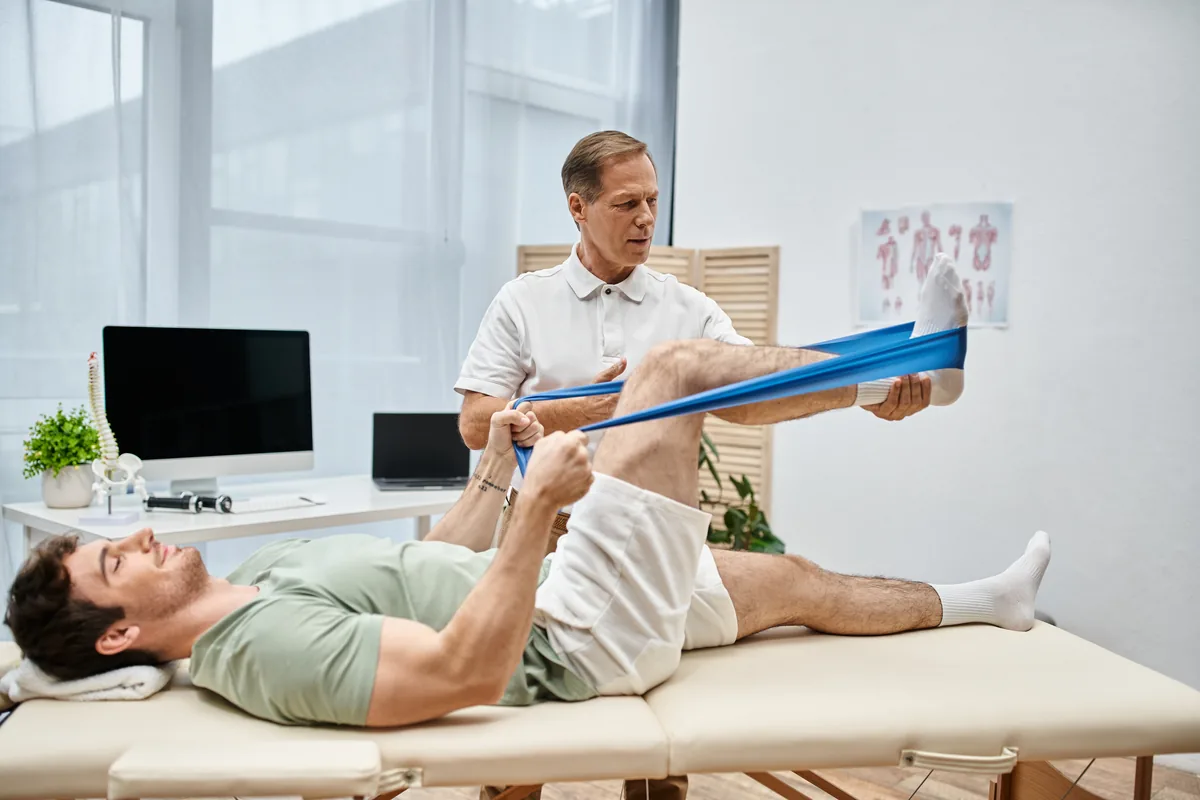
Criterion-based, not calendar-based
Progression after ACL reconstruction should depend on measured strength symmetry and movement control, not on weeks elapsed. Two patients at the same point after surgery can be at completely different stages of readiness, and treating them by the calendar is how re-rupture happens.
We test rather than estimate: limb symmetry index for quadriceps and hamstring strength, hop test battery, and landing mechanics.
The phases
First, restore full extension and reduce swelling — extension lost early is difficult to recover. Then quadriceps activation, which is inhibited after surgery and does not return simply through use. Then progressive strengthening, then plyometrics and landing control, then change of direction, then sport-specific work.
Full extension and quadriceps activation come first because later phases build on them, and lost extension has a long tail: in 502 patients followed for at least ten years after reconstruction, lack of normal extension was the factor most strongly linked to lower self-reported knee scores 4. They are unglamorous and they are the part most often rushed.
Return to sport
Clearance is given on test results, and typically not before nine months 1. Returning earlier is associated with substantially higher re-injury rates, and the difference between nine months and six is not a matter of caution — it is a matter of measured risk.
We give the numbers rather than an opinion, and if a player wants to return before meeting the criteria we document that decision rather than endorse it.
The second injury risk
Return to sport after reconstruction carries a substantially raised risk of a second ACL injury, to the reconstructed knee or the other one: in pooled studies, 23% of athletes under 25 who went back to their sport had one 5. In one cohort, the re-injury rate fell with each month that return was delayed up to nine months after surgery, and was lower when quadriceps strength was close to that of the other leg 1; whether passing a full test battery lowers it further is not yet clear 6.
This belongs to the athlete rather than to us, and it has to be presented as a trade-off rather than as encouragement. A criteria-based report gives someone under pressure from a coach or a club something to hold up.
Is reconstruction better than rehabilitation alone?
It depends on the knee and on when the decision is made. For a recent tear in young, active adults, a Cochrane review found one randomised trial: reconstruction followed by rehabilitation gave similar self-reported knee function at two and five years to rehabilitation alone with the option of later surgery, although 51% of the rehabilitation group had opted for reconstruction because of instability by five years 2. The review rated that evidence as low quality.
The picture changes for a knee that keeps giving way months after the injury. In a UK trial of 316 people with a non-acute tear and persistent instability, reconstruction gave better knee scores at 18 months than rehabilitation, and 41% of those allocated to rehabilitation went on to have the operation 3. Instability and the sport a person wants to return to decide it, not the scan alone.
Frequently asked questions
Can I return to sport at six months?
Usually not, and we will tell you that rather than agree to it. Return before nine months, and return with quadriceps strength below 90% of the other leg, are both associated with substantially higher re-injury rates 1. We give you the test results and the risk, and the decision is documented.
When can I return to sport?
When the criteria are met — strength symmetry, hop test performance, movement quality and psychological readiness — which is usually later than the timeline athletes have in mind.
Do I definitely need surgery?
Not always. Some people function well without reconstruction, particularly if they do not return to pivoting sport. The decision depends on activity demands and instability rather than on the scan alone.
What is measured before clearance?
Isokinetic or handheld strength for symmetry, a battery of hop tests, landing mechanics on video, and a validated psychological readiness questionnaire.
Why does psychological readiness matter?
Can I rehabilitate here after surgery elsewhere?
Yes, and it is common. Bring the operation note — the graft used and what else was repaired determine what is safe and when.
Sources
- Simple decision rules can reduce reinjury risk by 84% after ACL reconstruction: the Delaware-Oslo ACL cohort study — British Journal of Sports Medicine (Grindem H, Snyder-Mackler L, Moksnes H, Engebretsen L, Risberg MA) (2016)
- Monk AP, Davies LJ, Hopewell S, Harris K, et al. Surgical versus conservative interventions for treating anterior cruciate ligament injuries — Cochrane Database of Systematic Reviews (2016)
- Beard DJ, Davies L, Cook JA, Stokes J, et al. Rehabilitation versus surgical reconstruction for non-acute anterior cruciate ligament injury (ACL SNNAP): a pragmatic randomised controlled trial — The Lancet (2022)
- Shelbourne KD, Gray T. Minimum 10-year results after anterior cruciate ligament reconstruction: how the loss of normal knee motion compounds other factors related to the development of osteoarthritis after surgery — American Journal of Sports Medicine (2009)
- Wiggins AJ, Grandhi RK, Schneider DK, Stanfield D, et al. Risk of secondary injury in younger athletes after anterior cruciate ligament reconstruction: a systematic review and meta-analysis — American Journal of Sports Medicine (2016)
- Kotsifaki R, Korakakis V, King E, Barbosa O, et al. Aspetar clinical practice guideline on rehabilitation after anterior cruciate ligament reconstruction — British Journal of Sports Medicine (2023)
- Ardern CL, Taylor NF, Feller JA, Webster KE. Fifty-five per cent return to competitive sport following anterior cruciate ligament reconstruction surgery: an updated systematic review and meta-analysis including aspects of physical functioning and contextual factors — British Journal of Sports Medicine (2014)
Which therapies would I actually receive?
A therapy is a single method used inside a programme. It is measured in sessions and is not sold separately.
Technologies we use

Locations
Where you can receive this treatment



Related articles
Sports When is it safe to return to sport after an ACL reconstruction?
Not on a date, and not on how the knee feels. The safest published approach combines time and testing: wait until the graft and muscles are genuinely ready, then pass a battery of strength and hop tests before returning to pivoting sport. Waiting longer, up to a point, reduced reinjury risk substantially.Read moreSports How is a PCL injury different from an ACL injury?
The ACL and PCL are the two cross-shaped ligaments inside the knee. PCL injuries are less common, often result from a blow to the front of the shin, and isolated PCL tears are usually treated without surgery. ACL tears more often cause the knee to give way during twisting sports, and reconstruction is considered more frequently.Read moreSports Can you live a normal life without an ACL?
Many people can. In a Swedish randomised trial of young active adults, rehabilitation with the option of later reconstruction gave knee outcomes over time similar to early reconstruction, and a substantial share never needed surgery. People who want to return to pivoting sports or whose knee keeps giving way are more likely to need reconstruction.Read more



