
Physical agents
Magnetic field tissue repair (PEMF)
Pulsed electromagnetic fields applied over bone or soft tissue to support repair, used after fracture and in chronic joint conditions. For delayed fracture healing a Cochrane review found the evidence inconclusive, and for joint and soft tissue pain any benefit is small and short-term, so it is an optional adjunct, never the core of a plan.
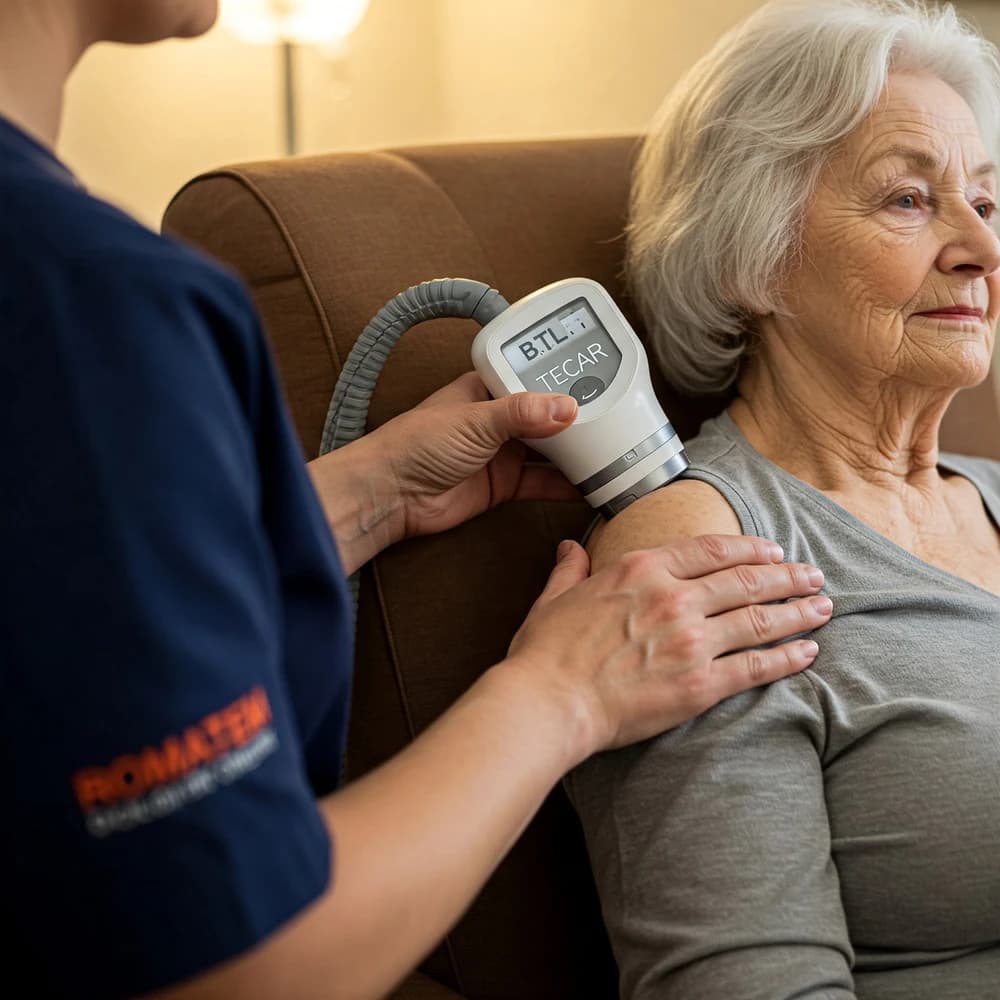
Pulsed electromagnetic fields
A coil generates a pulsed magnetic field through the treated region. The proposed mechanism is an effect on cell membrane activity and local circulation that supports tissue repair. Treatment is painless, requires no skin contact and can be applied through clothing and casts.
That last point is its practical advantage: it can be delivered to a region that cannot be touched, moved or loaded.
Who it is used for
Delayed fracture healing, bone oedema, osteoarthritis pain, chronic soft tissue problems, and post-surgical swelling and pain. It is used in the early phase where active treatment is not yet possible.
It is avoided in pregnancy, in patients with pacemakers or implanted electronic devices, in active malignancy in the field, and where there is active bleeding.
Where the evidence stands
For bone healing, pooled sham-controlled trials of bone stimulators, most of them PEMF, give moderate-quality evidence of fewer non-unions on X-ray, although the few trials that measured function found no difference 1. A Cochrane review limited to delayed union and non-union, however, found the evidence inconclusive 2. For osteoarthritis and soft tissue pain the evidence is weaker and the effect sizes are modest 3 4.
We use it where it fits, describe it as an adjunct, and do not present it as a primary treatment. Patients are entitled to know which category a treatment falls into before they pay for it.
An honest position on the evidence
Pulsed magnetic field therapy is widely offered and the evidence is limited and mixed. Some studies report pain improvement in osteoarthritis and better bone healing, but the osteoarthritis trials carry a high overall risk of bias and their gains may fall short of what patients would notice 5.
We use it as an adjunct where a patient finds it helpful and we do not build treatment plans around it. It is not offered as a treatment for systemic disease, and those claims exist in this field.
Where the honest line sits
It appears in programmes as an optional adjunct chosen by preference, and it never displaces exercise, loading or hands-on work. If a session has to be dropped for time, this is the one.
We do not offer it for systemic disease, immune conditions or as a general wellness treatment, and those claims circulate widely in this field.
Does it add anything to an exercise programme?
The trials that test this directly suggest it adds little. In a randomised, double-blind trial in shoulder impingement, patients who had active or placebo PEMF before the same strengthening programme finished with no difference between the groups in pain, function or strength 4. In knee osteoarthritis, pooled trials show short-term symptom relief compared with placebo but no advantage over other conservative treatments such as physiotherapy, and the gap between treated and control patients narrows as follow-up lengthens 3.
Exercise therefore remains the core of any plan for joint or tendon pain; PEMF, where it is used at all, sits alongside it as an optional extra.
Sources
- Aleem IS, Aleem I, Evaniew N, Busse JW, et al. Efficacy of electrical stimulators for bone healing: a meta-analysis of randomized sham-controlled trials — Scientific Reports (2016)
- Griffin XL, Costa ML, Parsons N, Smith N. Electromagnetic field stimulation for treating delayed union or non-union of long bone fractures in adults — Cochrane Database of Systematic Reviews (2011)
- Viganò M, Perucca Orfei C, Ragni E, Colombini A, et al. Pain and functional scores in patients affected by knee OA after treatment with pulsed electromagnetic and magnetic fields: a meta-analysis — Cartilage (2021)
- Galace de Freitas D, Marcondes FB, Monteiro RL, Rosa SG, et al. Pulsed electromagnetic field and exercises in patients with shoulder impingement syndrome: a randomized, double-blind, placebo-controlled clinical trial — Archives of Physical Medicine and Rehabilitation (2014)
- Chang YS, Lin CY, Huang WC. Pulsed electromagnetic field therapy in people with knee osteoarthritis: a systematic review and meta-analysis — Medicina (Kaunas) (2026)
- Pittler MH, Brown EM, Ernst E. Static magnets for reducing pain: systematic review and meta-analysis of randomized trials — CMAJ (2007)
Conditions this device is used for
The 2 conditions where this device is part of a routine programme, grouped by area. It is one tool inside the plan, never the plan itself.

Devices are used inside a programme and chosen after examination — they are not booked separately.
Your path to this treatment
Nothing here is booked from a page. You send the records you have, a rehabilitation physician reads them, and you get a written answer — including when the answer is that an intensive programme will not help.
4 steps, start to finish
1.Send your records
A discharge summary from the hospital that treated the original event, and any imaging of the affected area — CT, MRI or X-ray.2.A written plan in 48 hours
A rehabilitation physician reviews the case and returns the expected duration, the recommended programme and the centre. Free, no obligation.3.Travel and admission
Where a visa is needed we issue an invitation letter and treatment confirmation naming the dates and the facility. You are met at the airport and driven to the centre by private vehicle or ambulance; a bed for one companion and interpreting during therapy are arranged.4.Treatment, then home
The programme runs, then you leave with a discharge report and a written home exercise plan. Your return journey is organised before you go, with scheduled video reviews so progress does not stop.
In their words
What patients say after a programme
Short videos filmed during therapy: a child’s rehabilitation after a brain tumour, suspended gait training after spinal cord injury, and learning to walk again after a fall. Individual results vary.
Dave Evans on his physical therapy here
Musculoskeletal physiotherapy
Paediatric rehabilitation after a brain tumour
Inside a physiotherapy session
Spinal cord injury — the rehabilitation process
Suspension-assisted gait training
Walking difficulty and restricted movement after a fall
Regaining gait and range of motion
Locations
Centres that have this device — pick one.







Questions people actually ask
About this device
Does it work?
The honest answer is that evidence is limited and inconsistent. It is low-risk and inexpensive, which is why it appears as an adjunct rather than as a core treatment.
Is it safe?
Generally yes. Pacemakers and implanted electronic devices are absolute contraindications, as is pregnancy.
Does it heal fractures faster?
Some evidence exists for delayed union in specific circumstances. Routine use in ordinary fracture healing is not supported.
Should I choose a clinic because it offers this?
No. It is not a differentiator and any clinic presenting it as one is overstating what it does.
Is it the same as a magnetic bracelet?
No. PEMF devices deliver a pulsed field from a coil, whereas magnetic bracelets and insoles use static magnets. A meta-analysis of randomised placebo-controlled trials found no significant pain relief from static magnets and concluded they cannot be recommended as an effective treatment 6. Claims made for one should not be transferred to the other.



