
Remote
Home programme and remote follow-up
The programme that starts on the day of discharge: a written exercise plan, video guidance, and scheduled video reviews so progress does not stop when the patient flies home. Gains from an intensive block fade without a maintained programme, so the plan is taught until it is performed correctly.
Why this exists
The gains from an intensive rehabilitation block fade without a maintained programme. For international patients this is the largest single risk to the whole investment, and it is the part most often left to chance.
So the home programme is designed before discharge, taught until it is being performed correctly, written down with images, and followed up on a schedule rather than left open.
What follow-up consists of
Scheduled video consultations at agreed intervals, in which the exercises are observed and corrected and the programme is progressed. Between them, sensor-based or app-based recording where appropriate, so adherence and technique are visible rather than self-reported.
Progression is the point. A home programme that never changes stops producing gains, because the body adapts to it.
Who it is for
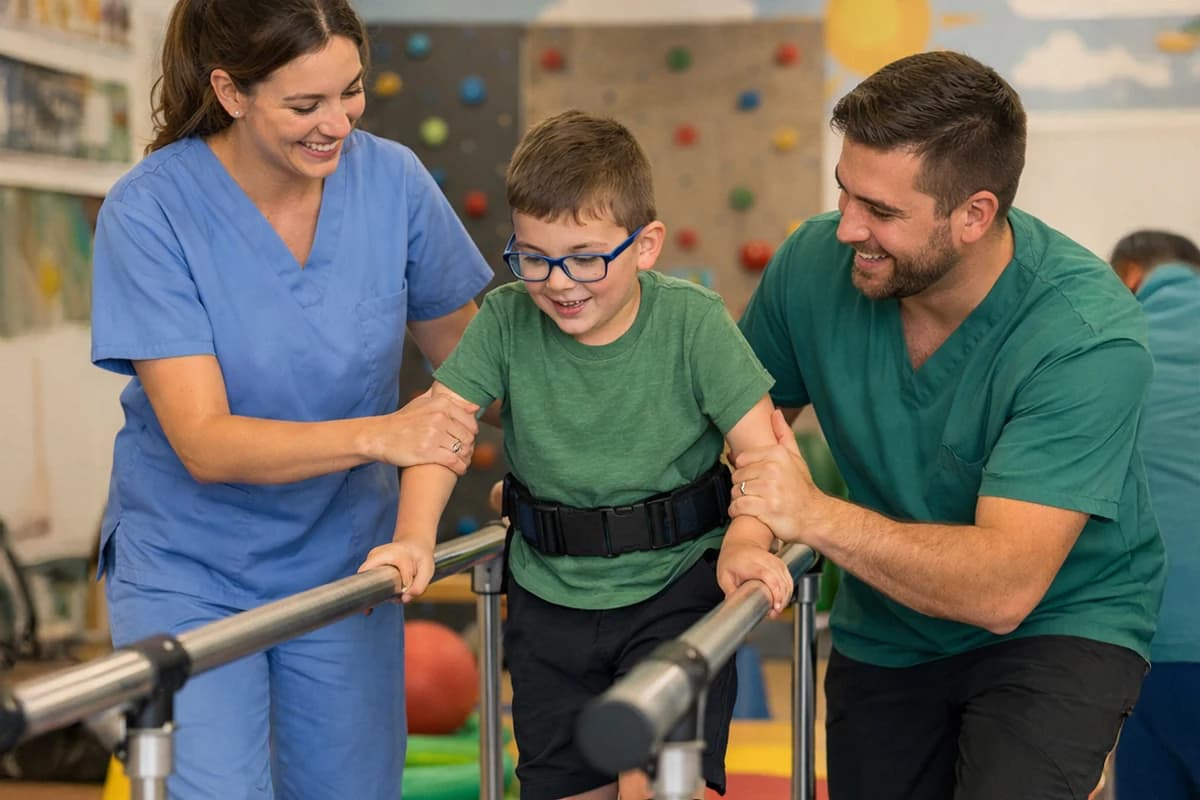
Patients returning home after an intensive block. Patients who cannot travel for regular appointments. Patients between blocks in a repeated programme, particularly children, where the interval work determines what the next block can build on.
It is also used for patients considering travelling to us, as a way of starting properly before arrival.
What it cannot replace
Hands-on assessment, manual treatment, and anything requiring equipment. Remote follow-up supports and progresses a programme; it does not substitute for the in-person work that established it.
Where we think a problem needs in-person assessment, we will say so rather than continue remotely because it is convenient.
What is reviewed in a remote session
The exercises are watched rather than asked about, because technique drifts and a programme done incorrectly stops working. Progression is set, load is adjusted, and problems that have appeared since discharge are addressed.
Measurements that can be taken at home — walking distance, chair-rise time, range at a joint — are recorded so that change is tracked rather than estimated.
When remote follow-up is not enough
Where hands-on assessment is needed, where a new symptom suggests something that requires examination, or where progress has stopped and the reason is not visible on video. In those cases we say so and recommend local assessment.
Video review is a genuine tool and it has limits. Presenting it as equivalent to in-person care would be dishonest and would delay problems that need looking at.
Does follow-up by video work as well as seeing a therapist in person?
For some purposes it appears to. A systematic review of 13 studies with 1,520 people with musculoskeletal conditions found that treatment delivered entirely by real-time video improved physical function about as much as face-to-face care, with comparable pain relief 1. After stroke, a Cochrane review of 22 trials found no difference between telerehabilitation and in-person therapy for daily activities or balance, although those comparisons were small and the evidence was of low quality 2.
The same Cochrane review found moderate-quality evidence that remote support programmes added after hospital discharge did not improve independence in daily activities compared with usual care 2. Its authors note that few trials were adequately powered and that the field is still emerging, so these conclusions may change 2.
Sources
- Cottrell MA, Galea OA, O'Leary SP, Hill AJ, et al. Real-time telerehabilitation for the treatment of musculoskeletal conditions is effective and comparable to standard practice: a systematic review and meta-analysis — Clinical Rehabilitation (2017)
- Laver KE, Adey-Wakeling Z, Crotty M, Lannin NA, et al. Telerehabilitation services for stroke — Cochrane Database of Systematic Reviews (2020)
- Nicolson PJA, Bennell KL, Dobson FL, Van Ginckel A, et al. Interventions to increase adherence to therapeutic exercise in older adults with low back pain and/or hip/knee osteoarthritis: a systematic review and meta-analysis — British Journal of Sports Medicine (2017)
Conditions this programme treats
The 3 conditions this programme is built for, grouped by area.

The programme is chosen after a rehabilitation physician has read your records — not from this page.
Your path to this treatment
Nothing here is booked from a page. You send the records you have, a rehabilitation physician reads them, and you get a written answer — including when the answer is that an intensive programme will not help.
4 steps, start to finish
1.Send your records
A discharge summary from the hospital that treated the original event, and any imaging of the affected area — CT, MRI or X-ray.2.A written plan in 48 hours
A rehabilitation physician reviews the case and returns the expected duration, the recommended programme and the centre. Free, no obligation.3.Travel and admission
Where a visa is needed we issue an invitation letter and treatment confirmation naming the dates and the facility. You are met at the airport and driven to the centre by private vehicle or ambulance; a bed for one companion and interpreting during therapy are arranged.4.Treatment, then home
The programme runs, then you leave with a discharge report and a written home exercise plan. Your return journey is organised before you go, with scheduled video reviews so progress does not stop.
In their words
What patients say after a programme
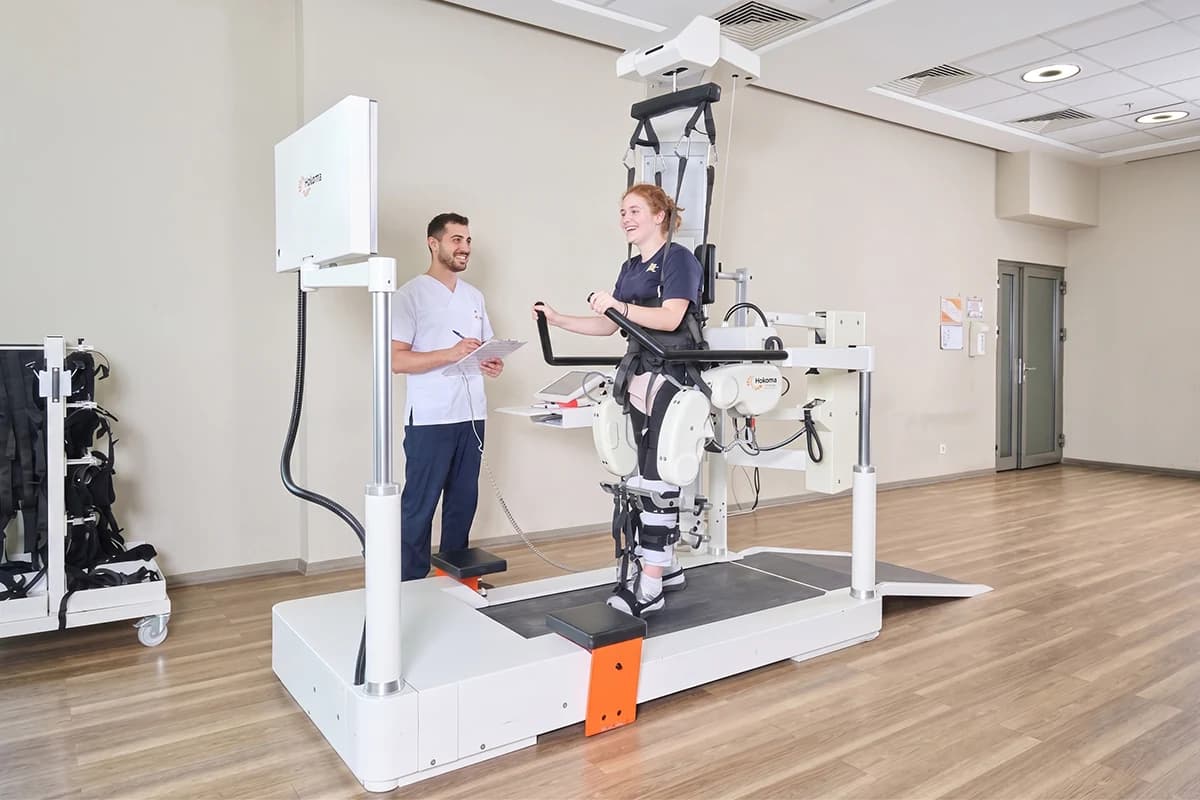
Short videos filmed during therapy: a child’s rehabilitation after a brain tumour, suspended gait training after spinal cord injury, and learning to walk again after a fall. Individual results vary.
Dave Evans on his physical therapy here
Musculoskeletal physiotherapy
Paediatric rehabilitation after a brain tumour
Inside a physiotherapy session
Spinal cord injury — the rehabilitation process
Suspension-assisted gait training
Walking difficulty and restricted movement after a fall
Regaining gait and range of motion
Locations
Where this programme runs — pick a centre.


Questions people actually ask
About this programme
How often are the reviews?
Typically scheduled over eight to twenty-four weeks after discharge, more frequently at the start. The interval is set to the programme rather than fixed.
What equipment do I need at home?
Usually very little, and the programme is built around what you actually have. Where a specific item genuinely matters we say so before discharge rather than assuming it will be bought.
Can this replace local physiotherapy?
No. It bridges the gap and keeps the programme progressing; it does not replace hands-on treatment where that is needed. Where local therapy is available we write the handover for that therapist.
What language are the sessions in?
Interpreting is arranged where needed. For sessions that depend heavily on language — speech therapy in particular — availability in the patient's own language has to be confirmed rather than assumed.
What if I stop doing the exercises?
Then the gains start to reverse. The reviews exist partly to catch that early, and the honest conversation about why it stopped is more useful than repeating the instruction.
Do scheduled reviews actually help people keep exercising?
They seem to. In people with hip or knee osteoarthritis, booster sessions with a physiotherapist improved adherence to exercise, on moderate-quality evidence, while audio or video exercise cues on their own did not 3. Scheduled reviews follow the same logic: contact with a therapist who checks and adjusts the programme, rather than reminders alone.



