
Medical condition
Dysphagia (Swallowing Difficulty)
Swallowing rehabilitation begins with an instrumented assessment of what happens when food and liquid pass the airway, then trains the specific phase that is failing. Untreated, it causes repeated chest infections rather than only discomfort. Diet texture is then set by the assessment, not by guesswork.
Why this is treated urgently
Swallowing requires the brain, nerves and muscles of the mouth, throat and oesophagus to act in a precise sequence. When that sequence fails, food or liquid can enter the airway instead of the oesophagus — aspiration — and the consequence is repeated chest infections and pneumonia rather than discomfort.
Untreated dysphagia also causes malnutrition and dehydration, both of which slow every other part of rehabilitation. This is why it is assessed early and instrumentally rather than by watching someone eat.
The signs that mean assessment now
Coughing or choking during or after meals. A wet or gurgling voice after drinking. Food remaining in the mouth or feeling stuck. Repeated chest infections. Unexplained weight loss. Avoiding meals or taking much longer over them than before.
Any of these warrants assessment rather than a change of diet at home. Thickening liquids without knowing which phase of the swallow is failing is guesswork: thicker liquids reduce the risk of liquid entering the airway, but they leave more residue in the throat after the swallow 2.
What treatment involves
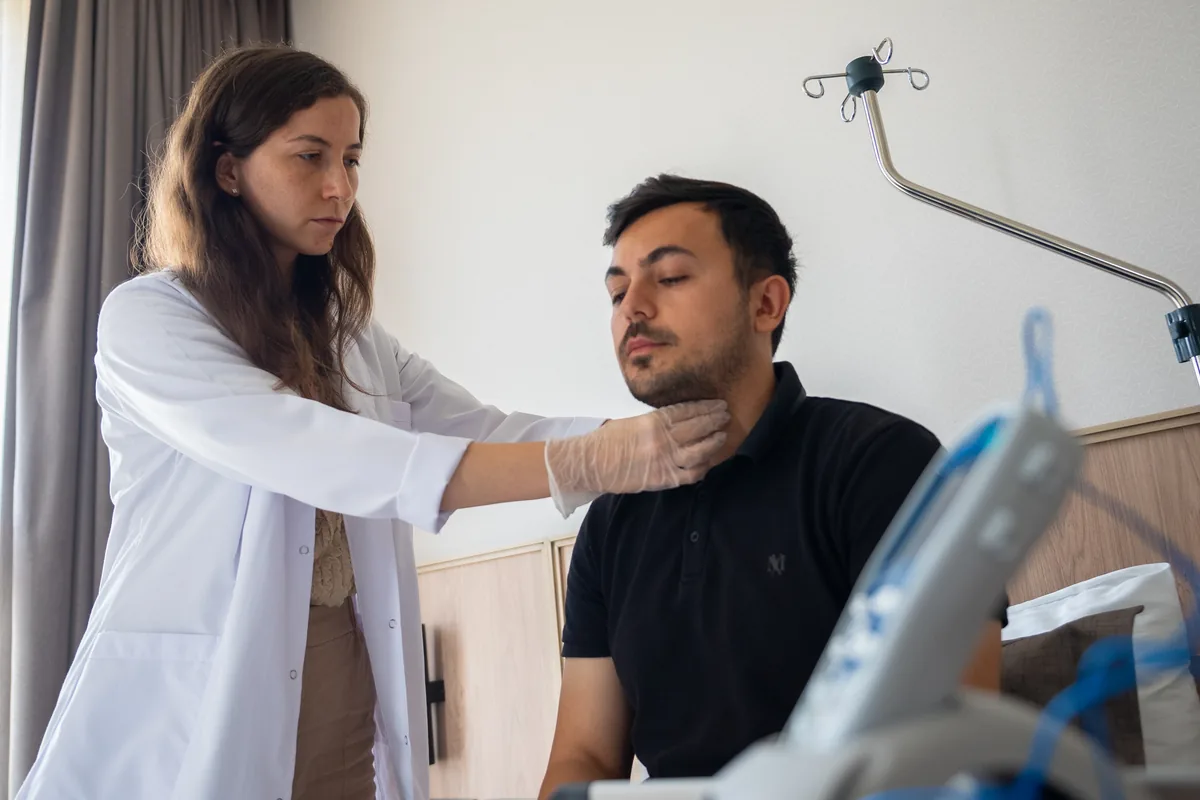
Assessment identifies the failing phase and the aspiration risk. Treatment then combines strengthening of the swallowing muscles, teaching safe swallowing technique, positioning during meals, and texture modification set to the level the assessment indicates rather than by guesswork.
Neuromuscular electrical stimulation and biofeedback are used where they add to the exercise programme. Progress is reassessed rather than assumed, because diet restrictions that are no longer necessary carry their own cost in quality of life.
Silent aspiration is the reason assessment matters
A substantial proportion of people who aspirate do not cough. Nothing is observed at the bedside, meals appear to go well, and the first sign is a chest infection weeks later.
This is why instrumental assessment — videofluoroscopy or endoscopic examination — is used where risk is suspected rather than relying on watching someone eat.
Texture modification is a prescription, not a precaution
Thickened liquids suit some swallowing patterns and are actively harmful in others, and they carry their own costs: reduced fluid intake, dehydration and poor acceptance.
The texture is set from the assessment and reviewed, not applied indefinitely because it seems safer. Where the choice is between a modified diet the person refuses and a normal one carrying some risk, that is a quality-of-life discussion held openly with the family.
Do swallowing exercises and electrical stimulation work?
After a stroke, many people's swallowing improves without treatment, but between 15% and 51% still have difficulty around two weeks later 3. A 2026 Cochrane review of 181 trials with 11,500 people found that swallowing exercises may reduce swallowing problems, although that evidence is very uncertain, and may reduce chest infections (low-certainty evidence) 3.
Electrical stimulation applied to the outside of the neck (neuromuscular electrical stimulation) probably reduces the severity of swallowing problems, on moderate-certainty evidence 3. No single therapy was effective overall, and many of the trials were small and of poor quality 3. That is why each treatment is matched to the problem the assessment shows and kept only while measured progress continues.
Frequently asked questions
Should I thicken liquids at home while we wait for an appointment?
Not without an assessment. Thicker liquids reduce the risk of liquid entering the airway but leave more residue in the throat after swallowing 2. Which of the two matters more depends on the pattern of dysphagia, and there is no way to tell that from outside. If someone is coughing on liquids, seek assessment rather than adjusting the diet.
What are the warning signs?
Coughing during or after eating, a wet voice afterwards, food sticking, unexplained weight loss, and repeated chest infections. The last two are the ones people fail to connect to swallowing.
Should I thicken liquids myself?
Can swallowing recover?
Frequently, particularly after stroke. Many people's swallowing improves on its own, and swallowing exercises may help further, although the trial evidence for them is still very uncertain 3.
What if my relative refuses modified food?
That is common, and it is a quality-of-life question as much as a safety one. The risks are stated plainly and the decision is made with the person rather than for them.
Is a feeding tube permanent?
Often not. It is frequently a temporary measure while swallowing recovers, and the plan should state what has to change before it can be removed.
Sources
- Stroke rehabilitation in adults (NG236) — National Institute for Health and Care Excellence (2023)
- Steele CM, Alsanei WA, Ayanikalath S, Barbon CEA, et al. The influence of food texture and liquid consistency modification on swallowing physiology and function: a systematic review — Dysphagia (2015)
- Wilkinson G, Everton LF, Bath PM, Benfield JK. Swallowing therapy for dysphagia in acute and subacute stroke — Cochrane Database of Systematic Reviews (2026)
- Flynn E, Smith CH, Walsh CD, Walshe M. Modifying the consistency of food and fluids for swallowing difficulties in dementia — Cochrane Database of Systematic Reviews (2018)
Which therapies would I actually receive?
A therapy is a single method used inside a programme. It is measured in sessions and is not sold separately.
Technologies we use
Locations
Where you can receive this treatment


Related articles
Neurological Why does swallowing go wrong after a stroke, and how is it retrained?
A stroke can weaken or slow the muscles and reflexes that move food and drink safely from the mouth to the stomach. This is called dysphagia and can cause choking, coughing or chest infections. Early screening, specialist assessment, adapted food and drink, positioning and swallowing exercises help many people return to normal eating.Read moreNeurological How long does it take to recover from a stroke?
Most recovery after a stroke happens in the early months, when the brain is most able to reorganise, and it continues more slowly for a longer period after that. How far someone gets depends mainly on how severe the stroke was, where it happened and how much active therapy follows.Read moreNeurological Can you walk again after a stroke?
Many people walk again after a stroke, including many who cannot stand at first. The chances are highest when some leg movement returns early and when walking practice starts as soon as it is safe. Walking often comes back before full arm recovery, sometimes with a stick, splint or other support.Read more



