
Gait and lower limb
Parachute body-weight support system
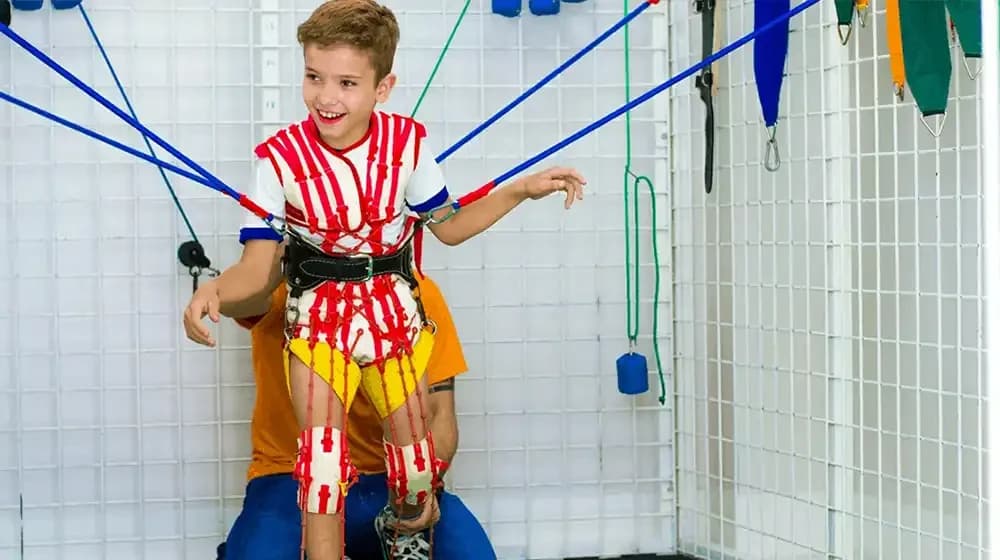
An overhead harness that carries part of the body weight and catches the patient if they start to fall during walking, balance and functional exercises. It is used after stroke, spinal cord injury or surgery, in Parkinson's disease and multiple sclerosis, and for older adults and people with poor balance. Support is adjusted to each person.
Support without carrying the patient
An overhead support system takes part of the body weight and catches a fall, which allows walking practice at the edge of ability rather than well within it. The harness pulls upwards on the pelvis or trunk, so the legs carry less of the body's weight 2.
It also means the therapist does not have to hold the patient up and can use their hands to guide the movement instead, so the session is limited by the patient's capacity rather than by the therapist's strength 2.
Practising where falling is possible
Exercise that genuinely challenges balance is among the most successful ways of preventing falls 3. Without a harness, the most demanding balance practice, such as being deliberately pushed off balance, cannot be done safely 3.
The harness removes much of that constraint: if the person loses their balance and cannot recover, it catches them before they reach the floor 3.
Does walking practice with body-weight support help after a stroke?
No study of this particular system has been published. The evidence concerns body-weight support and harness-protected training as methods, and in most studies of body-weight support the harness was used over a treadmill 2.
A Cochrane review of 56 trials with 3,105 people after stroke found that treadmill training, with or without body-weight support, did not make people more likely to walk independently than other physiotherapy, although this evidence is of low quality 4. Walking speed and endurance may improve slightly in the short term, mainly in people who could already walk, but with body-weight support the review found no clear gain in either by the end of follow-up 4.
For people who could not walk in the first 12 weeks after a stroke, a review of 15 trials found high-certainty evidence that machine-assisted walking with body-weight support led to more independent walking than the same amount of usual walking practice 5. For people who already walk and are more than six months past a stroke, a clinical practice guideline recommends walking practice at moderate to high intensity and advises against body-weight-supported treadmill training as a way to improve walking speed or distance 1.
What about spinal cord injury, Parkinson's disease or multiple sclerosis?
In traumatic spinal cord injury, a systematic review of randomised trials found that body-weight-supported treadmill training did not increase walking speed more than overground walking practice or other physiotherapy, and its effect on walking distance was unclear 6. For people with an incomplete spinal cord injury who already walk and are more than six months past the injury, the same clinical practice guideline advises against it as a way to improve walking speed or distance 1.
In mild to moderate Parkinson's disease, a 2026 systematic review found five small trials of body-weight-supported treadmill training, with the harness taking 20–40% of body weight 7. They reported moderate gains in step length, walking endurance and balance, but the reviewers judged the evidence limited 7.
In multiple sclerosis with severe walking difficulty, a systematic review found limited but promising evidence for exercise training, including adapted forms such as body-weight-supported treadmill training 8.
Does practising balance recovery in a harness reduce falls?
In older adults and people with balance problems, it appears to. In a systematic review of randomised trials, those who did reactive balance training, in which balance is deliberately disturbed so that the person practises recovering, were less likely to fall in daily life than control groups, although more adverse events were reported with the training 9.
The disturbance may be a sudden push, slip or trip, and the training is usually done in a safety harness that catches anyone who does not recover 3. Reported problems are mostly minor, such as muscle soreness or soreness where the harness presses, and people who cannot yet tolerate being pushed off balance, because of anxiety or pain, may need more basic balance training first 3.
How much of my weight does the harness take?
There is no agreed rule. A 2024 systematic review of 33 studies found starting levels between 17% and 78% of body weight, typically around 30% after a stroke and higher in spinal cord injury and multiple sclerosis, and many of the studies did not explain how the level was chosen 2.
In almost all of the studies, support was changed during training to match what the person could manage 2. More support means less muscle activity and seems to shorten steps, and the reviewers argue that the level should be set for each person rather than by diagnosis 2.
Sources
- Hornby TG, Reisman DS, Ward IG, Scheets PL, et al. Clinical Practice Guideline to Improve Locomotor Function Following Chronic Stroke, Incomplete Spinal Cord Injury, and Brain Injury — Journal of Neurologic Physical Therapy (2020)
- Ettema S, Pennink GH, Buurke TJW, David S, et al. Clinical indications and protocol considerations for selecting initial body weight support levels in gait rehabilitation: a systematic review — Journal of NeuroEngineering and Rehabilitation (2024)
- McCrum C, Bhatt TS, Gerards MHG, Karamanidis K, et al. Perturbation-based balance training: principles, mechanisms and implementation in clinical practice — Frontiers in Sports and Active Living (2022)
- Mehrholz J, Thomas S, Elsner B. Treadmill training and body weight support for walking after stroke — Cochrane Database of Systematic Reviews (2017)
- Alvarenga MTM, Hassett L, Ada L, Dean CM, et al. Mechanically assisted walking with body weight support results in more independent walking and better walking ability compared with usual walking training in non-ambulatory adults early after stroke: a systematic review — Journal of Physiotherapy (2025)
- Mehrholz J, Harvey LA, Thomas S, Elsner B. Is body-weight-supported treadmill training or robotic-assisted gait training superior to overground gait training and other forms of physiotherapy in people with spinal cord injury? A systematic review — Spinal Cord (2017)
- Battaglion GGS, Boni FDS, Zhang K, Rosa GHM, et al. Virtual reality and body weight-supported treadmill training in gait rehabilitation for Parkinson disease: a systematic review — American Journal of Physical Medicine & Rehabilitation (2026)
- Edwards T, Pilutti LA. The effect of exercise training in adults with multiple sclerosis with severe mobility disability: a systematic review and future research directions — Multiple Sclerosis and Related Disorders (2017)
- Devasahayam AJ, Farwell K, Lim B, Morton A, et al. The effect of reactive balance training on falls in daily life: an updated systematic review and meta-analysis — Physical Therapy (2023)
- Duncan PW, Sullivan KJ, Behrman AL, Azen SP, et al. Body-weight-supported treadmill rehabilitation after stroke — New England Journal of Medicine (2011)
Your path to this treatment
Nothing here is booked from a page. You send the records you have, a rehabilitation physician reads them, and you get a written answer — including when the answer is that an intensive programme will not help.
4 steps, start to finish
1.Send your records
A discharge summary from the hospital that treated the original event, and any imaging of the affected area — CT, MRI or X-ray.2.A written plan in 48 hours
A rehabilitation physician reviews the case and returns the expected duration, the recommended programme and the centre. Free, no obligation.3.Travel and admission
Where a visa is needed we issue an invitation letter and treatment confirmation naming the dates and the facility. You are met at the airport and driven to the centre by private vehicle or ambulance; a bed for one companion and interpreting during therapy are arranged.4.Treatment, then home
The programme runs, then you leave with a discharge report and a written home exercise plan. Your return journey is organised before you go, with scheduled video reviews so progress does not stop.
In their words
What patients say after a programme
Short videos filmed during therapy: a child’s rehabilitation after a brain tumour, suspended gait training after spinal cord injury, and learning to walk again after a fall. Individual results vary.
Dave Evans on his physical therapy here
Musculoskeletal physiotherapy
Paediatric rehabilitation after a brain tumour
Inside a physiotherapy session
Spinal cord injury — the rehabilitation process
Suspension-assisted gait training
Walking difficulty and restricted movement after a fall
Regaining gait and range of motion
Locations
Centres that have this device — pick one.






Questions people actually ask
About this device
Is it safe if I lose my balance?
That is what it is for. The system arrests a fall, which is what makes practice at the limit of ability possible.
Who is it used for?
People relearning to walk or working on balance after a stroke, a spinal cord injury, surgery or a leg injury; people with Parkinson's disease, multiple sclerosis or muscle weakness; children with cerebral palsy or delayed motor development; and older adults and people with poor balance. Whether it suits a particular person depends on their assessment.
Does it feel like being suspended?
No — support is partial and adjusted so that the legs still carry load. Full suspension would defeat the purpose.
How does it differ from a robotic gait trainer?
The legs are not guided by a machine. The patient produces the movement themselves, which suits people who have some walking ability to build on.
Are there any risks?
Serious problems are uncommon: in the Cochrane review of treadmill training after stroke, adverse events were no more frequent than without it and were not judged clinically serious 4. In a trial of 408 people after stroke, those training on a treadmill with body-weight support felt dizzy or faint during sessions more often than those exercising at home 10. A harness that fits poorly can cause soreness or bruising where it presses 3.
What if I am afraid of falling?
Fear of falling does not rule it out. Body-weight support is thought to reduce fear of falling by making walking practice safe 2, and in balance-recovery training a safety harness has been identified as one of the things that ease anxiety 3. The challenge can be kept lower at first and raised as confidence grows 3.



